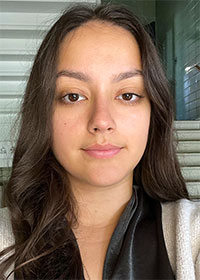
Before Daisy Cruz went on the Summer 2025 Educate Global trip to Indonesia, she considered herself “a very shy person.”
Now the senior Elementary Education major classifies that as “stepping into her voice.”
“My biggest reason why I wanted to experience this was because I’ve only known that, when students come here from other countries and other cultures, we make them have to understand us a little more than we have to understand them,” says Cruz, who grew up in Des Plaines, “so I wanted to experience going into their space, their home and just getting that raw, unfiltered experience.”
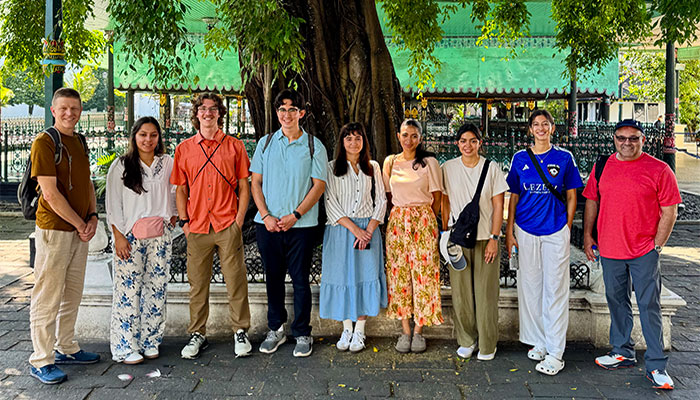
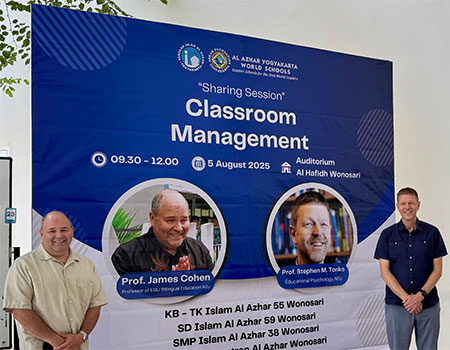
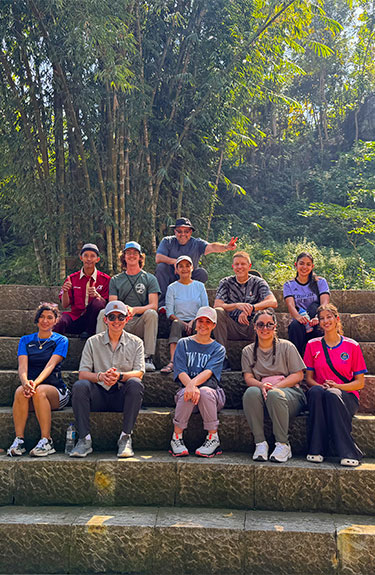
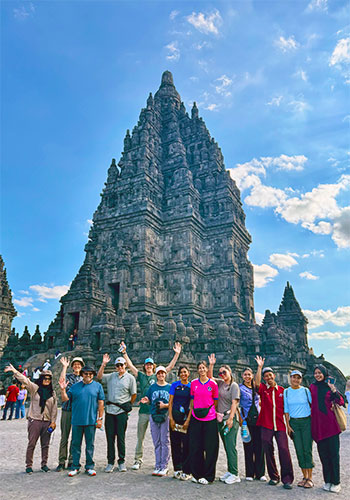
Cruz was among seven Huskies who traveled to Indonesia from July 16 to Aug. 11 to co-teach with Indonesian teachers at Al Azhar Yogyakarta Islamic School in Yogyakarta.
The grant- and donor-funded trip was the latest in the long series of international journeys where students apply what they’ve learned in their coursework while they “replace judgment with curiosity.”
Professors James Cohen and Stephen Tonks served as NIU on-site faculty mentors to Cruz, three classmates from the College of Education and three undergraduates from the NIU College of Liberal Arts and Sciences.
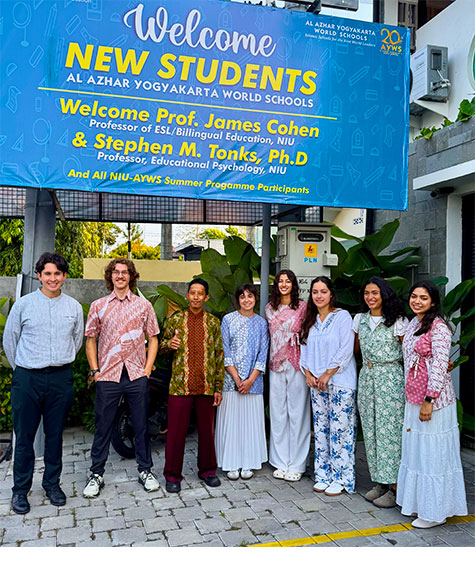 Other voyagers from the COE were Brianna Cobar, Emina Ogorinac and Carolina Zambrano. Bryan Bustos, Edward Hoffman and Nina Rasmussen were the CLAS contingent.
“Six of those seven students are from immigrant families, which was really, really cool,” says Cohen, a newly named Presidential Engagement and Partnerships Professor at NIU and recipient of the university’s Outstanding International Educator award for 2021. “They were such an amazing group.”
“For many of them,” adds Tonks, professor in the Department of Leadership, Educational Psychology and Foundations and the college’s faculty coordinator of Global Programs, “it was an experience in learning how to be flexible in working with other people, and coming into a situation where you have absolutely no idea about the expectations.”
Ogorinac, an Elementary Education major from Rockford, was among many success stories.
“She was teaching about germs,” Cohen says. “She created a very short PowerPoint about germs. She read a book about germs. She brought Play-Doh from the States, and they were sticking Q-tips into it to make little germs. And then she would say, ‘OK, now you touched the germ. What do you have to do now? We have to wash our hands.’ It was so cute.”
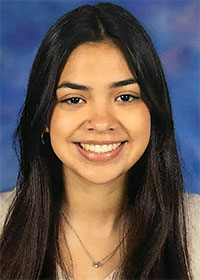
Cobar, a senior Elementary Education major from Crystal Lake, co-taught science, English and “global perspectives.”
She applied after hearing “beautiful” things from a friend who participated in the 2024 edition and, later, encouragement from Cohen.
“I was in a class with Dr. Cohen, and he mentioned it. I was curious, but I didn’t feel ready. I was like, ‘I don’t think I can do it. I’ve never been away from my family,’ ” Cobar says.
“But I just kept thinking about it, and I was like, ‘I want to try something out of my comfort zone.’ I’ve only been to Mexico once, and other than that, I’ve never been to any other country,” she adds. “So, I knew that it could be an amazing experience, not only to learn about another culture but also to help me feel more confident in my teaching. I feel like I learned so much from the teachers over there and the students.”
GREAT, THEIR PROFESSORS SAY.
“They became much more comfortable and confident in the classroom. They grew as cultural beings. As people. They have a better understanding of, ‘What does it mean to be an American? What does it mean to be traveling overseas? What does it mean to be a student? What does it mean to be a teacher?’ ” Cohen says.
“And were you to ask them those different ‘What does it mean?’ questions,” he adds, “their responses would be much more nuanced after coming home than before we left.”
He points to the scholarly work of Bob Fecho, Professor Emeritus of English Education at Teachers College, Columbia University, who studies “intellectual threat.”
“It’s the idea that you’re not really learning something unless you’re intellectually threatened or challenged by it,” Cohen says, “and I sincerely believe that the seven students we took this summer were intellectually threatened on so many different levels: how they were coming across as teachers, how they were coming across as humans, how they were coming across as men and women in the classroom, from their clothing to their stances to how they were talking to their confidence levels to how they were able to view themselves.”
Back to his “what if” questions, he says.
What does it mean to be a teacher in another country? Another culture? Another society?
“You’re challenged intellectually on a constant basis,” he says, “and something I find really amazing is that you don’t learn anything by just traveling. You have to reflect on it first, and that’s where the learning is.”
He, Tonks and the NIU students “would go to bed early, nearly every night, and the reason was not because we were waking up early. It was because, all day long, your eyes are wide open, and you’re just absorbing so much that by the time night comes, you’re exhausted.”
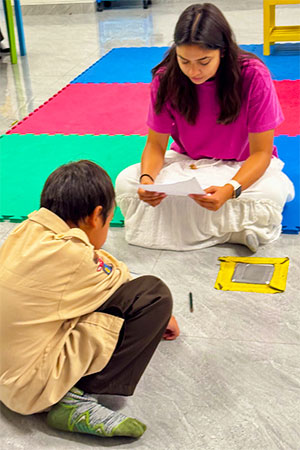
Opportunities for that reflection were frequent, including as part of nightly conversations between the students at the hotel.
Cruz came home with some surprises.
“The teachers don’t raise their voices – at least my co-teacher didn’t,” she says. “The teachers were very calm, their voices were low and they didn’t address the children in a mean way. It was really comforting for the students and me to be in that classroom. It really felt like a family.”
In return, she adds, “the students I met respect their teachers and elders. That comes naturally to them, and I didn’t have to go above and beyond for them to respect me. They liked to see a teacher from another country and were like, ‘OK, tell me everything you know.’ ”
She says she also glimpsed the powerful impact of her profession.
Working with a co-teacher, she says, “was an awesome experience because we were able to bounce off each other’s ideas and learn from each other because we obviously went to two completely different schools and learned different things.”
Meanwhile, Cruz saw the need to know her audience.
“I didn’t prepare myself to tailor my lessons to their lives. I feel like I didn’t realize that I had to switch up my lessons. They like different things. They do different things. They eat different things,” she says.
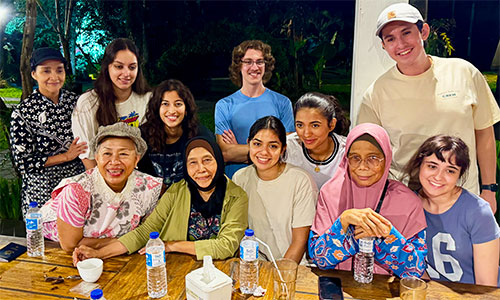
“We did a big lesson about foods in different cultures, and so I sat down with my co-teacher and was like, ‘OK, what are the names of the foods you guys like? What are the foods that you guys are more in love with here?’ ” she adds. “I want my students to be engaged, like on the corner of their seat, wanting to learn what I’m teaching. There are different ways to teach the same topic, and I’m always going to try the engaging way.”
Now in her student-teaching placement at Hoover Math and Science Academy, an elementary school in Schaumburg School District 54, she already is how her insights from Indonesia translate into practice.
“I knew that not all students come from the same background, but now that I have experienced it, I know that I can do my research to go above and beyond to connect with these students,” Cruz says, “so that they don’t feel like they have to be here living our lives – that they can also put in their lives and that we can all learn about each other and connect in the classroom as a family with different backgrounds.”
A DESCRIPTION OF INDONESIA 2025 on the Educate and Engage website declares that Indonesia has “some of the friendliest and accepting people on this planet.”
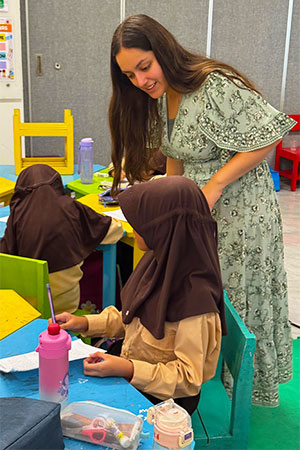
Verified, Cobar says.
“Those people there are so nice – the nicest people ever. I can’t explain how nice they are. They’re so welcoming. Everyone would just smile at you, even as you’re walking down the street,” she says.
“I was very intimidated because I was going to be working with sixth-grade students, and from clinicals here, I’ve been working with third-grade and lower, so I was so nervous. But when I went, I was like, ‘Oh, it’s not even scary. It’s so fun. They’re so nice.’ I really like the older grades,” she adds. “Teaching in Indonesia just gave me the confidence, patience and stronger problem-solving skills that I have been looking for this whole time.”
Like Cruz, Cobar returned with her eyes opened: “I honestly learned so much being there.”
Her observations included not only the differences in pedagogy and curriculum but also the day-to-day interactions of teachers and students.
Meanwhile, “I learned to be more thankful than I already was. Life out there is so beautiful and simple, and it really made me happy for the little things in life.”
Cobar’s students in Illinois – she’s currently student-teaching at Leggee Elementary School in Huntley Consolidated School District 158 – will benefit from those realizations.
“This experience will forever impact my career,” Cobar says.
“Teaching in Indonesia showed me the importance of cultural awareness and flexibility and creativity in the classroom,” she adds. “It taught me that every student learns differently, and that building relationships is just as important as teaching content. It will help me approach things differently and with empathy, and to change my teachings to meet diverse needs and to create a supportive environment where every child feels valued and capable of success.”
She emphasizes the “building relationships” part of that equation.
“Getting to know your students will always make the best impact in teaching,” she says. “It’s not having them memorize things or having them learn something in a specific way. I think that making connections and making sure they’re interested and having fun is also important.”
Proof was readily available at Al Azhar Yogyakarta Islamic School.
“I was impressed by how much respect the students had for their teachers,” Cobar says.
“At the end of the day, they would take the teacher’s hand and place it on their cheek,” she adds, laying her own hand, palm out alongside her face and snuggling into it, “and I thought it was really cute and beautiful.”
HOW THESE GLIMPSES OF TEACHING AND LEARNING will transform the travelers and their future students is clear to the professors.
 For Tonks, it’s career readiness.
“Any job they get here is going to be like this to some extent. The culture surrounding them will be similar to what they’re used to, but they’ll have all these people, and they’ll have to figure out how to work with them,” Tonks says.
“Principals all do things differently. The teachers you teach with have different expectations and are easy or hard to work with,” he adds, “and then your students are diverse. That’s always the first thing in my mind – that they’ll have to work with diverse groups of students in the United States – so going over to where the students were homogeneous, where they were similar to each other but very different from the teacher, our students were learning to be flexible. Figuring out how to do that will help them going forward.”
For Cohen, the confirmation is an intangible.
“I love to live vicariously through my students. I love seeing their eyes light up. It energizes me to see them growing like that,” Cohen says.
“It’s like, ‘OK, this is the reason that I’m on the planet. I’m making a difference in this way, in providing an opportunity for these kids – these students – to learn more about themselves, more about the world and, eventually, hopefully, make the world a better place.’ I know it sounds super idealistic and perhaps corny, but that’s really how I view all this stuff.”