
 NIU’s two-day Community Engagement Exemplar Symposium put several College of Education faculty front and center.
Held April 15 and 16, and hosted by the Division of Outreach, Regional Engagement and Development, the event gathered “impactful NIU community-engaged scholars, practitioners and community partners for shared learning, dialogue and co-creation.”
“The symposium is a space for faculty, staff, students and community partners to learn with and from one another,” its organizers wrote, “deepening understanding, expanding networks and strengthening NIU’s commitment to partnerships that are community-informed, mutually beneficial and transformative.”
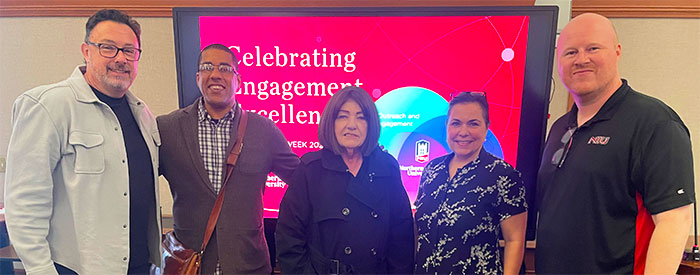
Day One – Wednesday – featured a panel discussion on “Rockford RISE: Co-Designing Teacher Preparation with Community” as well as a talk by Ben Creed, associate professor of Educational Administration and president of the NIU Faculty Senate, on “Community Engagement in Promotion and Tenure.”
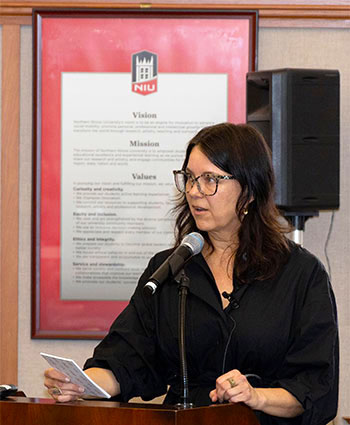
Creed spoke on how faculty can better incorporate community engaged scholarship, artistry and community-engaged teaching into their pursuit of promotion and tenure at NIU, giving participants a chance to think together and learn from one another.
Laura Ruth Johnson, professor in the Department of Educational Technology, Research and Assessment, delivered Day Two’s keynote address that explored “Communities as Intellectual Spaces.”
Johnson described her own various projects in Chicago’s Humboldt Park community while also sharing insights from José E. López, longtime executive director of The Puerto Rican Cultural Center to highlight the role of communities in knowledge production and transmission – and how universities can prepare for, and contribute to, meaningful engagement with communities.
She cited advice for researchers from an interview with López of good questions to ask themselves: “What is it the community wants to tell you? What is it that they’re concerned about? What is deep down in their soul that impacted them?”
Wednesday’s panel discussion, moderated by Eric Junco, assistant professor in the Department of Curriculum and Instruction and the college’s director for Academic Cultivation and Engagement, provided a progress report on the Grow Your Own initiative with the Rockford Public Schools (RPS 205) that is reshaping teacher preparation.
Panelists were Sally Blake, chair of the Department of Curriculum and Instruction; Mike Manderino, associate professor; Jason Pope, RPS 205’s executive director of Talent; and Miriam Ojaghi, Team Lead Professional Development consultant and SEL specialist with the DeKalb County Regional Office of Education.
Rockford RISE is “what happens when we prepare teachers not just for communities but when we prepare teachers with communities,” Junco said of the program that identifies local current paraprofessionals from minoritized communities and provides opportunities to earn bachelor’s degrees in Elementary Education along with professional licensure.
Core principles are reciprocal collaboration, co-designing experiences, impacting the public good and iterative cycles for continuous learning and improvement.
In simpler terms, Junco said, the initiative challenges itself to transform education by interrupting the status quo, working toward curricular equity, helping students see themselves in what they’re being taught and “rekindling that sense of awe and wonder in our classrooms.”

Key to the success so far, Blake told the audience in Altgeld Hall, are the voices of a community advisory board and open minds all around.
“You have to listen,” she said. “We started with focus groups in the community – teachers, parents, the leadership in the community – and what we learned from this, and one thing I think we really need to do, is to create teachers who would support that community. It’s not me. It’s not any of us individually. It took all of us together.”
Future teachers in the program are working adults, Pope said. Most have families and children. Many started college long ago but never finished.
“How do we develop our staff who are already supporting these buildings, who live and work in these communities, to become educators?” he asked. “We really needed something grounded in helping these individuals become teachers who could really focus in on their communities.”
State Rep. Maurice West connected Pope with Grow Your Own Illinois about five years ago, an introduction that eventually led to launching Rockford RISE in 2024.

“I knew NIU was the university partner that I wanted,” Pope said. “We’ve had success building out other programs with NIU, and the reason that NIU was so critical to this is that they will do what it takes to get students across the finish line. What I mean by that is they really invest in those wraparound supports that are critical to these students.”
Curriculum is co-designed to best impact the public good, Manderino said, and is dynamic. Four of the courses are unique to Rockford, preparing the preservice teachers with culturally competent, restorative, trauma-informed and community-connected teaching practices.
“Ultimately, we’re never going to get this exactly right,” Manderino said. “We’re constantly, iteratively designing and redesigning, going back to the drawing board, saying, ‘That worked, that needs revision, throw that out and let’s do it again.’ ”
Ojaghi offered stories from her personal experiences over three decades in education to illustrate the importance of teachers who bring the qualities woven into Rockford RISE’s coursework.
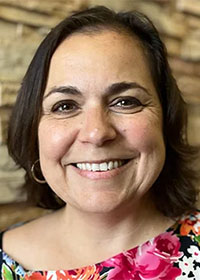
In one example, she told of a high school daughter of caring parents who attended a college fair alone because her father was working at his second job and her mother, who spoke Spanish, “didn’t want to embarrass her.” In another, she told of a paraprofessional who needed seven attempts to pass the state content test required for licensure – incurring the exam fee every time.
In the most compelling, she told of a college student who, while in a Chicago high school, survived a parade of different substitute teachers in her chemistry class every day and who had never used a microscope before majoring in biology with the hopes of becoming a science teacher herself.
When the young woman, who was the only student of color in her biology class, finally approached her professor for help with the knowledge that many of her classmates were similarly struggling, she heard an unsettling question: “Do you think this is the right major for you?”
“He didn’t mean any harm,” Ojaghi told the audience, “but for her, it was, ‘Did he ask anybody else who flunked the test? Or was he just asking me?’ That was part of my learning as a white, middle-class teacher.”
It’s a critical realization, Junco responded: “Some people are able to persevere though it,” he said, “and others close to the door to opportunity.”

Part of Rockford RISE’s learning, meanwhile, is in collecting “street data” to ascertain local knowledge and priorities.
Among the barriers to success identified by community members are bullying; a lack of emotional safety and unbelonging; teacher-student-family disconnect; racial trauma and mistrust of schools; and unresponsive curriculum.
Other honest and conversations between Rockford RISE’s aspiring educators and community partners explore issues of literacy inequality, food insecurity, housing instability, environmental justice, violence prevention, immigrant rights, trauma recovery and mentorship programs.
“What would it require us to change in teacher preparation,” Rockford RISE asks itself, “if we treated these testimonies as authoritative knowledge and not just anecdotal data?”
Beyond that, Blake asked, what if professors of education acknowledged the need for preservice teachers to learn more than content, instructional methods and classroom management so that they also graduate with the cultural competencies emphasized by Rockford RISE?
 “As I learned, and as I worked with the community, and saw the difference it makes in the lives of those children – which is what, of course, our field is about: How do you make it better for children? – I thought, ‘OK, let’s rethink this. Surely, somewhere in my past, I felt insecure about something,’ ” Blake said.
“But it doesn’t matter if I have or not. It doesn’t matter if I believe it or not. What matters is the change it’s making in our schools and with these children – period,” she added, “and that should be worth it to all of us.”
