

Developers of an NIU initiative that empowers K-12 students with rigorous and inclusive learning in the era of artificial intelligence took their message April 7 to a key audience.
Aspiring superintendents.
NIU College of Education faculty Eric Junco and Razak Dwomoh were the featured speakers for the latest edition of the Aspiring Superintendents Forum, which allows Ed.S. in Educational Administration candidates to probe the minds of current practitioners.
Junco and Dwomoh described Project LIST (Literacy-Inquiry-Social Justice-Technology), which guides school districts and teachers in employing AI in ways that support student thinking, strengthen writing and expand access to inclusive learning experiences.
Indeed, the researchers said, leveraging AI thoughtfully can enhance learning and strengthen teacher practice if leaders balancing innovation, trust and accountability.
“This session focused on AI in schools as a tool to deepen instructional activities while highlighting the biases and problems associated with using this technology,” said Ben Creed, associate professor in the Department of Leadership, Educational Psychology and Foundations.

Following the presentation and a set of hands-on activities, Creed added, “we had a conversation about the role school and district leaders can play in facilitating and supporting productive, positive work amongst staff in the application of AI.”
Project LIST’s goal, Junco and Dwomoh said, “isn’t more AI. It’s better teaching supported by intentional systems.”
Key obligations for leaders regarding AI are to clarify its role, create shared expectations that reduce inconsistency across classrooms, provide instructional vision, invest in and support professional development for teachers, ensure quality and accountability and emphasize equity.
Risks of ignoring AI’s inherent biases, meanwhile, can distort representation in curriculum with misinformation and widen equity gaps.
Leaders also must recognize that curriculum is not neutral: Dominant (often white) perspectives are centered; communities are missing, minimized or misrepresented; and, when included, identities are often simplified or stereotyped.
Such simplification, stereotyping, omission or subordination can magnify societal biases: According to scholarship, when some AI output does include minoritized groups, it places them in powerless, struggling or “needy” roles compared to white counterparts.
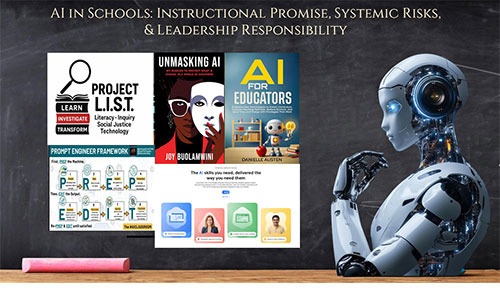 “These outputs matter because they influence identity, diminish confidence and shape students’ sense of belonging,” Junco said. “They signal who is expected to lead, succeed or struggle academically.”
Positive examples of AI “outputs” for lesson planning and grading practices showed the differences between educators who receive minimal guidance in using AI versus those who are supported with embedded instructional expertise, demonstrating that the quality of the AI “prompt” determines the quality of the output and instructional practices.
Questions posed to the aspiring superintendents for discussion and for future consideration in their respective school districts:
- What ways do you see AI already showing up in your district, formally or informally?
- What are the most important differences you saw in the outputs, and why do they matter for student learning?
- What conditions are needed so AI is used well, consistently and equitably?
Creed and Lynn Gibson, a clinical assistant professor in the Department of Leadership, Educational Psychology and Foundations, launched their semiannual forums in 2021.
Other members of the Project LIST research team are NIU professors Hyoju Ahn, Diana Bonilla and Cansu Tatar.
