
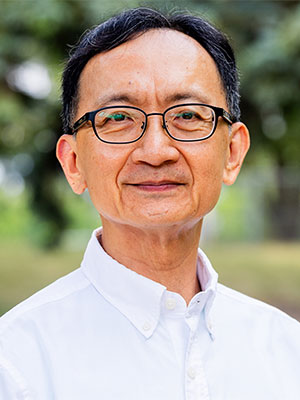
Wei-Chen Hung is among the recipients of a $2 million grant-funded project toward “Examining the Application of the IFLIP Pedagogy in STEM and Pre-service Science and Math Teacher Education by Institutional Context.”
The dollars from the National Science Foundation’s Institutional and Community Transformation (Level II) program are awarded to NIU, Chicago State University, Northeastern Illinois University, both campuses of Southern Illinois University as well as four community colleges.
Hung, chair of the Department of Educational Technology, Research and Assessment (ETRA), serves as principal investigator for NIU’s portion of the federal grant and is the collaboration liaison for the entire team.
Jason Rhode, NIU’s associate vice provost for Teaching, Learning and Digital Education and a member of the ETRA faculty, is a member of the coalition’s advisory board.
IFLIP – Inverted, Flexible, Inclusive Pedagogy – goes a step beyond the traditional “flipped classroom” concept, Hung says.
“Flipped instruction is not new. The key part is that you want to promote the learning ownership. Therefore, we specifically work with faculty members toward moving away from teaching to more of a scaffolding and modeling by promoting different types of learning approaches, such as scientific inquiry and evidence-based instructional practice,” he says.
“So, in this way, the students need to take responsibility for their learning while faculty, along the way, become a mentor – a scaffolder – to support their learning process.”

But IFLIP adds layers, he says.
“The design approach also builds flexibility into the course so students can truly engage in self-directed learning. In practice, they meet in class one week and spend the next week preparing with resources they’ve identified. That flexibility is also what makes the model inclusive – it creates multiple, equitable ways for all students to participate.”
Researchers want to provide evidence that supports adding this instructional model to teacher-preparation programs throughout the state.
Phase One, which took place before the pandemic, was conducted on a smaller scale involving only Hung and faculty from SIU and St. Louis Community College.
Its success prompted the application for the nine-school study.
“This project lets us look beyond a single campus through working across diverse institutions, we can see how each site adjusts its STEM and teacher-preparation practices and learn what changes truly drive institutional transformation,” he says.
“We’re focusing on student learning outcomes and faculty practice, and on how this pedagogical approach drives change over time.”
 Hung’s specific role is to visit and speak with faculty participants at the four other universities and the quartet of community colleges – Malcolm X, Oakton, Shawnee and St. Louis – to learn about their challenges and concerns as well as their opportunities for implementation and recommendations for improvement.
Each institution (NIU is not included) will provide six faculty “to give me an idea of how faculty adopt a new pedagogy and the thought process they go through to understand how this new teaching approach provides an impact to the student.”
First, however, the grant recipients will deliver a workshop to train the 48 faculty (grouped in two cohorts of 24) on how to execute IFLIP, support students, measure their results and suggest additional work that might advance the project.
Participants in the first cohort will serve as mentors to the second, Hung says.
