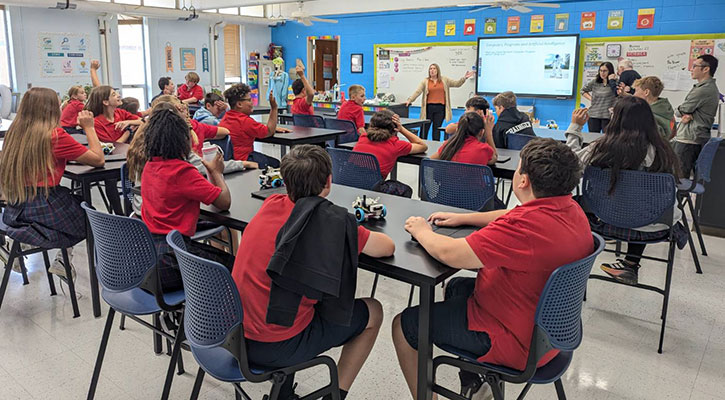

Researchers from the Department of Educational Technology, Research and Assessment (ETRA) are working with nearly 50 middle-level students and their teachers at St. Mary Catholic School to measure their comprehension of Artificial Intelligence.
How do they engage and interact with AI? What are its capabilities? Its limitations? What are the ethics? And can they recognize AI when they see it?
NIU’s Michael Tscholl and Cansu Tatar describe their mission inside the sixth-, seventh- and eighth-grade classrooms on Gurler Road as “absolutely vital” – and the duo hope to eventually expand to public schools and to publish their findings, both of which will benefit current and future teachers.
For now, though, the benefactors are adolescents.
“We need to prepare kids for AI. It’s a national imperative across all ages, including adults, and it’s very important to start early,” says Tscholl, an instructor of educational technology. “We need to teach them how AI works in order for them to be able to use AI tools well. They also need to know that AI sometimes fails – that it has biases and makes mistakes.”

Early conversations with the students set the stage for Tscholl and Tatar.
“Some of the students, when we were starting this intervention, said, ‘Oh, I know what AI is.’ But when we asked them, ‘So, what is it? Can you explain it to me?’ – they said, ‘Oh, AI is robots,’ ” Tatar says.
“But AI is more than robots. AI is something students intersect in their daily lives, so whether they are getting knowledge about AI or not, they’re all around it,” she says. “When we were finished, they understood that AI is learning through our data. Most of the students came to the conclusion that AI is not perfect, and that it needed more data to understand certain concepts.”
The activities that began in the fall and will continue this spring are the next step in Tscholl’s long-term project at St. Mary teaching the children how to encode robots, something that is now well integrated into the curriculum.
“Our goal was to use those programming competencies we taught them so that they understand how AI works in the background,” he says. “There are several principles of AI, and among them is transparency, so the kids – and even the adults – should know how it actually works below the hood.”
A good starting point, he says, is “pattern recognition – one of the big topics in AI, and this includes the ability to understand what a computer does with data. The computer collects data, interprets that and finds patterns of information in the environment.”
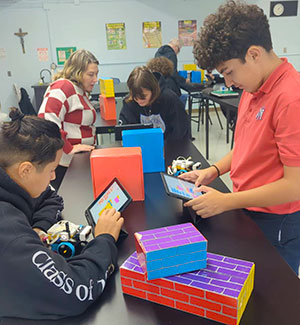
Students collected images of their choosing from the internet – airplanes, cows, clothes, Japanese anime, witches and more – and then employed Google Teachable to coach the AI in recognition and discernment.
“Is that a witch,” Tscholl asks, “or isn’t it a witch?”
Google Teachable then reported its percentage of confidence that it made accurate choices and asked the students to score those answers to confirm or enhance its learning.
Later, Tatar says, the researchers assigned students to devise their own AI games.
Rock Paper Scissors provided the example.
“You are playing the computer. You just make rock, paper or scissors with your hands to the camera on your laptop, and the computer is recognizing whether it’s rock, paper or scissors,” she says.
“I was really surprised how creative kids can be when it comes to designing their own AI applications or their own games,” she adds. “Most of the students used their childhood games that they liked on the internet or some of the games they play with their friends.”
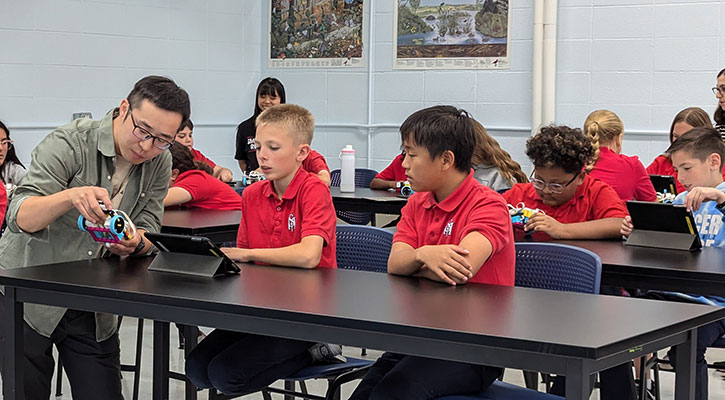
Tatar and Tscholl also are enthused by the excitement of the students.
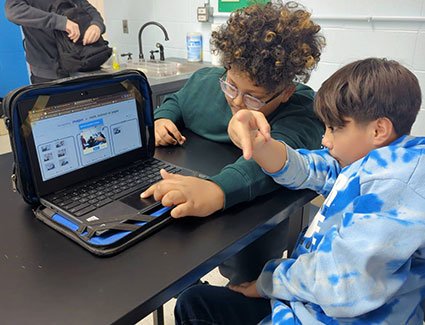
“We’re also trying to make the kids understand how these types of applications work for their future career plans: Instead of being only the consumers, they can be the producers,” Tatar says. “And if they aren’t the programmers, they can understand how AI works and how they can use AI to improve their problem-solving skills.”
“We had some interesting experiences that we didn’t expect,” Tscholl adds. “We gave them a simple task that we thought they would be really bored about, but they found it so interesting. It was simply to train a machine to recognize colors, and we thought, ‘Well, this is boring. They want witches and stuff.’ But no! It’s intriguing for them how the machine actually learns, and that is very, very promising for us.”
Future plans include broadening the research scope with a wider diversity of students, some from underrepresented populations, and professional development for current teachers.
“Teachers are very concerned about how students are using AI. They mostly think about AI as a tool for students to cheat on the courses or to just get the easiest responses from the AI so that they can complete their assignments,” Tatar says. “If students understand what are the capabilities of AI, what are the limitations of AI, what are the ethical considerations of AI, you can have this conversation. It’s important to have the same language with the students.”
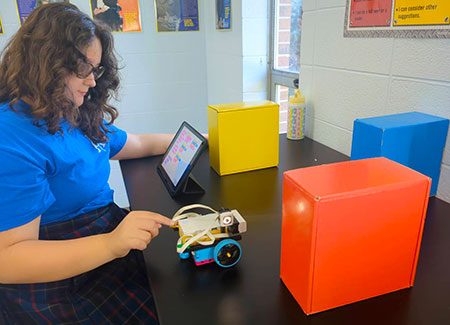
Meanwhile, she adds, teachers can learn how AI to prepare their own course materials or to develop their own AI-related curriculum “so they can develop some ownership.”
On the research side of the project, Tscholl says, the co-investigators are working with two Ph.D. students in Instructional Technology, Yen-Jung Chen and Lida Niu.
“ETRA sees this as a very promising research agenda. There is very little research, actually, on integrating programming and computational thinking with AI so we will be at the forefront because we have already taught them so much programming and computational thinking, and this is an ideal research setting,” he says.
“We are now writing a paper – a journal paper, a conference paper – and the plan is to submit it before the first of March. It would be immediately accepted. This is a new approach.”