
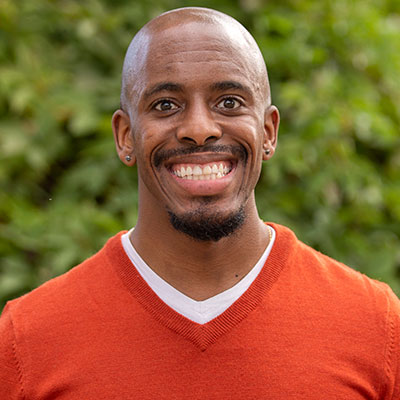
Quortne Hutchings believes the mission is to pay it forward.
And that, it turns out, is a family tradition.
“When I was applying for college, one of the things my mom and my grandma said was, ‘We don’t know if higher education is for you, but we want to ensure that you try it out to make sure it’s a possibility and pathway,’ ” says Hutchings (they/them), an assistant professor in the Department of Counseling and Higher Education.
“They said, ‘As long as you go – through your first semester, through your first year, and even if you don’t like it – then at least you can say that you did it. You actually went,’ ” they add. “In a lot of ways, folks in my immediate family, and my great grandparents, instilled in me that education is the pathway to changing not only myself, but our family lineage. I took that mantle as not only an obligation but also as something I took very seriously.”
Once at Penn State – “probably one of the best decisions I’ve ever made,” they say – the first-generation college student thought of more good advice from home.
“My mom said she wanted me to ensure that, when I got on the campus, that I could see myself there,” they say. “She’s like, ‘I want you to ensure that you can see yourself in class. I want to make sure that you not only survive in college but thrive. I want you to get involved. I want you to figure out who you are in your life.’ ”
Now Hutchings is preparing the future Student Affairs professionals who will guide coming generations of undergraduates in exploring, finding and reaching those same outcomes.
 Celebrating that work is the American College Personnel Association (ACPA) College Student Educators International, which has named Hutchings among its “Emerging Scholars” for 2025.
Implemented by the ACPA Senior Scholars in 1999, the program supports, encourages and salutes early-career individuals who are rising contributors to new knowledge in student affairs and higher education and who are pursuing research initiatives congruent with the organization’s mission, interests and strategic goals.
“Being an Emerging Scholar feels like a deeply indebted honor,” Hutchings says. “When I think about the folks who have been emerging scholars before me, they’ve all been my mentors. Mentors who have poured into me. Mentors who have supported me, and who have advanced the fields in their different disciplines.”
From a personal perspective, they add, “being an Emerging Scholar makes me the space of becoming someone who wants to deepen my understanding of minoritized students and recovery, and it gives me that vehicle. It gives me that linchpin to really explore those pieces.”
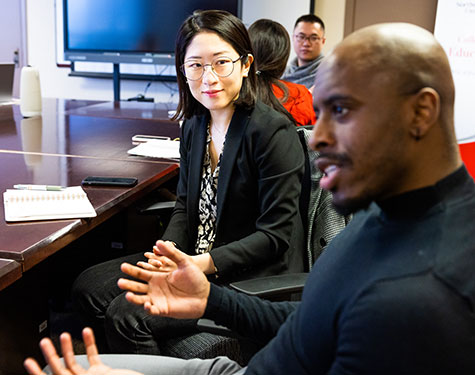
Even more, “being an Emerging Scholar gives me an opportunity to really deeply understand a community that is directly a part of who I am, and my project that I’ve been interested in is looking at minoritized students in college recovery programs and how they navigate experiences in those spaces.”
Hutchings clearly is grateful for the ACPA acknowledgement, which brought them to tears.
“You know, I was really emotional about it because I know the folks who have received this award over the years. They have been the people that I cite, the people that I love and my mentors, dear friends, colleagues and community members,” they say.
“To be part of a legacy of scholars who have not only changed research, but also have changed research in the communities that they care deeply about, was something I wanted to be a part of.”
“CHANGE” IS AN IMPORTANT concept to Hutchings.
Look at just some of the words on their self-penned reflection of Year One as an NIU faculty member. Dismantling. Transformative. Evolve. Metamorphosis. Learning. Unlearning.
Their own path to this destination included plenty of those steps.
“I changed my major about six or seven times. I came in undecided, and I probably changed my major as many times as I changed clothes,” Hutching says.
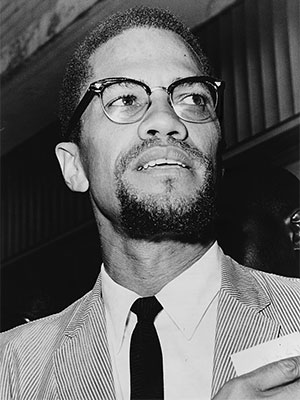
“But it wasn’t until I took an American studies class called ‘The Life and Thoughts of Malcolm X’ that my entire trajectory changed. I didn’t know Black Studies was a major that I could pursue, and it took me a few semesters to figure that out,” they add. “There was something about really understanding my own heritage and my own culture that I wanted to deepen, and it was one of the best decisions that I’ve made. It made me not only a better researcher but also a better faculty member.”
While completing their bachelor’s degree in African and African American Studies, they became a Ronald E. McNair Scholar; that led to mentorship from, and collaboration with, Kimberly Griffin, McNair faculty mentor and now dean of the University of Maryland College of Education.
Griffin advised Hutchings on a summer research project that examined the academic relationships of Black students and Black faculty.
“She kept talking about this thing called ‘Student Affairs,’ and I was like, ‘What is this word? I don’t know what this word means. It just seems like a word I’ve never heard,’ ” Hutchings says. “And she said, ‘Well, it sounds like you’ve already involved in college.’ ”
Truth.
“I was involved in our dance marathon. I was involved in our LGBT Resource Center as an intern. I was involved in orientation. I was a tour guide. I was involved in all these things,” they add, “and she’s like, ‘What you’re doing in college? There is someone out there who is a staff member or administrator or leader who helps figure those things.’ ”
Fascinated, Hutchings asked what it would take to become one of those professionals. Graduate school, Griffin answered.
That led Hutchings to the University of Illinois at Urbana Champaign, where they completed a master’s degree in Education, Organization and Leadership (with a concentration in Higher Education) in 2013.
Eager to keep going, and eager to learn more about what it means for students, faculty and staff to understand the shared college environment, they did not.
“My original path and trajectory was to do a straight-through from a master’s to a Ph.D.,” they say. “That was always on my mind because that was what McNair taught us: Your ultimate goal is a Ph.D.”
Lorenzo Baber, a professor of Higher Education at the University of Illinois who advised Hutchings during their master’s program, suggested something else.
“I was asking about my career path and he’s like, ‘I think you need to go work for a few years full time,’ ” Hutchings says.
“And I was really upset by that news, because there were other folks going straight through,” they add, “and he said, ‘You’ll be a better faculty member and a better educator if you get some practical experience. You’re going to be able to support your students in a different way.’ ”
None of that means those professors who choose to stay in school are not “phenomenal faculty members” – they are, Hutchings says – “but it was my path, and because I loved advising and working with students, and because I struggled with trying to figure out a major, I wanted to help figure those things out for other students.”
Employment began in a pre-college pipeline program, PEOPLE, at the University of Wisconsin-Madison, where “I was able to work with students who look like me – first-generation students from low-income, minoritized backgrounds who were given a full-tuition scholarship to be successful in college. I loved it.”
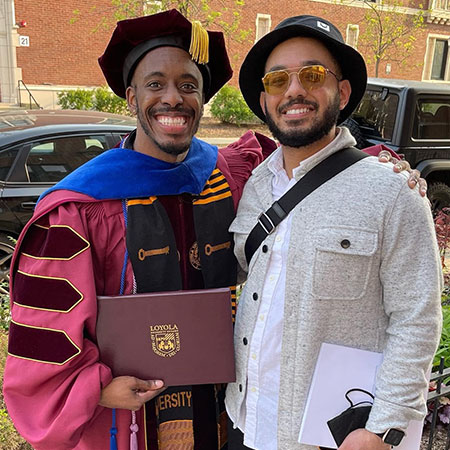
Work in Madison also involved Multicultural Affairs, which became a focus when Hutchings took a new job at Loyola University in Chicago.
Roles there included oversight of Brothers for Excellence, a mentorship group for Black men and men of color, as well as Loyola’s LGBTQIA initiatives and other areas of diversity, equity and inclusion.
The shift from learning about Student Affairs to becoming an on-the-ground administrator who created budgets and supervised staff made the doctorate something Hutchings could no longer resist: Their Ph.D. in Higher Education came in 2021 from Loyola.
NIU CAME NEXT.
With a focus on how higher education has advanced its educational and engagement practices to meet the needs of the most marginalized communities, Hutchings teaches courses on college student development; qualitative methodology; teaching and learning pedagogies; and dissertation proposal writing.
They integrate true stories from the job to empower future practitioners in “what it means to support students from different backgrounds and different spaces” and “what it means to really be a ‘thought partner’ with students.”
“I think that one thing that Student Affairs taught me is to be in good community with students; to be in good company with students,” they say. “My background is giving me space to tell students that, ‘Even though my story might not be your story, your path and your trajectory will be incumbent on how you engage with the campus community. How do you engage with people who maybe look differently from you? How do we support each other in our efforts?’ ”
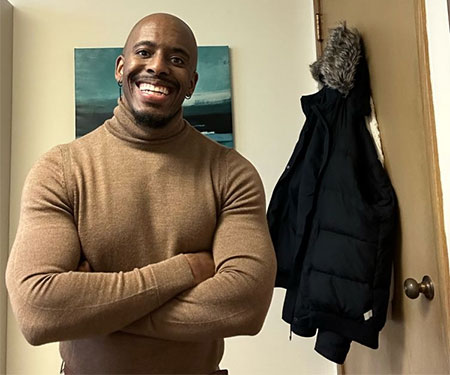
Hutchings primarily centers their research on the intersections of blackness and queerness in higher education, always employing that “storytelling approach” and always considering participants in the studies as “co-researchers or collaborators.”
“My intention,” they say, “is always to think about who is in the room, what happens in those spaces and how those stories can be told from the people who matter.”
Other areas of inquiry examine how minority students experience minority Student Affairs professionals, what it means to have multiple marginalized identities on the job and college-based recovery programs for people with substance abuse issues.
The last of those is “deeply personal. I’m about seven years in recovery myself,” they say, “and I look at, ‘What is the role of recovery on college campuses? Where does it happen? How does it happen? Who is responsible?’ ”
Campus-based recovery programs also must confront a stigma that substance abuse is not yet a genuine health problem, Hutchings says.
“Most folks are like, ‘Oh, it’s just an experimental thing. This is what students do when they go to college. They experiment. They have the good-old college experience.’ But we also know that these things can be really harmful for certain communities and certain students.”
THE EXPERIMENT OF COLLEGE began by Hutchings in Pennsylvania is one that has since inspired his family.
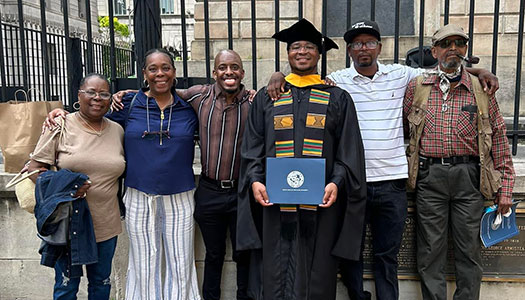
Brother Quince is a data analyst who has now earned his master’s degree.
Mother Lisa eventually decided that she, too, would pursue a degree. That bachelor’s in organizational management came in 2024, and the credit analyst is already thinking about graduate school.
Once Mom was in school, and Hutchings was teaching in DeKalb, the two chatted weekly on the phone for “Accountability Tuesdays” to discuss and process their latest experiences from their respective sides of the classroom.
She’d already laid a good foundation for the value of education: As a single mother raising her children, she moved the family around Pennsylvania, New Jersey and Delaware in search of the best school situations.
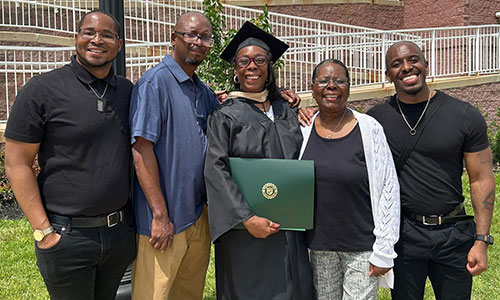
Even their uncle, a Navy veteran, and their grandmother, Gail, a retired nurse, figure in the equation.
“I always say that my mom and my grandma were my first teachers,” Hutchings says, “not necessarily in a formalized teaching capacity but in their ability to teach me about what was right in the world, what was wrong in the world, where I fit as a Black, queer person in the world and that I matter.”
They all told Hutchings, “You have a purpose in this life. You always have a purpose. It’s your job to figure out what that is.”
And after that answer finally arrived, Hutchings adds, “my mom and my grandma always said, ‘Make sure you write and do research for the communities you care about.’ I’ve always taken that very seriously.”
