
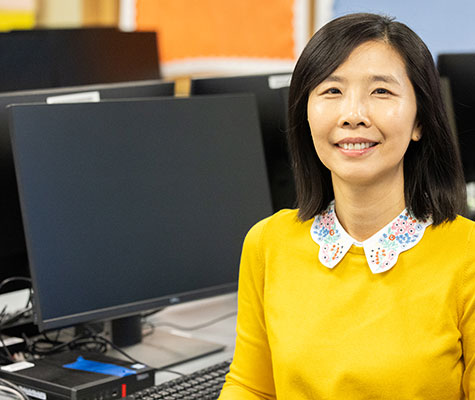
After years of equipping Rockford middle schoolers to create makerspaces, Pi-Sui Hsu wanted to elevate her outreach to another level.
Hsu, a Presidential Engagement Professor in the NIU Department of Educational Technology, Research and Assessment, had taught her after-school students and summer campers about engineering design and the scientific argumentation that fuels it.
She’d put 3D printers in their reach. She’d overseen tests of their resulting prototypes.
Now she’s ready to implement computational thinking into her curriculum.
“The research team was thinking about how we can move the project forward to teach students different skill sets, and we want to bring computational thinking into our project,” Hsu says.
“Computational thinking is a problem-solving skill – how to identify a problem, how to solve a problem, how they can use coding to implement those ideas,” Hsu says. “We want them to learn how to analyze the problem and how they could use a sensor, and then how they can use programming to respond a challenge we will present.”
Beginning in March at the Rockford Environmental Science Academy, the after-school students will incorporate maker tools and robotics kits as they learn how to code sensors and then ponder and determine ways to solve the problem.
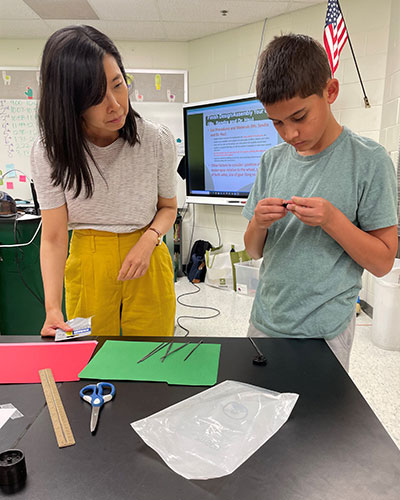
“We would like students to look into community issues, so I collaborated with the City of Rockford to identify some. One of the issues is lighting because, in some areas, the city removes some of the streetlights to save on cost,” she adds. “I want students to be aware of what’s happened in their community and how we can address it.”
Meanwhile, “we want them to learn about the engineering-thinking process – again, how to identify a need and how they can apply their design skills to develop a prototype and to see if the prototype is a good solution to the problem.”
Introducing those challenges and skills at the middle school level offers an earlier glimpse at different college majors or careers that the students might want to pursue, Hsu says.
Rockford’s demographics also play a role, she says. Some students aren’t aware of the full range of opportunities.
“They might say, ‘I want to be a technician’ – and it’s great to be a technician, but they might now know technician is kind of related to engineer, so we kind of take one step ahead. We say, ‘Well, a technician is great, but engineers take a technician’s work to a higher level. Here’s what you can think more about – that you can actually create. You can do research,’ ” she says.
“Our goal is to provide students exposure to what they can become when they grow up,” she adds. “I bring professors from other colleges, and students in our college and other colleges, to share their experiences with the kids.”

HSU IS ALSO WORKING to benefit teachers.
A grant from the NIU College of Education’s Morgridge Endowed Chair Office allowed her to study “Gamifying Scientific Argumentation as an Equity Pedagogy.”
The research, taking place with 11 teachers in Rockford and Aurora public schools, intends to help middle school science educators understand how they can nurture academic parity in their classrooms.
“We feel like gaming is maybe one of the ways to appeal to students of Generation Alpha. They grew up with technology,” she says, “and, on top of that, we feel that games can appeal to kids from different, diverse backgrounds. English might not be their first language.”
Developed by Hsu and Reva Freedman, associate professor in the NIU Department of Computer Science, the game teaches students about the components of scientific argumentation. The 11 teachers implemented the game in the fall, allowing Hsu to collect preliminary data about its effectiveness and to ask teachers to reflect on the experience.
A second part of the game coming this spring – “Collaborative Arguespace” – will actually enlist the students in scientific argumentation.
“Last semester, the minigames were more for individual students to complete at their own pace. Some of the students were very quick, but some of the students were slow,” Hsu says.
“In the Collaborative Arguespace, we focus on the collaborative nature of scientific argumentation,” she adds. “We will work with the teachers and see how we can engage students in smaller groups.”
Following that, the pair will interview the teachers again and create a database of the project’s results.
“We are able to track the students’ performance from the back end; for example, how many correct answers they provided, how many incorrect answers, how many mouse clicks they used when playing the games and their learning trajectory,” Hsu says. “This will be another advancement in the research.”
SOME OF HSU’S current explorations of instructional technology are focusing not on tweens but college students.
She was one of four College of Education faculty members awarded a 2023 Curricular Innovation Grant Fund from NIU’s Center for Innovative Teaching and Learning. Her project, which remains active, is testing “flipped instruction” in ETT 231: Digital Visual Literacy in Learning’s online and face-to-face modalities.
The goal is to engage underprepared students, help them persist by creating a learning environment rich in diversity, equity and inclusion and lower DFUW rates.
“For freshmen, online courses are a new concept,” Hsu says, “and I noticed that some of the students were really struggling with how to navigate online courses and how to complete them successfully, so I started thinking, ‘What are some strategies that could be implemented to support students, especially students with different learning styles or different cultural backgrounds?’ ”
Hsu, who created and introduced ETT 231 to NIU students, knew that her course was the perfect candidate for experimentation.
 “I had been looking for ways to revise the course. I mentor three to five teaching assistants every semester, and I get feedback from them after each semester as I try to improve ETT 231,” she says. “And, with the CITL funding, I was able to bring some innovative ideas.”
Weekly presentations to students, including announcements, lists of that week’s activities, assignment instructions and in-the-moment questions, became interactive using Kaltura. They also were supplied in two ways: text (the traditional method) and video.
The changes also offered fertile soil for research.
Students were split into an “intervention group” and a control group; surveys were conducted to measure their connection to the course delivery and its content.
“We found significant difference. Students in the class where we implemented the new strategies demonstrated a much higher level of engagement, and we believe that will probably lead to higher completion rates and reduce the DFUW rates,” she says.
“Most students said, ‘I was able to identify the critical points that I should remember after every lesson,’ and, ‘By reading the text-based assignment instructions, I was able to make sense of them – but by looking at the video-based assignment instructions, I was able to follow along.’ ”
Deviations also were seen between intervention group’s freshmen, who reported strong engagement and provided positive feedback on course evaluations, and the juniors and seniors Hsu considers more mature.
The team, including her teaching assistants who participated in the design, development and implementation of the innovation strategies, are planning to submit conference proposals and journal articles.
“We’ve been able to collect data and analyze the data, and now we can share what we’ve learned with the broader community,” she says. “I’m very happy about that.”
