
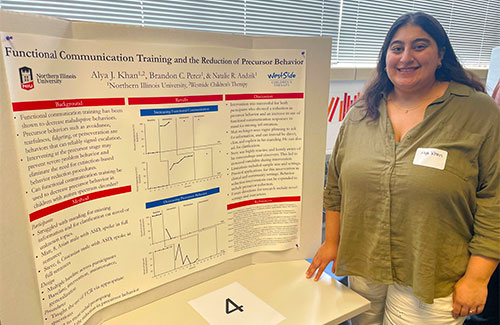
In Alya Khan’s daily work as a registered behavior technician at a children’s therapy clinic, she experiences an aspect of autism that she wants to understand better.
Many of her young clients present with a large deficit in communication skills, whether that is a lack of understanding, a lack of expression or both.
Peer interaction can suffer as a result, including when classmates or potential friends try to include them by asking if they know how to play a certain game.
“But a problem that a lot of kids with autism have, and express, is that they don’t ask very specific questions. They will say, ‘I don’t know’ – and that’s where the conversation ends,” says Khan, who is earning her M.S.Ed. in Special Education with a specialization in Behavior Analysis.
“For an adult, that usually means you’ll fill in the blank. You’ll go, ‘You don’t know? Let me explain it to you.’ For kids, it goes, ‘OK. You don’t know.’ Then they run away to find another kid who does know how to play.”
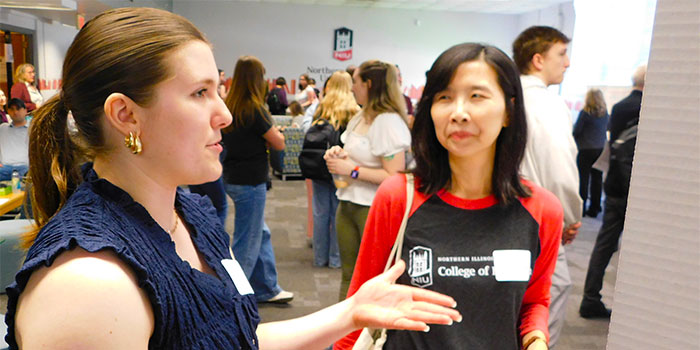
Khan was one of more than 40 Huskies who presented posters or delivered talks April 17 at the annual Student Research Symposium. Many were also Mary F. English Scholars who discussed their studies of assistive technology.

Corrine Wickens, the college’s Senior Faculty Fellow for 2024-26, delivered the keynote address on “Cultural Paradigms in Contemporary Realistic LGBTQ+ Young Adult Literature.”
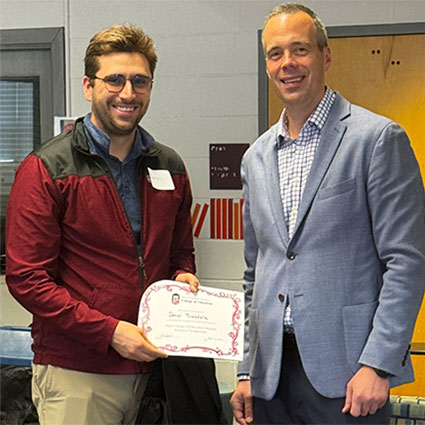
Awards were given to Katie Garcia for her poster on “Behavioral Skills Training and Error Correction Implementation,” her project with faculty mentors Amanda Borosh and Brandon Perez; and to Daniel Truesdale for his oral presentation on “Sampling Rigor in Instructional Technology Mixed Methods Research.”
Todd Gilson, associate dean of Research, Resources and Innovation, opened the event on behalf of the College of Education Research Committee.
“We know this is a lot of work, but hopefully you’re as excited as we are,” Gilson said in welcoming the students. “Today is your day.”
Further inspiration came from Wickens.
“Research is an essential component of our educational enterprise,” she said, “because to research is to inquire, and to inquire is to wonder – to be curious – and we need more wondering. We start with questions: How? Why? Then, we find and employ methods to answer those questions.”
Questions and questioning “are at the very heart of doing research,” she added. “It is also the heart of the education but, for some reason, that part gets lost in the nuts and bolts of teaching and schooling.”
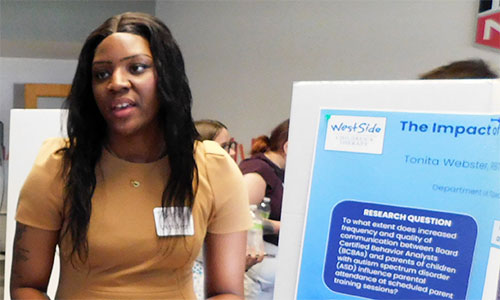
TONITA WEBSTER, WHO IS pursuing her M.S.Ed. in Special Education with a specialization in Behavior Analysis, wondered whether improved communication between service providers in her field and the parents whose children they serve would boost attendance at parent trainings.
Webster, from New Lenox, is employed at Westside Children’s Therapy as a registered behavior technician.
For the purposes of her study, some of the Board Certified Behavior Analysts (BCBA) she works with “either did not reach out at all to parents, or they would reach out with just very minimal information. As an example, they would just say, ‘Hey, it’s time for parent training,’ and that was it.”
Meanwhile, her experiment routinely contacted other parents with a weekly, structured email.
“Every single day, after a registered behavior technician was done working a client, they then typed a little message summarizing how that session went – if any behaviors occurred, if the client struggled with anything, if they ate, if they went to the bathroom,” Webster says.
“At the end of the week, the BCBA and I would take all of those messages and summarize them so we could then put it into a weekly email,” she says.
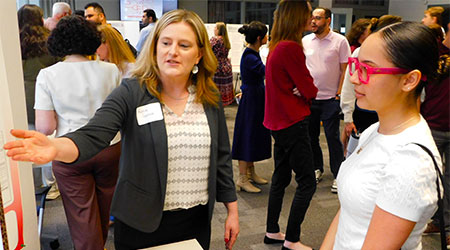
“We also would give parents the chance to voice any concern that they might have, whether that concern would be in in the clinic or about any behaviors that are happening at home, and then the BCBA would give at least three dates and times in the next week when they could meet.”
Sure enough, she adds, attendance climbed. So did the frequency and quality of correspondence.
“There were some weeks when the parents would miss those trainings, but they still had that back-and-forth communication,” Webster says. “They were able to tell the BCBA, ‘Hey, I don’t think I’ll be able to make it this week,’ and the BCBA was able to let the parent know, ‘Hey, this is how your child’s week went.’ ”
Shayan Shafiei Nikou, who is pursuing his M.S. in Kinesiology and Physical Education, also was part of an examination of efficacy.
Nikou collaborated with Professor Paul Wright’s team looking into the impact of the U.S. Soccer Foundation’s professional development model, which provides a one-time workshop along with “clear and hands-on” instructional curriculum to P.E. teachers and coaches to deliver in ways that enhance their own learning.
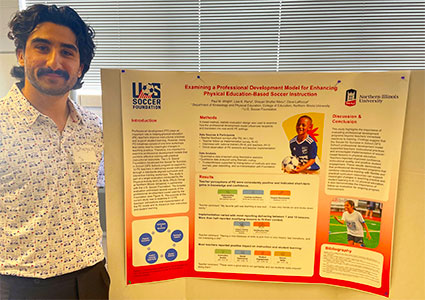
Immediately after a workshop, Wright’s team asked its 1,792 participants whether they felt that their knowledge had grown and that they had confidence to teach what had just been demonstrated.
Ninety-five percent said they believed that they could, says Nikou, who helped to analyze the data and to present the findings at two national conferences.
“They reported they had great learning outcomes in their soccer skills, student engagement, social experiences and instructional quality,” he says, “and concluded that having this type of professional development – a one-time workshop as well as curriculum – was much more useful.”
Similarly, Khan saw positive change through her interventions with children who have autism by subtly teaching them how to pose appropriate questions to obtain necessary information.
“I used very contrived situations. I would say, ‘Go tell my friend over there what my shoe size is,’ hoping that they would turn around and ask, ‘What’s your shoe size?’ – and they would ask that very specific question,” she says.
“They were able to then generalize it in situations where someone was just telling a story about their weekend or what their favorite thing is, and they know that they can ask more specific questions throughout the conversation,” she adds. “Hopefully, this will reduce some of that anxiety and a lot of those ComB (Comprehensive Behavioral) diagnoses that a lot of kids with autism can have.”
Khan, whose bachelor’s degree is in neuroscience, appreciated her opportunity to conduct research in humans.
Her undergraduate experiments typically involved rats.
“Working with human subjects, you learn, ‘This is real life. This is how people talk to each other, even though they might have a disability – even if they have different needs,’ ” she says. “As a group, we just want to know each other better and we want to know more about what’s going on in our environments.”
ORAL PRESENTATIONS
- “Knowing Without Seeing: Epistemic Responsibility in AI-mediated Knowledge Work.” Brad Blair, LEPF
- “Sampling Rigor in Instructional Technology Mixed Methods Research.” Daniel Truesdale, ETRA
- “Exploring Runners’ Experiences with Regional, Mid-Sized Marathons: A Case Study on the Illinois Marathon.” Patrick Tkachuk, KNPE
- “PEACEful Warriors: Incarcerated Youths’ Learning of Life Skills through a Sport-based Martial Arts Program.” Jeremy Charles, KNPE
- “AI Chatbots to Support Disciplinary Literacy in Social Studies for Middle School Multilingual Spanish Learners.” Caio Gomes, Eric Junco, Razak Dwomoh and Diana Bonilla, ETRA
- “Teaching Beyond the Game: Instructor Influence on Youth Behavior in a Detention-based Sport Program.” Luc Charlebois, KNPE
POSTER PRESENTATIONS
- “Collaboration and Inclusive Practices in the Field of General and Special Education.” Hanna Lengquist, Tommy Jonen and Lisa Liberty, SEED
- “Effective Professional Learning Communities.” Tommy Jonen, SEED
- “Cross-cultural Perspectives on STEM Education and Career: Insights from Chinese International Students Majoring in GIS.” Lida Niu, Yen-Jung Chen, Md Ehtesham Adnan and Rabab Batool, ETRA
- “Chatbots as Cognitive Partners in Inquiry-based Elementary STEM Education.” Md Ehtesham Andan, Lida Niu, Sahar Yaghoubzadeh Torki and Michael Tscholl, ETRA
- “Functional Communication Training to Reduce Precursor Behavior.” Alya Khan, Brandon Perez and Natalie Andzik, SEED
- “Multi-level Intervention for Rigid and Repetitive Behavior.” Nancy Santoro, Brandon Perez and Natalie Andzik, SEED
- “Behavioral Skills Training and Error Correction Implementation.” Katie Garcia, Amanda Borosh, and Brandon Perez, SEED
- “Teacher Implementation of the ‘Soccer for Success in Schools’ Curriculum.” Shayan Shafiei Nikou and Paul Wright, KNPE
- “The Impact of BCBA Contact on Parent Participation.” Tonita Webster, Amanda Borosh, Brandon C. Perez and Natalie Andzik, SEED
- “The Impact of TEA Program on Teaching Practices of the Secondary EL Teachers of Bangladesh.” Md Tozammel Haque, LEPF
Members of the COE Research Committee are Gilson, Babatola Arogundade, Wonock Chung, Alissa Droog, Razak Dwomoh, Olha Ketsman (chair), Michelle Sands, TJ Schoonover, Stephen Tonks and Daniel Truesdale.
FURTHER READING
→ Undergraduate Student Research Spotlight: Lexi Koehl
→ Undergraduate Student Research Spotlight: Tommy Jonen
