
 One dreamed of teaching art but eventually decided that she would not pursue that goal – until, well, she did.
The other wanted to work as a print journalist, and even did so for a while, but ultimately realized that she needed to find another avenue to nourish that talent, ambition and interest.
Both are still in unexpected places, putting their NIU College of Education degrees to work, and are now connected in a prestigious way: as 2025 finalists for Chicago-area Golden Apple honors.
Gerrie Aulisa, principal of Albright Middle School in Villa Park-based Salt Creek District 48, is among the top six contenders for the Golden Apple Award for Excellence in Leadership. The nominees drive exemplary, significant and sustained positive impact on their schools, creating cultures of inclusivity and delivering dramatic growth in student achievement.
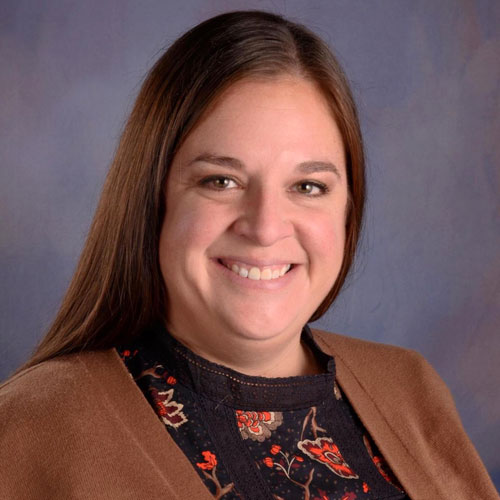
And Amy Howerton, chair of the English Department at Oswego High School in Oswego Community Unit School District 308, is one of the 30 frontrunners for the Golden Apple Award for Excellence in Teaching. Winners have made lasting and positive effects on lives, learning and growth of their students and school communities.
Representatives from the Golden Apple Foundation, which is the leading Illinois nonprofit committed to preparing, honoring and retaining great educators, will celebrate their winners later this spring during in-school surprises.
“It’s really exciting. I was also nominated maybe four years ago, but I didn’t make the finalist round, so I feel very honored to have this chance,” says a grateful Aulisa, who earned her M.S.Ed. in Educational Administration in 2010.
“Having now been at Albright for six years, I can see the improvements that have been made with the staff and with the data – and I think now that before was too soon,” she adds. “Now I feel like we can show all of our progress, and that’s what’s important. The growth that we’ve had has been amazing, and I share that with my staff. I look at this as our school being nominated, and not just me, because it does take a community.”
For Howerton, who completed her Ed.D. in Curriculum and Instruction in 2016 with a specialization in Curriculum Leadership, being a finalist amounts to the proverbial cherry on the sundae.

“Probably the biggest joy of my day is teaching – working with kids in a classroom,” Howerton says. “I absolutely love the students and those relationships that I get to develop with them and, I hope, the inspiration I’m able to give them. But they also inspire me.”
Consider Alan Mather, president of the Golden Apple Foundation, equally inspired by the teachers and leaders nominated and those selected for the penultimate stage of the process.
“Great teachers change lives. Their commitment to fostering student growth and inspiring a love for learning enriches not only their classrooms but also the entire educational community,” Mather says. “Great school leaders affirm the good that people do, challenge them to be their best and support them when they take risks in the best interests of children.”
AS IDENTICAL TWINS, Gerrie Aulisa and her sister, Jamie Peterson, grew up with similar interests and goals.
They initially resolved to attend different colleges, but that didn’t happen when both were admitted to the University of Illinois.
“I started as art education, and then she decided to switch her major to art education, and I was like, ‘Well, we can’t have the same major. We have to have our own identities.’ So then I said, ‘OK, I’ll do advertising. I’ll do the creative side, and I’ll design and write for advertising.’ ”
Beginning a master’s program in that discipline, Aulisa quickly realized something was wrong.
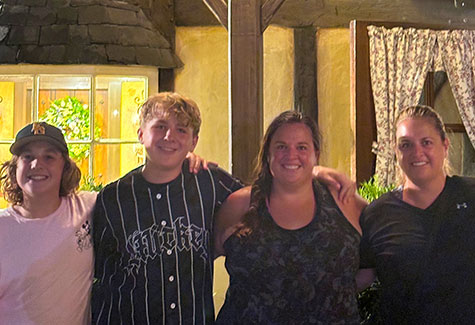
“Finally, I said, ‘What are you doing? You really want to be a teacher.’ So – full circle – I ended up going back for art education at Northern,” she says, “and because of all the other coursework that I took in my travels in figuring this out, I was able to get endorsed in business and technology as well, so it wasn’t a total waste of my energies, but it was a long path.”
Some of her clinical placement and observation hours even took place in her sister’s art classroom at Crystal Lake South High School.
With her 2006 master’s from the NIU College of Visual and Performing Arts in hand, Aulisa began teaching art, technology and business at Addison Trail High School.
“I enjoyed it so much,” she says. “I started an Advanced Placement class in the art program that really dug into photography, web development and graphic design. I even taught consumer management and wood shop.”
Meanwhile, hoping to someday become a department chair, she returned to NIU for her M.S.Ed. in Educational Administration, which she earned in 2010.
Yet the winding road curved again during the process.
“Unfortunately, when the economy crashed back in ’08, they started merging and eliminating positions,” she says. “So, by the time I had the degree, the program kind of got smaller. I stayed on one more year part time, but I did have to leave to find something full time. And, luckily for me, just down the street was Albright Middle School.”
 Aulisa taught there for two years when opportunity knocked: “The principal said, ‘We have this assistant principal job, and I’d love you to try for it.’ ”
The gig was hers, and soon she climbed higher.
“I have been principal in all three schools in this school district at this point. I’ve actually gotten to see my students go from preschool and kindergarten, and I’ve stayed with them, and followed them to elementary and then into middle school,” she says. “It was always the joke that I’m going to end up at Willowbrook High School, teaching them again.”
She is grateful for Salt Creek, where she also serves as director of technology.
Home to 500 students, the district provides “that community vibe” and allows teachers and administrators to closely know students and their families.
Personally, she adds, it’s nourished her nature of remaining dedicated and consistent to “make the hard conversations easier” and to improve future focus and planning. And, now that she’s the district’s longest-serving leader, she is regarded as “a historian” able to advise colleagues in decision-making.
“This place really gave me a home. It gave me a chance. I’ve been really fortunate to find this small district that has helped me grow as a leader, and excel as a leader, in education. It’s a unique place, and I love everything about it,” Aulisa says.
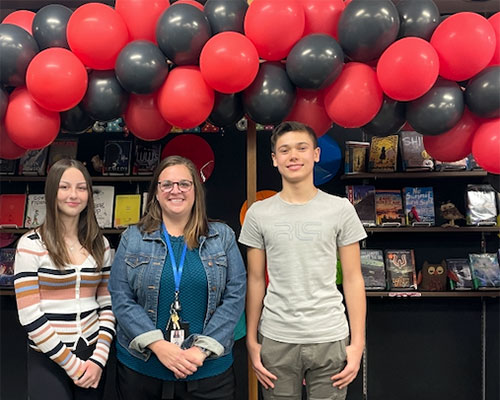
“Just the staff is something you won’t see anywhere else. They’re so dedicated. They’re so passionate. They’re so strong at what they do, and they care about the kids and how we’re doing,” she adds. “We continue to spike up academically, and we hit our highest scores in math, science and language arts just this past school year.”
NIU equipped her well, she says.
“Having finished my doctorate now, I’ve seen all types of school programs, and NIU was very authentic,” she says. “The courses were authentic. The visits and projects that we had were very realistic in what you need to do in this role, because sometimes a lot of the stuff you don’t learn in school – but you need to learn the skills to handle it, and I felt very prepared for that. The skills I learned at NIU prepared me to handle anything.”
MUCH OF AMY HOWERTON’S young days took place in DeKalb, where her grandparents lived and where her mother, Kathleen Prins, B.S.Ed. Elementary Education, ’72, grew up.
“I spent a lot of time in Huskie territory. My grandparents took me to the lagoon as a child, and so I have an affinity for NIU’s campus,” she says. “I’m glad that I ended up there to get my doctorate. It just felt like the right place.”
But her true hometown is Thomson, a tiny village in Carroll County known for watermelons and, since 2001, its much-talked-about prison.
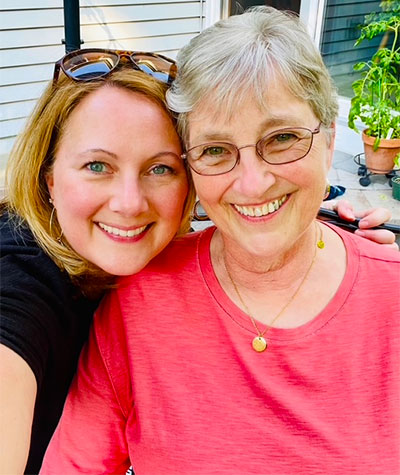
Thomson is also where Howerton’s mother taught elementary school for 30 years, “and I swore I would never become a teacher. But, of course, that is the family profession – and I love it. I can’t imagine doing anything else.”
First, though? Those journalism aspirations.
During high school, where she graduated in a class of 24, she was editor of the yearbook.
And, after earning her associate degree in journalism from Clinton Community College in Iowa, she advised the student publication.
She also worked at her hometown newspaper, the Carroll County Review: “It doesn’t really exist anymore, unfortunately, as many small-town newspapers don’t.”
But already missing, at that point, was something different.
“I loved it, but I quickly realized that the kind of life I wanted to lead, with a family and children, probably seemed to be a little bit in conflict,” she says. “I decided I wanted to teach. The adviser I had at the community college, Suzanne Hess, said, ‘You’d be a really good teacher.’ And I had kept fighting that urge. I’m like, ‘But my mom’s a teacher, and my whole family – they’re all teachers.’ And then I just went into teaching.”
Enrolling at Western Illinois University for her bachelor’s in secondary English education, Howerton started teaching high school English and, yes, journalism.
She also honored her roots, advising yearbook staffs at several schools before landing at Oswego High School in 2001.
Oswego 308’s two high schools support four thriving and award-winning student publications: two yearbooks and two news-oriented websites that combine multiple channels of digital communication.
 Her students perform well in statewide and national high school journalism competitions and envision themselves in the industry.
“They see the excitement in this work. I have two students in my classroom right now who have said, ‘This is what I want to do with my career.’ One of them really wants to be an investigative journalist because she sees the need to really dig for facts,” Howerton says.
“There is a passion for this within students,” she adds, “and part of that is exposure. If you expose students to something that taps into things that they have an interest in, they’ll run with it. You just have to offer them the opportunity to learn and to kind of play with their ideas. They often surprise me wonderful ways.”
Her own opportunity to chair her department required a master’s degree in educational leadership.
During that process, “I found that I really wanted to learn more about curriculum and how curriculum was designed in specific to assessment, because none of my other coursework really prepared me to understand how to build, create and effectively use assessment in the curricular framework. That’s what really drove me to want a doctorate.”
As she researched doctoral programs, she found colleagues doing the same.
“We all said, ‘Northern is the place to go,’ so we had a little cohort, and we all ended up in the same program, and we graduated at the same time, which was wonderful,” Howerton says. “It was really a fantastic, collegial experience. I had probably one of the best professional learning experiences I’ve ever had at Northern.”
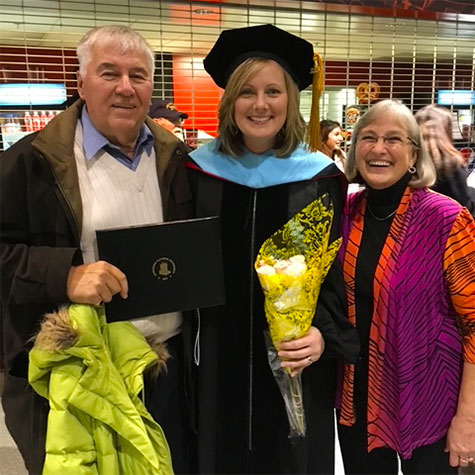
Howerton continues to collaborate with former NIU College of Education professor Beth Wilkins, who chaired her dissertation committee and remains a mentor.
She also partners with Oswego colleagues on curriculum matters, “so having that doctorate really supports my understanding of so many curricular structures, and it allows me to have a strong background in theory and pedagogy.”
“It allows me to have a deep wealth of information to pull from when people have questions about why we might do what we do, how we move forward and how we have curricular changes processes,” Howerton says. “Because of my doctorate from NIU, I feel very well versed and strong in my ability to lead those processes.”
The same goes for her classroom.
“Knowing more about curriculum and instruction, I understand individual lessons. I understand backward design,” she says. “I’m really glad I’m a teacher, because I do love it. I do.”
