
Nicholas Koronkiewicz was born and raised in Bolingbrook, the only place he’s called home.
Just coming to the cornfields of DeKalb as a transfer student in the Department of Computer Science supplied some stranger-in-a-strange-land sensations for suburban Koronkiewicz, who soon declared a new major in Elementary Education.
In all fairness, though, he had boarded an airplane for the first time at age 18, which was less than five years ago, and had never left the United States.
Until this summer, that is.
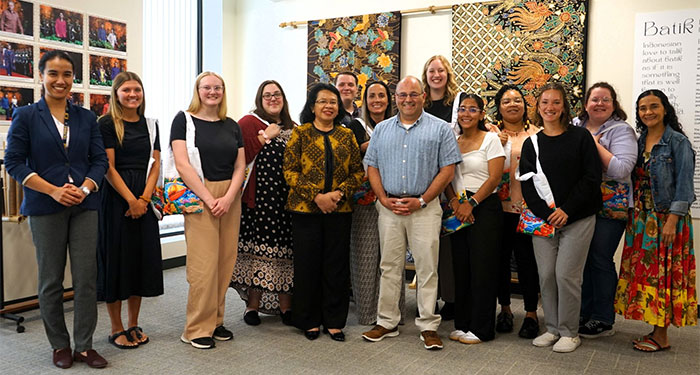
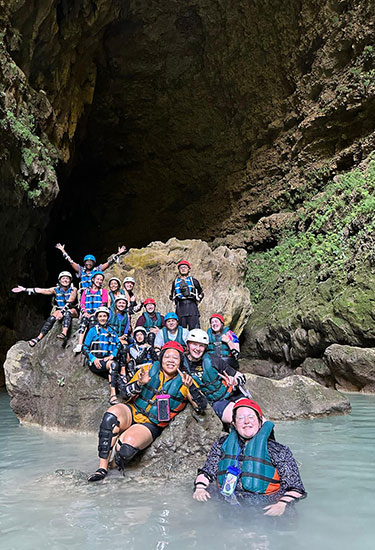
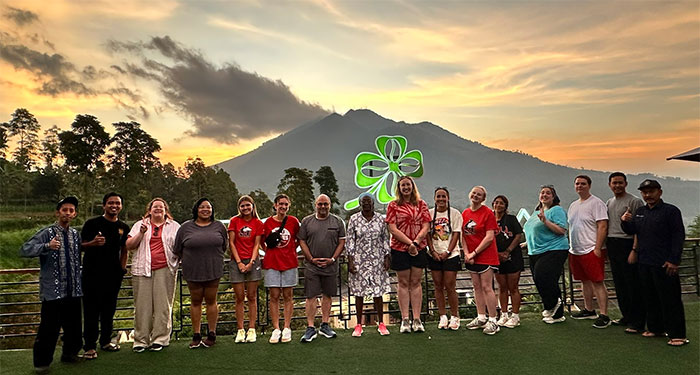
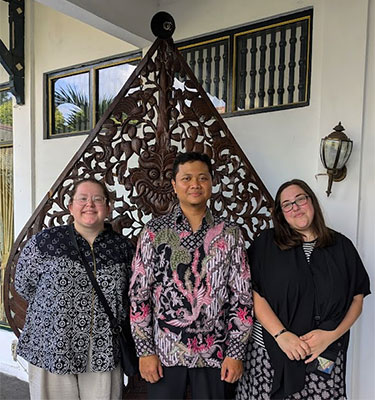
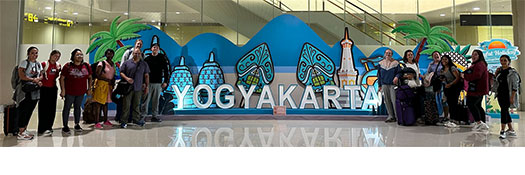
Koronkiewicz was among 10 NIU pre-service teachers who flew to Indonesia and gained unparalleled hands-on experience in teaching as a part of the College of Education’s Educate Global program.
And now, given his first taste of international travel and life abroad, Koronkiewicz is thinking about returning to Yogyakarta for work “with the kindest people in the world” after he graduates next May.
“I just fell in love with the students because they are so driven to learn. They want to learn. They listen. They want to do all these things because they want to be the best – and I want them to succeed as well,” says Koronkiewicz, who is student-teaching this fall at Brooks Elementary School in DeKalb.
“So I just fell in love with the country, the culture, the students, the teachers – just everything made me fall in love with it, and it made me really say, ‘Wow, this is something I could see myself doing in the future,’ ” he adds.
“Honestly, the culture shock was needed for me to progress as a human, to get out of my comfort zone. I really needed that different culture and that different lifestyle to find myself as a human being in this world. I got to realize that America is not the only place in this world.”
That’s exactly the point, says James Cohen, professor of ESL/Bilingual Education in the Department of Curriculum and Instruction.
“What I want students to get out of this is a deeper understanding of themselves as cultural beings. I’ve learned that the more I travel, the better I am able to understand myself,” Cohen says.
“Experiencing another culture with that different language, different beliefs, different food, different everything, and to learn what it feels like to essentially be the odd person out? The othered? They all talked about this from a positive sense,” he adds, “because when Americans go to Indonesia, we’re elevated. When immigrants come to the United States, they’re denigrated. They’re ‘othered.’ This gave our students an understanding of what it feels like to be put in a position that is not their normal status in quote-unquote society.”
Visiting foreign nations as that outsider or “othered” also fosters a powerful tool for educators, he says.
“Teachers need to be able to empathize with their students, and this absolutely moves them in that direction, especially with their multilingual learners – the students who are immigrants,” he says.
Cohen sees that empathy flourish and bear fruit in teachers who practice a “strengths model – a funds of knowledge perspective” while he says the opposite is often true for those who adopt a “deficits model.”
“In the deficit model, a student walks into your classroom, and you say, ‘Oh, man, you don’t speak English yet. You don’t have our culture. You don’t have our background. You’re going to be a nuisance for me.’ And, unfortunately, a lot of teachers view their immigrant students that way,” he says.
“With the strengths model or, as I like to say, the funds of knowledge perspective, it’s, ‘How can I tap into your background to make you feel comfortable and feel like you belong, not only with me but also in the whole classroom community, and that the whole classroom community is wanting to learn from you so that you feel you belong?’ That’s the difference.”
Following that approach makes it clear that immigrant students are members of the learning community, he adds, “and when you have that combination, the immigrant students want to go to class and want to learn. It’s black and white.”
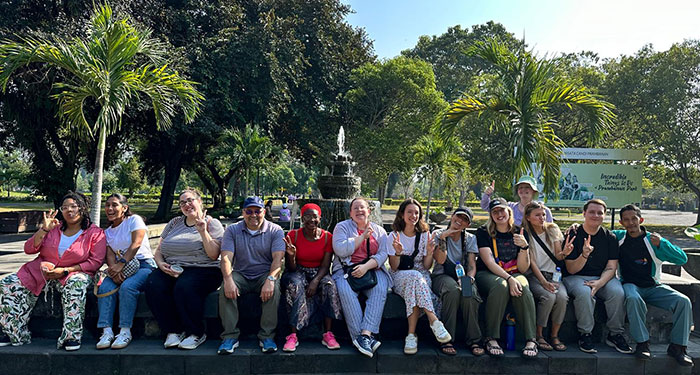
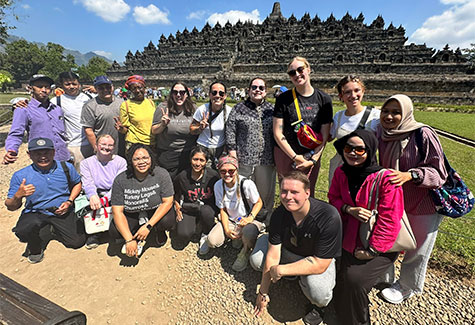
EDUCATE GLOBAL TRAVELERS departed July 11 and returned Aug. 5.
The students made the journey at no cost. Roundtrip airfare, housing and food all were paid thanks to the NIU Center for Southeast Asian Studies, the College of Education, the Morgridge Chair Office and the College of Liberal Arts and Sciences.
Huskies selected for the program taught five days a week – four to five hours each day – at the private Al Azhar Yogyakarta Islamic School, which enrolls local students of all ages, skill levels and socioeconomic statuses. NIU’s undergraduates were matched with Indonesian teachers who taught in the same grade level. With them, they co-planned and co-taught their respective grade levels: early childhood, elementary, middle level or high school.
Before leaving, they participated in three online sessions where they met and got to know their Indonesian co-teachers; gauged their English proficiency; learned of their expectations, academic interests and curricular needs; and began making plans for the three weeks of teaching in the country.
Their pre-departure preparation also involved five, three-hour meetings in DeKalb that covered trip logistics and provided an introduction to Indonesian language and culture as well as an orientation in pedagogy and perspectives.
Joining Koronkiewicz from the College of Education were fellow Elementary Education majors Carissa Bos, Keyla Bustamante, Inga Collin, Lydia Sciascia, Jenna Shlifka and Olivia Warren. Students from the College of Liberal Arts and Sciences were Jailynn Carter, Angelina Damiano and Jayne Hill.

Teresa Wasonga, an NIU Distinguished Engagement Professor in the Department of Leadership, Educational Administration and Foundations, accompanied the group along with Cohen and his wife, Lady.
Part of Wasonga’s role was to work with Al Azhar Yogyakarta Islamic School principals.
She asked them about their daily routines, their challenges and their questions on how to improve, quickly realizing that “they don’t have formal training to be a school leader. They are either identified as somebody who can work with other people and then are promoted to their job, or it’s one of those crisis situations where, ‘Oh, we need somebody, and it looks like you can do it.’ ”
Wasonga then prepared a workshop on topics covering “the things they really needed to know, plus examples of how those can be operationalized and done.”
Included in that were strategies for motivating and inspiring teachers as well as ideas on how to make a private, religious school attractive to families with educational choices. Her tips to stimulate staff promoted concepts of seeking their opinions; sharing in decision making; providing time and resources; and cultivating a climate where people feel needed and valued.
“I talked about how they can work with their teachers so the teachers can figure out what they can do in their classroom,” Wasonga says. “One of the things I said was, ‘If you don’t have happy teachers, you don’t have happy children, so you have to figure that out.’ ”
Cohen and Wasonga also observed the Huskies in the classroom and met with them individually afterward. They also held regular group debriefings.
“We say that ‘experience is the best teacher,’ and that’s true to a degree, but without reflection, that experience is just another experience,” Cohen says.
“Several of the students commented that, for the first time in their lives, they found their teaching voice. They felt comfortable being a teacher in a classroom, and to me, that’s huge,” he adds. “One student hadn’t had any clinicals yet – she had lots of teaching experience in early childhood programs outside of the College of Ed, but she didn’t have any official clinicals yet – and now she’s going to go into her first clinical with, ‘OK, I’ve done this. I know what I’m doing. I have confidence in myself.’ ”
 Elementary Education major Carisa Bos demonstrated how well she is harnessing her NIU preparation, Cohen says.
“You could tell she took the ESL endorsement classes because her lessons were so hyper-structured. As I was observing her, I could totally see how her brain was working and how she was thinking. ‘I want to do this first, and then this,’ and then all the scaffolding that she put into place. Everything was just so perfectly executed,” he says.
“And I sat back and thought, ‘Oh, it’s a work of art.’ It was just beautiful to watch her teach,” he adds. “I could not have been more pleased with this group of NIU teachers.”
Meanwhile, Wasonga says, the hands-on practice in Indonesia provided a different level of authenticity than many clinicals in the United States: Some cooperating teachers here are “reluctant to give their classes over,” she says, worried that progress or accountability might derail.
“These Indonesian teachers didn’t have anything like that, so they were flexible,” Wasonga says, “and that allowed our students to actually make mistakes, correct their mistakes, learn from their mistakes and, therefore, really build confidence in themselves. They were in a situation where they were accepted and looked up to, and I think that really helped.”
LYDIA SCIASCIA GREW UP in Huntley, where she eventually proved mom and dad wrong about the career choice she announced as a young child.
“I’ve always wanted to be a teacher, ever since I was little,” Sciascia says. “At first, my parents were like, ‘Oh, that’s just the little kid. They only see their teacher, and so they say they want to be a teacher.’ ”
Ever the mindful daughter, she initially heeded those words, exploring a path in psychology.
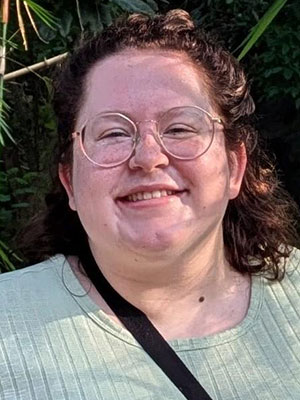
“But then I got a babysitting gig for one of my teacher’s friends, and it just made me realize how much I loved being face to face with the kids. At that point, it was just playing with them, but it really sparked my want to be a teacher again,” she says. “I took a couple of teaching classes at McHenry County College, and then I got a job at a daycare, and it just cemented that this is what I want do with the rest of my life – and that’s what I’m trying to do.”
Good choice.
“She is an absolutely amazing teacher,” Cohen says. “If I had a middle school teacher like her who taught math, I just might have gone into a different profession.”
Sciascia is proud of her professor’s glowing assessment.
“It’s something that I’ve been wracking my brain over since I got back because one of the things he said during my observation was that it felt like I had been teaching for a really long time, and the only way I can think about it is that I took the idea of what’s called ‘gradual release’ to heart,” she says.
“As a kid, I knew that just get lectured at was not very helpful,” she adds. “Instead, I like to explain everything on the board, ask the kids for questions, put up some example questions like the ones we did on the board and then go around the room to help. I try my best to not be completely lecturing.”
She appreciated the on-the-spot assistance and feedback from Cohen and Wasonga.
“They were always willing to look at our lesson plans beforehand, and it felt like they were always there for you to ask questions,” Sciascia says.
“On observation day, they would come into your classroom and write down different notes about how often you would interact with the class, how you interacted with boys versus girls – were you unconsciously biased toward one gender over the other? – and how clear you were in your topics,” she adds. “Once we got back to the hotel, they would sit down with you and give you ways to improve, ask for your feedback and how it felt observed.”
How valuable was that constructive criticism?
“Insanely valuable. You can always go somewhere, do something and have that experience and say, ‘Oh, well, I did that. That’s cool,’ ” she says.
“But to have the opportunity to get that outside point of view of how you’re affecting a classroom, or just a social situation, is so important. You can realize how you affect the world, and it shows, ‘Yes, you’ve learned these strategies in classes, but can you actually utilize them in the times when it’s most important?’ ”
Language obstacles provided learning opportunities that Sciascia expects will benefit her at home.
For example, she says, maybe she needs to talk slower. Maybe she needs some more patience. Maybe she needs to sit down with students to explain concepts.
“I tend to get really excited and/or nervous, and that kind of turns into a snowball of just going really fast. I need to take a moment during the class to just take a breath, see where the kids are then slow myself down,” she says.
“I think it’s going to help because I assume that there will always be language barriers, whether that’s the language I use due to my vocabulary or whether there are students who primarily speak another language at home,” she adds. “It gave me a kickstart to what an average classroom will be like in America. You might have more Spanish speakers, or more Korean or Japanese or Hindi speakers, depending on where you are in the U.S.”
KORONKIEWICZ ALSO IS FOLLOWING what seems like a predestined path.
“My entire life, I’ve grown up around teachers,” says the transfer from Joliet Junior College. “My mom was a paraprofessional and teacher’s aide my enter life. My aunt’s a teacher. My sister’s best friend is a teacher. I’m surrounded by them. I can’t escape. It was bound to happen.”
Teaching English at Al Azhar Yogyakarta Islamic School confirmed his direction. His students seemed advanced in their studies, he says, and eager to show their stuff.
“I wanted to see how their writing was, and their writing was phenomenal, so I challenged them. I introduced them to an autobiography unit, and they wrote their own autobiographies,” says Koronkiewicz, adding that those works eventually were displayed in a learning center for a family night. “I thought that was pretty cool to think that a project I did was going to be something the parents see.”
He also appreciated Cohen’s requirement of “dialogue journals.”
“Basically, it was just letters with you to each individual student, so they would get their notebook, and then they would write something to you. Then you would read it, and you’d write something back, and it was back and forth for the three weeks,” Koronkiewicz says.
 “You really got to know the students on a different level, whether it’s personally or academically. You got to learn a lot about them,” he adds. “I would try my best to meet their needs so that we could have that conversation. I could make those connections.”
And it’s already in helping in DeKalb: “I’m starting to learn a lot about myself as a teacher,” he says.
“One of my students in my clinical – his parents are deaf – knows a lot of sign language, but he’s not deaf himself. And DeKalb is doing an incredible job because they are pushing the students to learn more sign language,” he adds.
“So now being able to connect to students more, I try my best in every way to learn a little bit more about each student in the sense of, ‘Oh, this student loves to play basketball,’ or, ‘This student loves shoes,’ and finding ways to connect it. When we were doing sign language, I had the student whose parents are deaf come up, and I said, ‘Hey, we’re going to do this together. You’re going to teach them a little bit of sign language because I know that you are very good at this.’ ”
Results like that are only one of many benefits of Educate Global, Sciascia says.
“It’s a great way to truly see who you are as both a teacher under pressure but also a person in the world,” Sciascia says. “You can think you would be great in a different situation, and you can think all these things about yourself in a pressurized situation, but until you’re in that situation, you have no idea how you’ll react. This is a great way to for people to see whether they’re the person they want to be or if they need to change.”