

When NIU faculty have technical questions about Blackboard, they often turn to the Center for Innovative Teaching and Learning (CITL).
And when NIU students have technical questions about Blackboard, they turn to … well, typically, the faculty who are requiring them to use it and who might not know how to respond.
Enter Jen Sacenti.
Sacenti, who earned her M.S.Ed. in Instructional Technology in December, designed an online training module for students to learn how to use Blackboard, NIU’s learning management system.
Her work took place during an internship supervised by Diane Alberts, CITL’s associate director for Operations and Administrative Support, as well as Stephanie Richter, director of Teaching Excellence and Support.
“The module is needed because a lot of students are jumping into courses, and they don’t know how to use the tools to manage their assignments and to manage messaging between themselves and their instructors,” says Sacenti, now a double-alumna of the Department of Educational Technology, Research and Assessment.
“I worked with Diane, Stephanie and others in CITL and created an outline, and we really thought about who needed to access the platform and where it was accessible,” she adds. “It needed to be accessible outside of Blackboard, ironically enough, so that they could look at before they got into Blackboard.”

“Course schedules are jam-packed with content; it doesn’t make sense for faculty to devote valuable time to teach students to use Blackboard,” Richter says. “CITL already provides resources for students about Blackboard that faculty can share with their students, and this module takes that to the next level.”
“In working with Jen, we came up with the idea to provide a self-study Blackboard orientation for students. We wanted to chunk it into meaningful steps, and give students the option to go through the entire course or select a specific topic. For example, if they only need to know how to submit an assignment in Blackboard, they can focus just on how to complete that task,” Alberts adds.
WORKING MOSTLY REMOTELY from Yorkville, and conducting her internship hours mainly nights and weekends to accommodate her full-time job as a project manager for Northwestern Medicine, Sacenti served as the primary instructional designer for the module, with Alberts serving as project manager and Richter as subject matter expert and providing review and approval.
Sacenti first prepared an outline of topics and learning objectives. After these had been approved by Richter, she identified existing resources as well as gaps in resources that might necessitate new videos. She storyboarded webpages for each topic and drafted scripts for any new videos that the course would require.
Graduation in December ended the internship, however, so Sacenti turned in the completed design assets, including design document, storyboards and video scripts. CITL will continue the work to develop and publish the module.
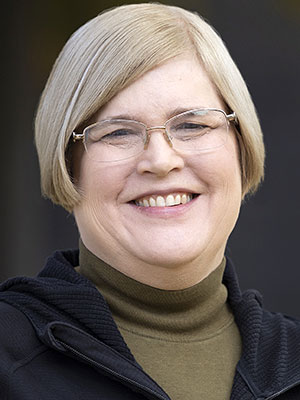
“Jen has done all the groundwork. She has done all the design work. She has written the scripts. She brought of lot of knowledge from her experience and expertise in corporate,” Alberts says.
“Because she was doing a lot of her work in the evenings and the weekends, she had to be self-motivated. She had to be self-directed. She had to be able to take initiative and to understand when she needed to reach out for help. Jen has positioned us very well to get this completed this spring.”
The internship included the then-master’s student maintaining a weekly reflection journal that Alberts could read to track the work and to know “when I needed to plug in. It was a great collaborative effort.”
SACENTI AGREES.
“I was extremely blessed to land this internship because Diane was just so collaborative and kind, and her leadership skills are phenomenal. Everybody I worked with was so helpful and I grew in the way that I learned things, which is what I wanted to do,” Sacenti says. “I could have taken the easy route and taken an internship with what I already knew, but that’s not what I wanted.”
No kidding.
Part of her ambition as a health care professional focuses on corporate education and organizing, aligning and understanding emerging technologies with integrated initiatives.
She also aspires to become an adjunct professor to teach “the next generation” and, toward that end, taught a course at NIU last semester.
“I really enjoyed that,” Sacenti says, “and I’m hopefully going to continue to grow in that way and join the force as an adjunct as soon as I have a little time for the dust to settle in my chaotic schedule.”
 Her path toward that outcome began at Waubonsee Community College, where in 2006 she earned her Associate of Applied Science degree in Administrative Systems. She already was part of the workforce by that point, starting in 2000 at Aurora-based Advocate Dreyer Medical Clinic as a team lead in Health Information Management.
Twenty-one years later, she completed NIU’s B.S. in Applied Management-Instructional Technology, Training and Evaluation; staying connected with Academic Program Advisor Judy Puskar prompted her return.
“NIU’s program is phenomenal – I always tell everybody – and the environment (Go Huskies!) is just great,” Sacenti says. “Judy and I stayed in touch, and I always had a goal of completing my graduate degree, so she encouraged me to apply and get back in. I did, and I’m very grateful and thankful.”
