
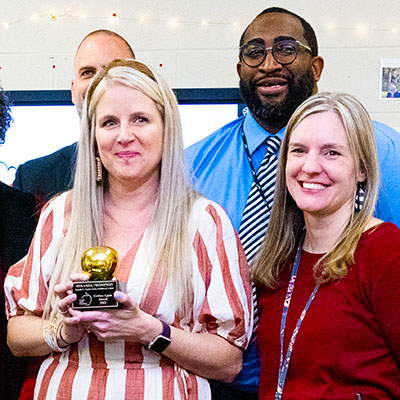
Erin Anderson had witnessed a Golden Apple surprise before.
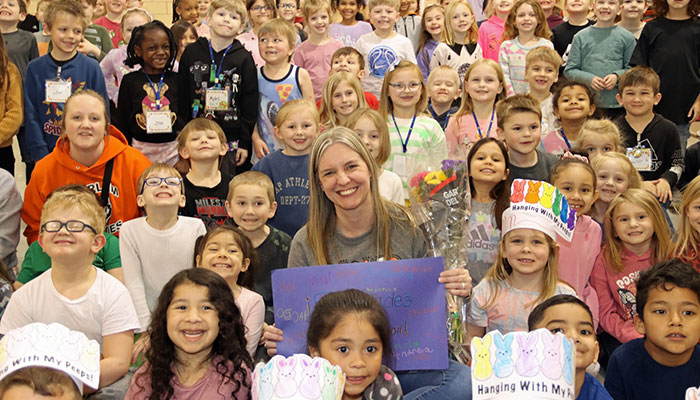
March 16, 2023. An entourage of well-wishers had come to Harlem School District 122’s Donald C. Parker Early Education Center, where Anderson serves as principal.
They huddled near her office, waiting to congratulate kindergarten teacher and fellow NIU College of Education alumna Miranda Thompson. Among them were Thompson’s family, representatives of the local media and members of the organization that recognizes educators and empowers them with classroom resources to improve academic outcomes in the community.
One year later – March 25, 2024 – brought Anderson’s turn. This time, the group in anxious hiding included her husband, Mark; her stepdaughter, Relena, now 24; and her sons Tristan, now 16, and Wyatt, now 12.
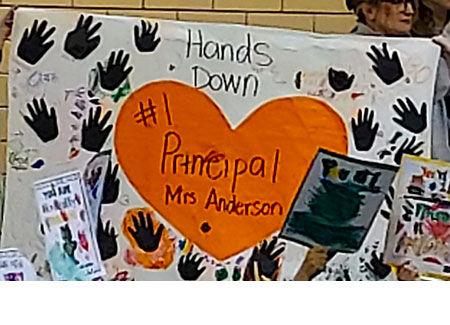
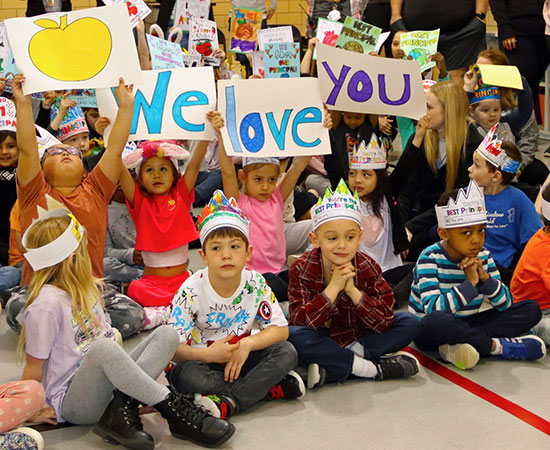
“I can’t figure out how an entire building of 3-, 4- and 5-year-olds kept this a secret. I literally did not have any idea about it,” says Anderson, who that day was honored as the 2024 Golden Apple Outstanding Principal. “My husband hadn’t even told my kids, who were a ninth-grader and a sixth-grader at the time, because he was like, ‘They’ll tell her.’ But these 3-, 4- and 5-year-olds? They all kept it a secret. I think I was in shock the rest of the day.”
For Anderson, who earned her NIU B.S.Ed. in Elementary Education in 2003, the real, and lasting, joy of that moment came after the visitors left.
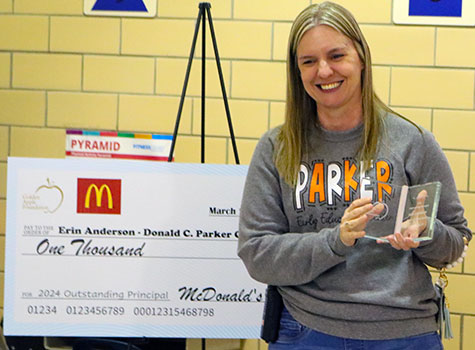
She read the nomination materials written by the Donald C. Parker team.
“We had a couple of hard years together, navigating through COVID and then the after-effects of COVID, and even when things were kind of back to normal, most of our supplies were still stuck in a storage shed,” she says. “It’s only been the last couple of years that we’ve been able to bring back all of our play items and get back to some pre-COVID things, and it was great to hear from the staff that they appreciated this and that they felt we had really built this community together.”
Anderson’s journey at the Parker Center actually began during the tempests of the pandemic.
Beginning her new role July 1, 2020, and coming from Crystal Lake Consolidated School District 47 two counties to the east, she faced heightened uncertainty.
Would school open in the fall? If so, what would it look like?
“That was an interesting experience because I hadn’t been here. I didn’t know all of the staff here, and I’ve having to make decisions about how the children had sat at tables and they shared supplies and now they need to sit in desks and they need to sit as far away as possible,” she says.
 “A lot of it was relying on the staff I did know in the building and asking them a lot of questions; just talking to people, listening to people and figuring out what was going to work,” she adds. “At one point, instead of actual desks, we were talking about lap desks for students sitting on the carpet, and then we kind of problem-solved through all of that. We really had to flip everything that we knew was best practice for 3-, 4- and 5-year-olds, and then help the staff to understand that this is what need to do to keep students safe.”
SUCCESS CAME BUT WITH CHALLENGES along for the ride.
Remote options were offered that fall, something that abruptly shifted some reading specialists and Multi-Tiered System of Supports facilitators into new roles as online kindergarten teachers so that learning could continue.
Meanwhile, Anderson worried about how to make the at-home children feel included in school spirit events, such as dress-up days.
And, when operations eventually and finally returned to a full-time, in-person basis, “we had the joy of being the first school in the district that had a mini-COVID outbreak. I don’t think we were even a full two weeks into school yet when 12 of our classrooms got shut down and we had to go virtual.”

Yet “I think that trying to manage all of these things helped in a way, because if we could do that, we could get through anything.”
“Coming in at that point was a big learning curve but a great opportunity to kind of dig in with the staff and figure out, ‘OK, these are the things we need to do to keep everybody safe and are still going to give our kids somewhat of a kindergarten or preschool experience,’ ” Anderson says. “Being my first year as a building principal, it was a lot of learning on the fly and just figuring it out, trying to support parents and staff and students as best we could.”
People noticed.
Words from her Golden Apple nomination praise her “true leadership” to “boost morale and restore trust and respect,” and her commitment to “really getting to know the teachers, both personally and professionally.”
- “Erin understands how important play is to a kindergarten student and has incorporated more play time back into our days.”
- “She has been known to sit on the rugs with students having bad days, using building blocks and talking with them.”
- “She turned around the school environment, which is now described as positive, fun, creative and safe for risk-taking.
- “She encourages teachers to have work-life balance, boundaries and self-care. She trusts them to make their own decisions and is present for all staff and students.”
- “Teachers feel heard and supported as she uses ideas and needs shared in these conversations to drive staff meetings and school improvement days. The collaboration has led to increased student achievement.”
“I think I do a really good job of listening to staff. They know that they can come in, whether it is a little concern or a big concern, and that my door is open,” Anderson says.
“We can brainstorm, and we can problem-solve through it together, and they know that I’m not necessarily going to solve it for them. I might just be an ear for them. Half the time, I don’t even have to say anything. They just come in, they talk through it and they’re like, ‘Thanks.’ And then they leave,” she adds.
“Sometimes, it’s just like, ‘Hey, this is what I’m thinking. This is what I need to do.’ – and I think that’s super important because they are all professionals. They all have gone to school. They all have degrees. They all have worked really hard in their field – many of them for more years than I have done it – so it’s important that they know that their opinion matters and that they do have someone they can talk to.”
GROWING UP IN ROCKFORD, Anderson always knew her destination in life.
“I don’t remember ever wanting to be anything else than a teacher. That was just my dream,” she says. “I had some really great elementary school teachers who just made it look fun and enjoyable, and so I was the weird kid playing school with my stuffed animals that would all sit in their row of desks.”
Following graduation from East High School, she enrolled in the NIU College of Education.

Courses in children’s literature struck a chord with the avid reader who was thrilled to learn how to choose good books for students and how to engage them with the words on the pages.
“That’s something that, in every single one of my roles, I’ve been able to carry with me,” she says. “Even though I’m not in the classroom anymore, I can still come in and do read-alouds, and I can support my teachers in purchasing books that are going to be exciting.”
She also appreciated encouragement from NIU faculty to earn additional certificates and endorsements, such as the middle-school approval that she never thought she’d use – until her first job proved differently.
“When I graduated, I started teaching eighth-grade in the Belvidere School District,” she says, “and in my first three years that I taught, I taught at the middle school – sixth- and eighth-grade language arts and social studies.”
Next? The Harlem School District, where she taught first- and second-grades and was a professional development specialist.
Each stop confirmed for Anderson why she loves teaching.
“It’s really just those moments when either you’ve built that really strong relationship with the child, and you can see on their face that they’re excited to see you,” she says, “and then that lightbulb moment, when you have been going over something, and going over it and going over it, and it finally clicks for them – and then just that look on their face of, ‘I can do this. I’m smart. I can learn,’ is really, really cool.”
Combining that variety of situations, along with the NIU preparation that encompassed more than just elementary education, provides “a really wide perspective.”
“My students right now in my building are preschool and kindergarten, but I have that first- and second-grade experience – knowing where they’re going – and understanding the bigger picture, too, because I spent some time in the middle school,” she says. “I appreciate that my NIU degree allowed me to do so many different things, which I think has helped me in the principal role.”
PONDERING HER TRAVELS to this destination makes Anderson laugh.
“It’s actually kind of funny because I never wanted to be a principal,” she says.
“When I was teaching in Belvidere, they had a cohort on site for a master’s degree, and it was the administration degree, and I was like, ‘Well, I just want to move over on the pay scale. I am 22 years old, and I’ve no desire to use this, but this will get me more money,’ ” she adds.
“Then, I didn’t even take the Type 75 test until five years after finishing my principal degree because I was like, ‘Why do I need to take this test? I’m not going to use it.’ ”
But something unexpected happened.
Anderson began getting leadership roles in her building, “and I realized that I liked the piece of it, but I still didn’t think I wanted to be a principal.”
She went instead to Crystal Lake, where she became the district’s director of Literacy and Social Studies “because curriculum has always been something that’s really important to me, and so I thought I would be able to make a big impact.”
“What I learned really quickly is that I can’t not work closely to the students,” she says. “You’re in the district office, and you can go see students any time you want, but it’s not as easy as walking out of my office, and there are kids in the hallway, or going two doors down and there’s a classroom full of kids I can see.”
Her new awareness fueled her next, and still most recent, move.
“A friend of mine who worked in Harlem gave me a call and said, ‘Hey, we’re going to have this opening. Do you know anybody who might want to apply?’ And I was like, ‘Maybe I do.’ That’s how all of this happened. I do like the leadership aspect, and I love working with adults, too, but I still need to have the kids. I can’t remove myself to the district-level office.”
Naturally, considering her two decades of ambition and mindset of growth, Anderson is committed to pushing her school to greater heights.
“One of the big goals we’ve been working on right now is making sure that all of our students feel included. We are becoming increasingly diverse in our building,” Anderson says.
“We’re making sure that our toys – we have developmental play time in all of our preschool and kindergarten classrooms – represent our students. Do we have multicultural food items? Do we have dolls of different races?”
 Meanwhile, “being the only kindergarten building in the district, we have all of the self-contained programs. Do we have books that represent different abilities?”
Part of this is “talking with students about their friends who might be in wheelchairs or their friends who might have visual impairments,” she says, “having those conversations with students so that they understand, ‘Just because they have a different ability than I do doesn’t make them any less than I am.’ ”
Her reasoning is multifaceted.
“This is our students’ first experience coming to school. We want them to love it. We want them to feel that they belong, that they’re important and that we care for them – and we want the families to know that, too. It does not matter your background,” Anderson says.
“Building that love of learning helps families feel comfortable with the school district and feel supported within the school district,” she adds. “It sets their whole school trajectory, and that’s super important to me – just making sure that we have that good first step.”