
Networking, anyone?
When Department of Educational Technology, Research and Assessment colleagues Cansu Tatar and Michael Tscholl were measuring how well students at DeKalb’s St. Mary Catholic School understood artificial intelligence, they also met the teachers.
And when one of those teachers took a new job last fall, joining the faculty of Marmion Academy in Aurora, that connection opened a new avenue for Tatar.
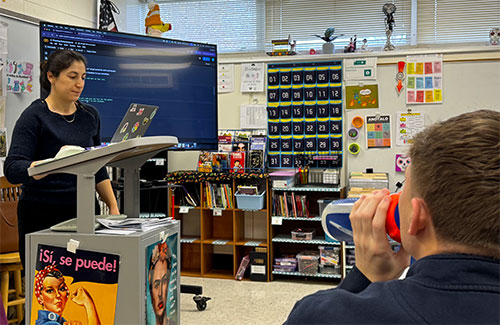
“Thanks to her, we were able to communicate with the Marmion school principal and met with the curriculum team,” says Tatar, an assistant professor. “We presented our ideas there and presented what the curriculum was going to look like, and they arranged the course.”
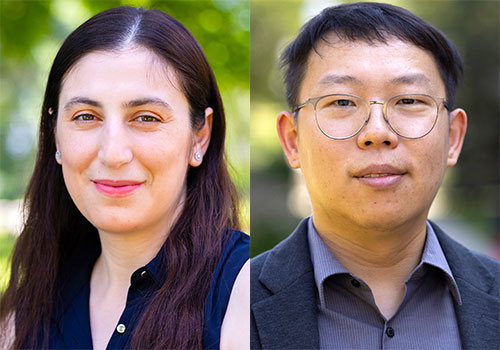
Collaborating with Lei Zhang, an assistant professor in the NIU Department of Computer Science, the result is Secure-AI Project: Empowering High School Students’ Artificial Intelligence and Cybersecurity Literacy.
Designed for long-term sustainability, Secure-AI empowers teachers by partnering to shape lessons, adapting activities to their classrooms and sharing feedback that directly improves materials.
Meanwhile, Tatar and Zheng say, the project “intentionally connects learning activities to STEM career pathways, helping students see themselves as potential contributors rather than just users of technology.”
Such preparation equips students to question AI outputs; recognize bias and misuse; protect their digital identities; and make ethical decisions as future workers, consumers and citizens.
“High school students are being exposed to AI through social media, recommendation systems, image generators and automatic decision-making tools,” Tatar says. “These tools are also bringing up an important conversation on how their data is securely stored in this web-based application and how their data is exposed to algorithms to train the AI models.”
Questions now exist “about privacy, security and the ethical concerns as well,” she adds, “so we want them to understand that AI is not a ‘black box.’ We want them to understand what is behind this technology. We want them to understand how AI actually works, and how they can make their data more secure.”
 Zheng shares Tatar’s urgency – and optimism.
“I have a hope that we can foster the next generation of AI researchers because people in every field are using AI and machine-learning,” Zheng says.
“When I was a Ph.D. student several years ago, I actually started having experiences in mentoring high school students when I was at Virginia Tech,” he adds. “I mentored several very talented students at Thomas Jefferson High School for Science and Technology – one of the best, if not the best, high school for STEM education – and, in recent years, I have noticed high school students submitting papers to conferences, and those papers are being accepted.”
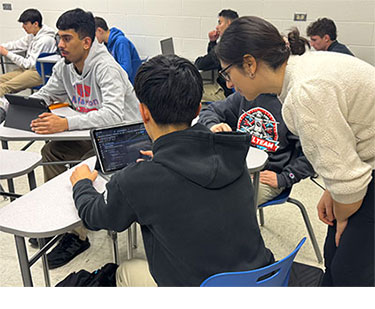
Tatar and Zheng are delivering their curriculum in a six-module, project-based sequence.
- “Paradigms in AI” – code-level introduction to AI logic.
- “Machine Learning from Scratch” – programming simple machine learning models.
- “The Hidden World of Cybersecurity” – coding for security and understanding encryption
- “Networks, Firewalls and Digital Defense” – simulating digital communication and protection mechanisms.
- “AI Ethics, Adversarial Attacks and Defense” – coding the vulnerabilities of AI systems.
- Capstone project: “Build Your Own Secure AI.”
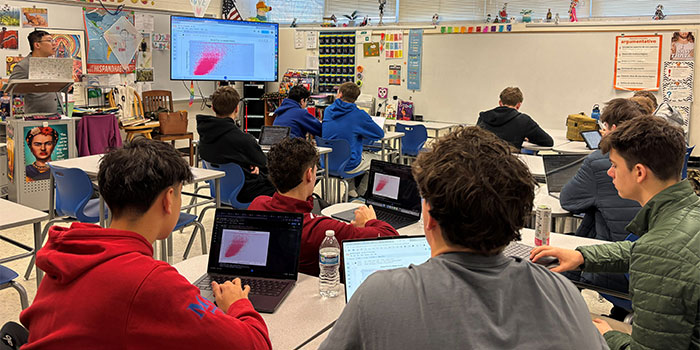
Students begin by learning how AI systems work at the code level, including data, algorithms and machine learning fundamentals. Next, they explore cybersecurity concepts such as encryption, digital identity, networks and system protection.
Across modules, students examine how AI systems can fail, have bias or succumb to attack, and how technical design choices relate to ethics and security.
The NIU professors fielded many questions from the students at Marmion, a Catholic-Benedictine college preparatory school for young men and women founded in 1933 and guided by the Benedictine monks.
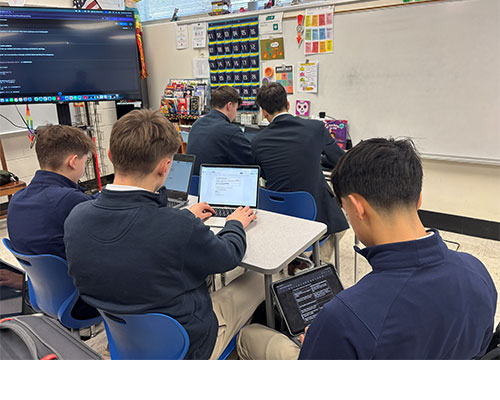 Some asked how many lines of code are needed to implement commercial-level products, such as ChatGPT. Others wondered about Gemini, Google’s AI assistant.
“One of the questions was about if the government is hiring ‘national attackers,’ like hackers, to safely secure information,” Tatar says. “I thought that was very interesting.”
Next on their agenda is presenting the curriculum at international conferences, publishing in prestigious journals and preparing for a repeat performance.
“We are going to work on improving some of the content because Marmion Academy wants us to come back in the fall semester,” Tatar says, “so we might just go and do a second round with a different group of students.”
