

Funny how one unexpected moment can change everything.
Or, in the case of David Walker, a series of spontaneity – or, as he calls it, just dumb luck.
The College of Education’s associate dean for Academic Affairs hails from Crosby, Minnesota, a tiny town in the east-central regions of the Land of 10,000 Lakes.
“My dad was principal of the school. That’s how we ended up there,” Walker says. “At the time I grew up in the late ’70s, early ’80s, it was in one of the poorest counties in the state, and I think that informed me as a young adult. It’s quite a diverse place. We had a number of first-generation kids from the former Yugoslavia and Czechoslovakia as well as Native American students in our school. It was right next to the Mille Lacs Lake Indian Reservation.”
Being the son of Principal William Walker meant “it was pretty much understood – you go to college,” he adds, “and I was an active kid academically, athletically, outdoors, student government and things of that nature. I had a pretty good background in education.”
When his older brother enrolled at the University of Minnesota Duluth, Walker planned to follow. “Duluth wasn’t too far away. It’s the big town up there,” he says, “and I actually got in.”
Now for that plot twist; well, the first one, anyway.
During the summer between his junior and senior years of high school, Walker attended Boys State in Minnesota at Gustavus Adolphus College.
 “I was nominated by the American Legion, which my father belonged to,” he says. “I had a good week and learned about civics and democracy.”
One day that fall, he was called out of class to the principal’s office. His dad’s office.
“And, of course, all the kids were like, ‘Oh, now you’re in trouble with the Big Cheese,’ ” Walker says. “But it was my counselor from Boys State, who also was an admissions counselor at St. Olaf College, which I’d never heard of, and he wanted to talk to me. I went home with an application, applied and ended up going to school there.”
Choosing St. Olaf over Duluth “was probably one of the best by-chance decisions ever made in my life. Some guy I spent a week with thought I could make it at a pretty selective, private liberal arts school. That set me on a great academic course.”
Quickly, though, Walker realized his decision came with consequences.
“The things I learned in elementary school and junior high school and high school gave me enough of a base to compete academically at a place like St. Olaf,” he says, “but the first year-plus was pretty rough, learning how to digest great works of literature, and write papers, and argue your point – things that I didn’t do a lot of in high school. We didn’t have any AP courses.”
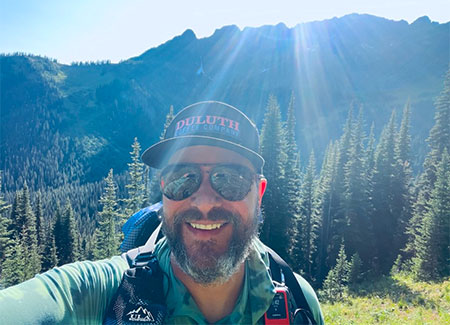
Yet Walker did succeed, of course, and nearly four decades later, his 27-year career in higher education is coming to a close: The professor in the Department of Educational Technology, Research and Assessment will retire June 30.
“I really did enjoy, so much, teaching statistics. I say I’m a very lucky person. I’ve been put on the planet to do this, and I know it, and I hope the students enjoyed it,” Walker says.
“Statistics is not easy, and it was really cool to see some apprehensive students come into their own and be masters of their craft by the end of 16 weeks,” he adds.
“Early in my career, instead of having people come up one after another to do a presentation, we did more of a conference style where they presented their poster on a research project and showed their skillset. That was always so rewarding to hear students stand on their own and really speak as experts on their topic of interest, using some statistical techniques they had learned in my class. I’ll certainly miss the students. That was just a blast.”
WALKER CAME TO NIU in 2003 thanks to a professional connection.
Christine Sorensen was not only dean of the College of Education then but also a classmate of Walker’s from graduate school at Iowa State University.
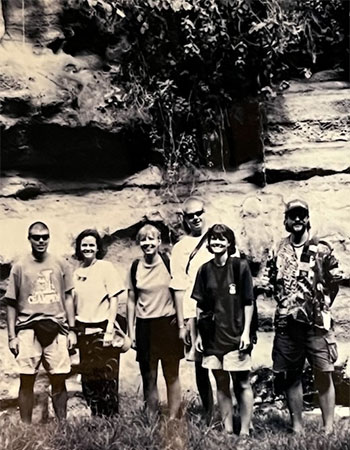
“My wife and I, we had started our family, and we wanted to get back to the Midwest,” he says, “so I gave it a shot.”
Back to the Midwest?
He was working at Florida Atlantic University, where he’d gone mainly to meet and work with an idol of sorts.
“There was a statistics guy there who helped create a statistical technique called ‘bootstrapping,’ and I wanted to learn under him. I was a bit of a fanboy; he only knew this after they hired me,” Walker says with a laugh, “so I went down to Boca Raton and was very nervous, but I learned so much: how to be a young professor. How to do research. How to teach pretty high-end stat classes. How to mentor on a dissertation or thesis. All the things that helped me later in my career.”
Statistics had become Walker’s passion in another of life’s curveballs.
At St. Olaf, he completed a triple-major in history, political science and Russian studies with a minor in Asian studies.
“My dad’s family was from Russia and came to this country in the early 1900s, settling in South Dakota,” he says, “and I’d always been interested in history, really took to it in high school and was pretty good at it. A lot of American history is what I got, and some world history.”
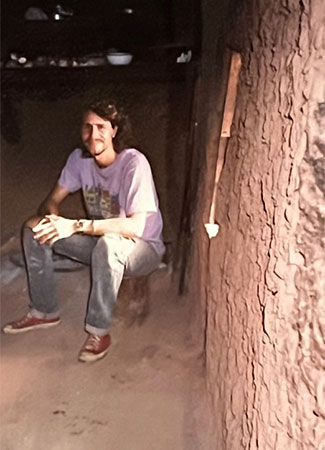
Political science stoked his curiosity during that week at Boys State and its lessons on civility, democracy, citizenship and more.
“I took some of those courses right away as a first-semester freshman. I remember reading de Tocqueville’s ‘Democracy in America’ – no clue who he was, what this book was about, hard to understand for me as an 18-year-old – and kind of fell in love with it and wrote papers on it,” he says.
Good professors “made things pop and come to life and piqued my interest,” he adds. “I enjoyed reading books that I had never heard of, or maybe kind of heard of, but never read, and then writing papers, or attempting to write papers, and articulating my viewpoint.”
Meanwhile, a senior-year Study Abroad trip to what was then the Soviet Union delivered another of the many life-altering meetings that have defined Walker’s life.
His major in Russian studies, and his own family heritage, was what made the trip intriguing. The person he met in the St. Olaf group was more.
“I met my wife,” Walker says. “She was a couple years younger than I was – I believe she was a sophomore – and, again, just by happenstance, things came together.”
Jill Franke and Walker began dating, and even though he’d taken the LSAT and was admitted to the Drake University Law School, “I figured that moving from Minnesota down to central Iowa wasn’t probably in my best interest, and I didn’t want to be a lawyer anyway.”
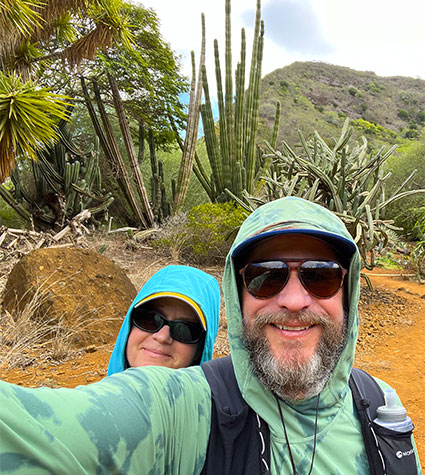
“So, I didn’t go to law school,” he says. “I just hung out quite a bit, worked in Minneapolis and waited for her to graduate. I went to rock ’n’ roll shows with my sister, who also lived there at the time.”
Once married, Walker and Franke joined the Peace Corps.
“St. Olaf in the ’80s, ’90s and probably into the early 2000s was one of the premier Division III, small, private liberal starts school producers of Peace Corps volunteers, so it was all around me,” he says. “The first time I heard about it was when I was a freshman in college, and so it was in the back of my mind – but I didn’t really act on it.”
When he told Franke about that notion, however, she had a surprise for her boyfriend. She shared his intrigue, and they applied. “It took nearly a year to get in,” he says.
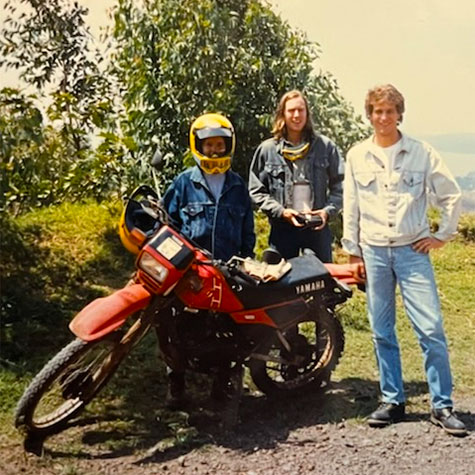
Their first 30-month stint transported them to Zaire, now the Democratic Republic of Congo, was from 1989 to 1991. Their second appointment took place in Mauritania for another 30 months from 1992 to 1994.
Projects involved water and sanitation.
“There was no running water there, so we built gravity-flow systems where you catch rainwater off your tin or thatched roof and store it in cement cisterns,” Walker says. “We dug some wells. We did some work building ventilated, improved pit-latrines. We did a lot of education surrounding these projects. It’s one thing to help build a system well, or a pit latrine, and it’s another thing to have education with it.”
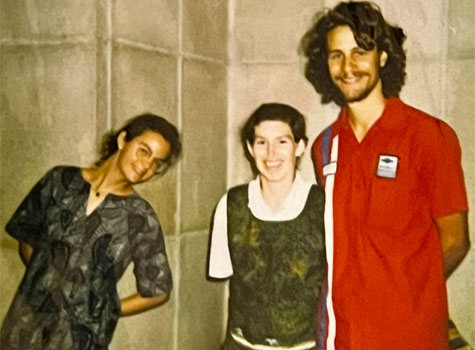
Living with village families in their mud huts, and functioning in their local languages and dialects, gave the young couple an incomparable glimpse of the world and the rich and diverse culture far beyond Minnesota and the Chicago suburbs where Franke grew up.
Among the rural tongues they picked up to communicate effectively were Cilubà, Hassaniya Arabic and Kipende as well as traditional French.
“In all of those languages, I could function, but more so in French,” Walker says. “I never really learned to read or write French, but that wasn’t the point. The point was to be able to articulate and engage. It was just a wonderful set of experiences.”
Part of that package was learning “how to listen and to let people express themselves.”
“I learned a lot by doing – putting myself out there knowing I was probably going to screw up culturally or with the language or by not understanding what was happening,” he says.
“I also learned to take chances on people, and I learned the beauty of people,” he adds. “It’s a trite saying, but we’re all just human. Most people have a good heart, and most people want good things to happen for everyone. There were times when we were traveling and a vehicle broke down, and people would take us in, feed us, give us clean water, put us up for the night and would want nothing in return. They just wanted to know who we are – our story.”
He strives to pay that forward as a professor and associate dean.
“The folks in Africa were always so patient and gracious with us, no matter what, and they didn’t have a lot of material items and money, but they always showed us love and that they cared and that they valued us as human beings,” Walker says.
“So I’ve tried to incorporate that, probably not always successfully, in my career in higher education from young people to professionals,” he adds. “I try to listen and see where people are coming from and validate them – I always felt validated in Africa – and I’ve tried to learn to be humble with people, to just be cautious in what I say and to understand positionality.”
VOLUNTEERING FOR THE Peace Corps also provided the travelers with free tuition for graduate degrees and – spoiler alert – set the stage for Walker’s next unanticipated-yet-consequential conversation.
While at Iowa State, where he earned a master’s in Francophone African history to study the colonization and its negative influence on places such as Zaire, the left turn came during a meet with his advisor.
“He called me into his office and said, ‘I noticed you’re wrapping things up here. What are you going to do?’ And I’m like, ‘I don’t know. I don’t really have a plan. I do know I can get my doctorate and that it’s being paid for.’ And he said, ‘Well, you know where you are?’ ”
Yeah, Walker thought, you’re in the jungle, baby.
But he kept his Guns N’ Roses joke to himself.
“I said, ‘Yeah, Iowa State, obviously.’ And he’s like, ‘You’re at the home of statistics,’ ” he says. “Evidently, Iowa State had the very first codified discipline in statistics during World War II, and some of the greatest statisticians at the time helped set that up and came to campus.”
Next, Walker says, “he asked a really important question that I’ll never forget and that I try to impart on students.”
Tell me one thing in your heart, academically, that you’re good at but didn’t pursue.
For Walker, that indeed was math – and, bonus, he was not in the jungle, baby, but the home of statistics. With some room in his schedule for the next semester, he took a course.
“Lo and behold, I fell in love with statistics,” he says. “I was like, ‘I kind of get this.’ And I took a few more, and then I ended up getting a Ph.D. in their College of Education with a focus on quantitative research methods in the social sciences, which I do professionally, and I just absolutely fell in love with it. I didn’t know that about me.”
Years later, when Walker was visiting his alma mater, he tracked down that advisor.
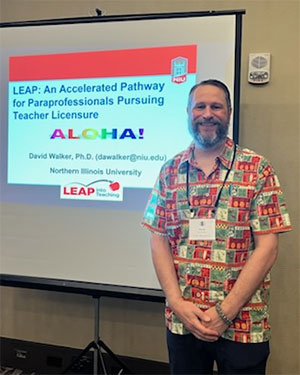
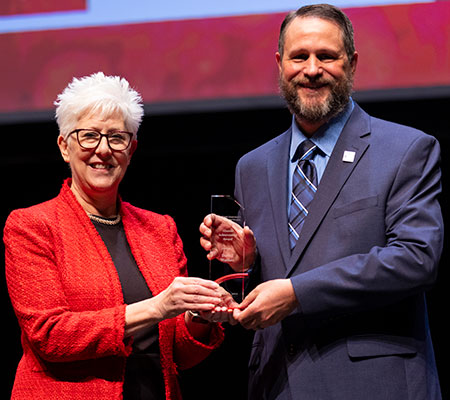
“I said, ‘You probably don’t remember me,’ ” says the 2017 recipient of Iowa State’s Virgil Lagomarcino Laureate Award, “and he’s like, ‘Oh, I remember you’ – because I had really long hair and a long beard – ‘You’re that Peace Corps hippie guy.’ I said, ‘You asked me a question.’ He said, ‘I remember what I asked you.’ And I said, ‘You changed the course of my life.’ ”
He told the advisor everything. The doctorate. The post-doc working at an Iowa State research center. The tenure-track position at NIU.
Amazing stuff, Walker told him. “ ‘You asked one key question that changed the trajectory of my life. I had no plan. I never would have thought to do this. I just knew that I liked school and that it was paid for.’ ”
WORKING AT NIU has meant the world to Walker, who has enjoyed serving on dissertation and thesis committees and sometimes co-publishing or co-presenting with students: He loves bumping into alumni at scholarly conferences “where they’re making a name for themselves.”
Service as associate dean, a position he applied for and received in 2016 at the urging of his ETRA colleagues, provides a different type of reward.
“I’m really proud of my work with all types of students, both graduate and undergraduate, but in particular, undergraduate students who are young and finding their way in their life,” he says.
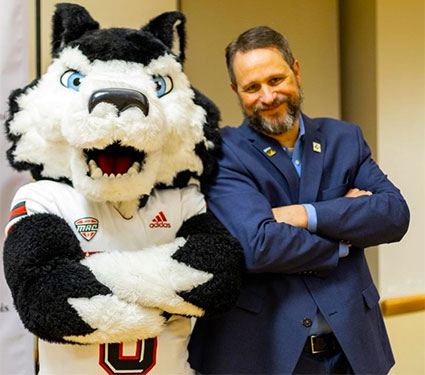
“And that validation I talked about? It’s giving them second and third chances, because we all make mistakes,” he adds, “and I tried to be more asset-based and developmental in my approach working with students in trying to navigate our system. We all assume that students understand our lingo and policies, but half of our college undergraduate population is first-generation students and may not know how to effectively navigate the system. The last handful of years have just been an awesome experience.”
Retirement will bring Walker and Franke, parents to adult children Tsavo and Lili, more time for what brought them together in 1987: travel.
“My wife and I, with some friends, got some permits to hike for about a week in the backcountry of Yellowstone in late July, and then on the drive home, they’re dropping me off at the northern terminus of what’s called the Colorado Trail, just south of Denver, to hike by myself 486 miles to Durango,” Walker says.
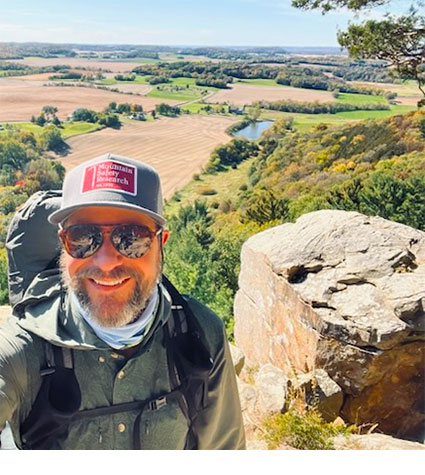 “If it doesn’t work out, it doesn’t work out,” he adds, “but I’ve got time. I’ll be retired. I want to challenge myself. I’m a flatlander here, and this is 10,000 to 12,000 feet, so we’ll see. I want to see that part of the country, and it will be good reflection time for me.”
Maybe, he adds, he’ll someday tackle the Arizona Trail, or maybe the famed Appalachian Trial, but “those take five to six months, and that to me it a little too much and too selfish.”
Walker also plans to visit family up north, spend time with his elderly mother, help Franke take care of the farm and, maybe, pick up the basketball and guitar again.
“I just want to take each day as it comes,” he says. “Exercise. Keeping physically active is very important to me. Cultivate my relationships. Things like that. Try a little simple life.”
