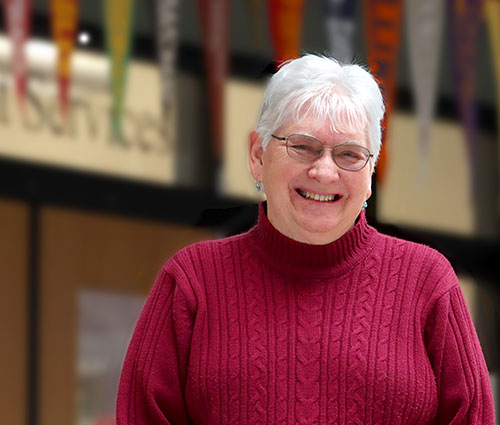
Mary Noe knows the key to flourishing and informational transactions between high school students and educators.
Listening.
“I feel that a lot of students do not have many people who would listen to them talk; they would talk at them but not really listen to their concerns or try to open them up. It’s definitely a two-way street,” Noe says. “That bouncing back of ideas is important, I think, especially during the teen years. They have a lot of choices to make, not only their year-to-year choices at school but also what they want to do after school.”
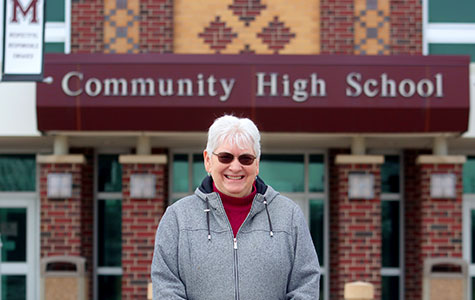
Noe’s insight comes from years of experience in McHenry County as a guidance counselor at Marengo Community High School along with an equal number of years before that as a classroom teacher and counselor in Alden-Hebron School District 19.
And both of those careers began at the NIU College of Education, where Noe earned her B.S.Ed. in Elementary Education in 1971 and her M.S.Ed. in Counseling in 1974 – and where she remains engaged five decades later to inspire and support future generations in her profession.
Yet her aspiration truly is rooted in Clark County, Wisconsin, pretty much in the middle of the Dairy State.
Her parents were farmers – so were her grandparents, as well as her uncle, whose farms were “right next door” – and her education commenced in a one-room school.
“That was my start. My teacher, Miss Sparks, was the lady who got me interested in being a teacher. She was awesome,” Noe says. “She played the piano, and I like that idea of playing the piano, and she read to us. I thought, ‘I want to be a teacher.’ I was one of those, right from the get-go. That was it.”
Eight children were enrolled, as far as she remembers, which accounted for three families.
“We only had three of us in first-grade who moved to second-grade,” she says. “To be able to listen to what the older kids did, and to do our own work independently, was great.”
But life intervened.
Otto Svoboda, Noe’s father, was having a rough time making ends meet in the mid-1950s with only an agricultural income: “You couldn’t do it,” she says. “You couldn’t.”
So her dad found additional work in tool-and-die in nearby Marshfield – his vocation before he bought the farm – and when he heard of jobs for the taking at Union Special in Huntley, Ill., the family headed south to Illinois.
Good timing, too; change also came that fall in Clark County, when all of the rural schools, including Valley View School, were combined.

“We could have moved to Huntley, but we moved instead to Woodstock,” Noe says, “and I’m forever thankful that we did that because that was led to a lot of great friends. I’m still part of our high school group, and so happy to have lived in Woodstock.”
Joining the high school’s chapter of Future Teachers of America put her on the road to DeKalb, but not without a possibly life-altering memory that still makes Noe smile.
During a field trip to visit one of three colleges their advisor thought would provide a suitable undergraduate home for the young women – “There were only girls in that group at that point,” Noe says – the teacher opened a door to a study room.
“There was a couple making out,” Noe laughs, “and she shut the door and said, ‘Ladies, this is not going to be your choice.’ ”
BECOMING AN NIU HUSKIE in 1967, with tuition paid by the State of Illinois because she was going to teach, “was a no-brainer.”
“Northern was close. It was less than an hour’s drive from Woodstock, and quite a few of our friends were in education already. I’ve never, ever regretted that choice,” she says. “All of my teachers were just excellent – very helpful. We learned so much.”
She took some summer courses and graduated early so that she and her husband, Doug, whose family farmed in Marengo, could get married.
Entering the education job market in January meant that she needed to take substitute teaching gigs for the spring semester, but her own classroom came in the fall of 1971.
Returning to NIU for her master’s degree in Counseling came almost as quickly.
“My first year teaching, I had a very interesting class of fourth-graders. It was one of those you could hear a mile away, even when they were lining up. You can imagine what fun this was,” she says, “and I thought, ‘OK, I need a little bit more help than normal with this group,’ and we’re really fortunate we had a program in McHenry County that assisted teachers, especially new teachers, with mentoring, so I had a person who would come in.”
Noe and her mentor teamed with strategies to modify the children’s behavior, including “one of us at one end of the class lineup and the other at the other end” and Pizza Fridays rewards.
 And after leaving the Hebron district for a few years after becoming a mother to a son who now lives in Naperville and a daughter who now lives in Lake in the Hills, she returned as a guidance counselor working with students throughout the K-12 spectrum.
“That position was really neat. My initial scope was obviously elementary education, but I did some teaching in the middle school, and I really liked the scope of doing such a variety of things with all of those ages,” she says.
“It expanded me. It led to many things, like at church being superintendent of Sunday School, and teaching Sunday School and teaching Vacation Bible School, so my education work wasn’t just in schools,” she adds, “and that made me much more comfortable with all ages. I loved the high school group because that’s when you could help them with future planning, not just the day-to-day concerns they had but looking at the beyond. I really enjoyed that part.”
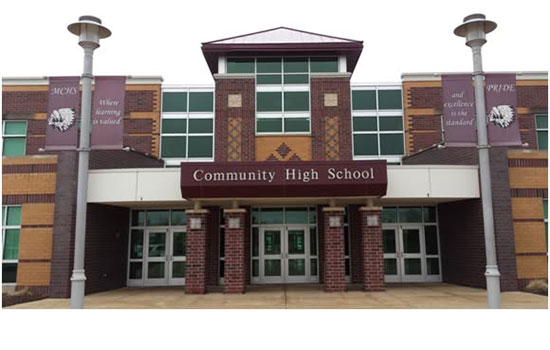
When the Marengo Community High School job opened in 1995, she applied.
“That was where I ended up: 14 years as director of Guidance,” Noe says. “Those are my two schools two districts. I was totally blessed with wonderful colleagues, superintendents and definitely families and students.”
As part of that director’s role, she advocated for her team to attend professional development workshops held on the NIU campus in the fall.
 “I felt it was really important that every counselor in the building had that knowledge. It’s hard to transfer some of that just by reading it. It’s good to be there, to listen to the questions asked and the comments that the various other schools made about their programs and what was going on,” she says. “The education of the Counseling Department was part of my big push. I had great colleagues, and that really helped – and I think it helped the students.”
Noe’s staff championed the concept of the high school diploma as a launching pad and promoted the importance of being, and remaining, “willing learners.”
“We did push college, but it wasn’t just college. It was, ‘What training do you want after school?’ That was our push: Everybody needs to get their diplomas,” she says, “and I think that’s coming back again – the idea that you’re not going to have enough just by getting a diploma.”
She loved the job, which she calls a “fun adventure.”
“The students have problems from A to Z, just like adults have problems from A to Z, and you just listen to them. You see what you can do to help,” she says. “You can’t help them all the time, but you can direct them to places for help.”
 HER RETIREMENT IN 2009 did not end her service to education, of course.
The grandmother of three is active with the McHenry County Historical Society, the Marengo Area Schools Education Foundation and the McHenry County Retired Teachers Association (MCRTA). She was recognized in 2019 as the McHenry County Retired Teacher of the Year for her leadership as MCRTA Scholarship Chair.
Part of her service with the association includes evaluating scholarship applications from students eager to follow in her footsteps.
“I’m looking and thinking, ‘This could be my granddaughter’s future teacher. This could be my neighbor children’s future teacher,’ ” she says. “You want those good people, and it’s important to be able to have mentors in those situations, so I’m proud of what we’re doing and what we’re getting through the school system. Woodstock participates in an incredible program for future teachers now called Educators Rising, which we hope can be leveraged in other districts.”
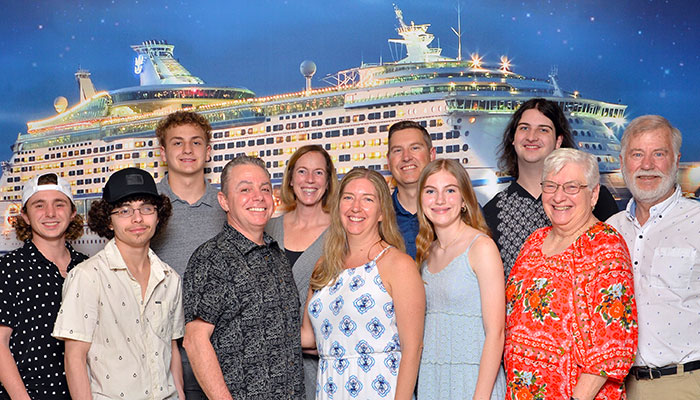
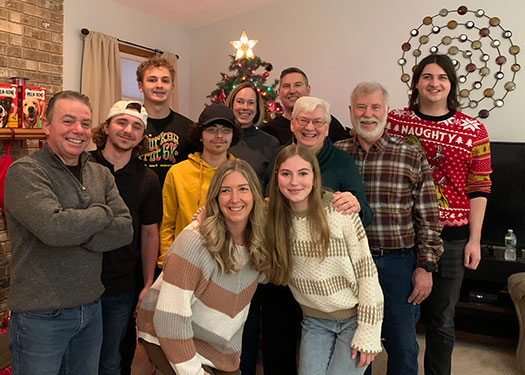
That granddaughter – Maggie – is carrying on a family tradition with her enrollment in Marengo Community High School’s Class of 2029. She represents the fourth generation of Noes to attend the high school, following in the footsteps of her mother, Lisa; uncle, Rob; grandfather, Doug, and his two sisters; and great-grandparents Dale and Margaret Noe.
Meanwhile, Noe has reconnected with her double-alma mater: the NIU College of Education.
Retirement provides time for travel, including a special trip to Ireland in 2022 organized by the NIU Alumni Association. Through that, she met Liz McKee, senior director of Alumni Engagement (and a fellow NIU College of Education alumna).
“Liz was the one saying to me, ‘Hey, if you want to help here …’ and that got me into the scholarship evaluations and writing those postcards for the end-of-the-semester finals and different things like that,” Noe says.
She has contributed money to Project Graduate, which financially assists undergraduate students within four semesters of commencement (or graduate students within two semesters) so that they can complete their degrees – and she encourages fellow members of the McHenry County Retired Teachers Association to do the same if they’re able.
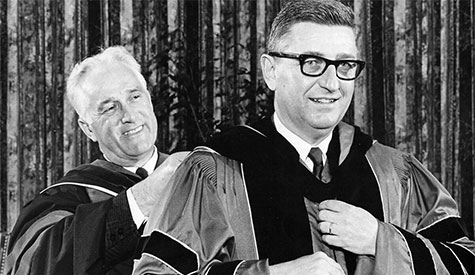
“That’s the sharing of your gift, and I look at my Northern diplomas and degrees as gifts. Yes, I earned them, but they were truly gifts. They directed my life and the different activities and different groups that I have been a part of. That was driven by my Northern background in education and counseling,” Noe says.
“For teachers, in particular, if you are thankful for what you have – if you are grateful for what you have – it’s time to pass it on,” she adds. “If you have that capability, use it as long as you can. I’m so thankful for Northern.”