
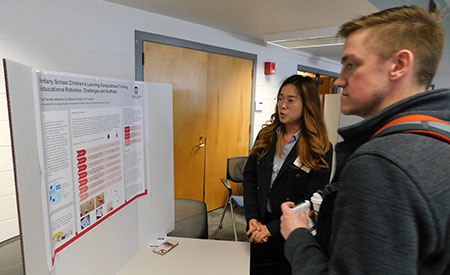
Questions and answers took center stage April 21 at the NIU College of Education’s Student Research Symposium.
Held in the Learning Center of Gabel Hall (face-to-face for the first time since COVID forced an online format), the event featured five oral presentations, nine poster presentations, two table talks and two faculty panel discussions.
Research topics ranged from the impact of frailty on activity behavior and cognitive function in older adults living in a senior housing facility to the experience of shame in a supervisory relationship among international supervisees of color from an Eastern culture.
Todd Gilson, associate dean of Research, Resources and Innovation, is pleased by the results.
“Getting back to hosting the Student Research Symposium in-person was an important goal for the College of Education Research Committee,” Gilson says.
“This event allows students the opportunity to showcase their hard work and hone ‘softer’ research skills when interacting with faculty and other presenters,” he adds. “Working with the College of Education Research Committee on this initiative for the past semester, it is clear that their hard work was on display and the credit for a successful event is theirs.”
For Grace Louis, a Ph.D. student in the Department of Kinesiology and Physical Education, the hard work covered “Assessing the Mental Health Resources of Mid-major College Athletic Departments.”
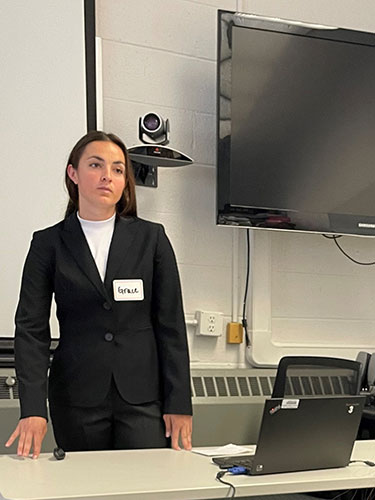
Louis, who came to DeKalb from Cincinnati to play for the NIU Women’s Soccer team, is specializing in sport psychology.
Her topic is close to her heart, and is one she expects will inform her research agenda throughout her doctoral program and into her eventual career as a professor.
“I’ve been a student-athlete my whole life, and I had a lot of problems in high school – trying to be invincible and not ever break down – and it was really hard,” says Louis, who was advised by Shaine Henert. “When I was going through it, there weren’t the resources that I personally needed, and I felt really alone. It was just kind of challenging.”
Conducting research “was definitely interesting,” she says. “I learned a lot of statistics, and I did not realize how much work goes into the research process. Doing a thorough literature review is pretty heavy work; you’ve got to look at everything.”
She also learned about writing and collecting qualitative data.
“I really love writing, and it’s fun for me to write in a not-professional voice. I love to relate to people and being able to write in that sort of way, so being able to connect my writing back to literature was something I had to learn,” Louis says, “and I had to learn about how to interview people, the process that goes into consent forms and following ethical considerations.”
Louis appreciates the guidance of Henert, associate professor and director of the Kinesiology program.
“He’s been a great teacher,” she says. “He’s given me so much of his time, and I feel really grateful for all the help that he’s provided me. He’s gotten on me a lot, and I’ve definitely been able to keep that vibe and keep things going.”
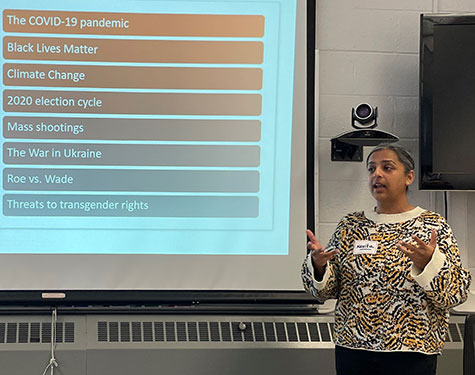
Kavita Khara presented on trauma-informed counselor supervision.
“I wanted to do this research for really personal reasons,” says Khara, who is pursuing her Ph.D. in Counselor Education and Supervision.
“I’ve been working in the field for 12 years – I graduated in 2011 with my master’s – and all of my work has been in trauma, and I was not adequately prepared. I don’t think any two-year master’s probably can adequately prepare you,” she adds.
“But as I delved deeper and did more trainings, it really shifted my framework. My core has
become very much trauma-informed, and how you infuse that in every part of counselor education has become more and more interesting to me.”
With a clinical background, her foray into research was “a little daunting.”
However, Khara says, “I do like how when you start to read more and more literature, certain patterns start to emerge and how that helps to inform the process and seems to make it more interesting.”
“I was really fascinated when I realized that trauma-informed was supposed to be organizational because it was so pushed-upon as a care process and framework you used with your clients,” she says. “The idea that the entire structural system from top-down was supposed to be trauma-informed was probably my favorite part of the learning, and probably where I’m most curious. It could apply to any other mental health profession.”
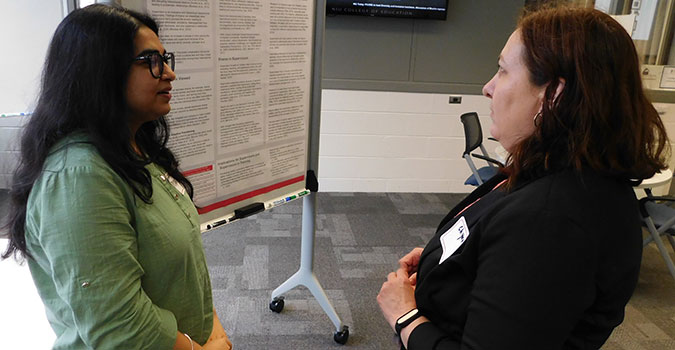
She enjoyed working with Peitao Zhu, assistant professor in the Department of Counseling and Higher Education.
“Peitao has been really supportive. He’s really relational in his work, which I don’t think I had seen or expected – a lot of times, there’s a dynamic of professor-student, and you just consider the power differential,” Khara says.
“He’s very good at picking up on your strengths, and can be also quite encouraging,” she adds. “He has a researcher’s mind, so I appreciated being able to just observe that and the way he conceptualizes and gives feedback.”
Natalie Andzik, associate professor in the Department of Special and Early Education, mentored Hannah LaMarca, a senior Communicative Disorders major in the College of Health and Human Sciences.
LaMarca conducted a literature review on multilingualism and augmentative alternative communication.
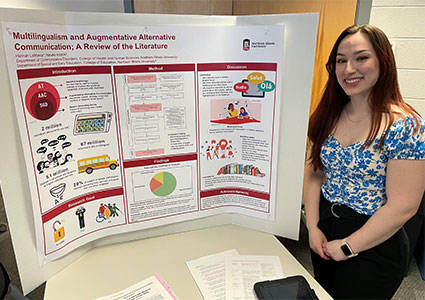
“A lot of children with disabilities who have a hard time communicating are also multilingual. The problem is, there is not a lot of technology that easily translates between two languages or that supports their multilingual communication,” says LaMarca, who is from Rockford. “After going through this, I just realized how much research we still have to do in the entire field of both special education and speech-language pathology.”
Andzik “was amazing in growing my confidence and understanding in what you need to put into that type of research,” LaMarca says.
“She’s definitely an expert when it comes to review of the literature,” she says. “Instead of just walking me step by step – like hand-holding – she kind of just threw me in and was like, ‘Here are some examples of the different formatting. See what you can come up with, and then we’ll come together and brainstorm to see how you can improve.’ ”
During those meetings, she adds, “she was constantly asking me, ‘OK, what did you like about this part that you did? What do you think you can improve on?’ We had these discussions about how to improve myself as a researcher and a writer, and it wasn’t so much learning about how to do research; it was about how to approach different parts of research, and building my confidence as a researcher and as a person as well.”
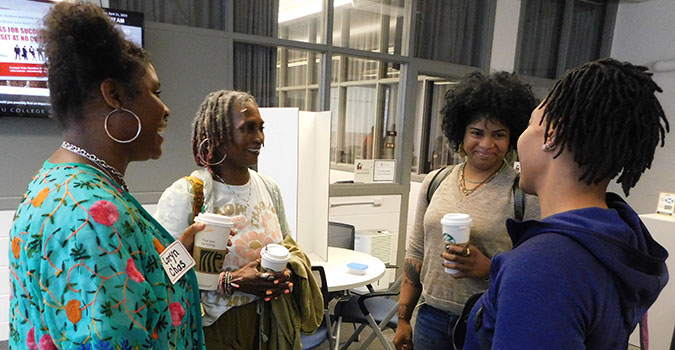
Several other students participated in oral or poster presentations along with table talks:
- Leo Barzi, “Sensory and Reinforcement Feedback Differently Change Locomotor Learning and Retention.” Faculty advisor: Christopher M. Hill.
- Liliana Banuelos, “Exclusionary Practices: Undocumented Immigrants in the U.S. Health Care System.” Faculty advisor: James Cohen.
- Tylo Blackburn, “Reconstructing Community-based Youth Sport Programs through Participatory Action Research.” Faculty advisor: Wonock Chung.
- Marissa Fetters and Brianna Pasillas, “Evaluating Coach Training to Support SEL in Sport Settings.” Faculty advisor: Paul Wright.
- Matthew Herring, “Motorized Sled-push Exercise: A Powered Study in 36 Apparently Healthy Older Adults.” Faculty advisor: Emerson Sebastião
- Priyanka Jha, “Experience of Shame in a Supervisory Relationship among International Supervisees of Color from an Eastern Culture.” Faculty advisor: Dana Isawi.
- Stella Jung, “Elementary School Children’s Learning Computational Thinking with Educational Robotics: Challenges and Scaffolds.” Faculty advisors: Michael Tscholl and Ying Xie.
- Loryn Chás Kimbrough, “A Transformative Approach to Triangulating Power in Clinical Supervision.”
- Margi Patel, “The Impact of Frailty on Activity Behavior and Cognitive Function in Older Adults in a Senior Housing Facility.” Faculty advisor: Emerson Sebastião
- Akosua Birago Poku, “Perceptions of K-12 Teachers on Using Mobile Technologies for Informal Learning.”
- Sharda Sharma, “Cultivating Scientific Skills through Technology-supported Inquiry Learning Pedagogies in Middle School (6-8 grades) Science Students.”
- Vitor Siqueira, “Electromyographic Study of Leg Muscles during Lower Extremity Functional Assessment in Older Adults.” Faculty advisor: Emerson Sebastião
Members of the College of Education Research Committee are Todd Gilson, Todd Reeves, Vitor Siqueira, Lindsay Harris, Lisa Liberty, David Nieto, Gudrun Nyunt, Marcella Otto and Sharda Sharma.
Faculty panelists included Cynthia Campbell, Alissa Droog, Pi-Sui Hsu, Q Hutchings, Laura Ruth Johnson, Olha Ketsman, Thomas Smith and Peitao Zhu.

