
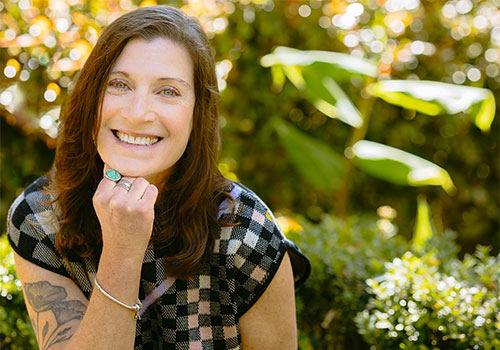
Cynthia Taines, associate professor in the Department of Leadership, Educational Psychology and Foundations, recently answered questions from the Ed News about her book titled “The Metropolitan Community: Partnering for Equality Across the Educational Divide.”
Published by Myers Education Press, the book “tells the story of two Chicago-area schools – one suburban, one urban – whose students come together to examine the disparities between their schools and advocate for change.”
What inspired you to write the book, and how did you devise its two-schools format?
Before I was inspired to write the book, I was inspired to create the educational program at its heart. I’d been moved while reading the dissent in the 1974 Supreme Court case Milliken v. Bradley. The court’s majority had ruled that suburban schools did not have to assist with the integration of their city centers, effectively stopping integration’s progress in this country. Justice Thurgood Marshall, the lawyer who’d championed Brown v. Board and then became a Supreme Court justice argued in opposition that the “city … and its surrounding suburbs should be viewed as a single community,” an idea he called “the metropolitan community.”
When I moved to Chicago, I took this seed of inspiration into a curiosity about what it would be like to bring students from the city and students from the suburbs together for the purpose of building a more equal school system.
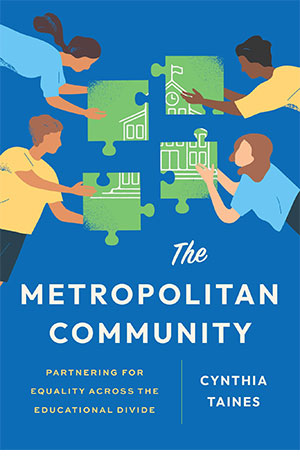 When I didn’t find a program that was doing that, I built one. I recruited Chicago Public Schools teachers who I’d gotten to know from a school that I call “Taylor” in the book. And I recruited teachers from a public school in the suburbs north of Chicago where I taught an off-site graduate class, a school I call “Wyndham” in the book. The teachers, a community organizer, and I designed a program where students learn about educational history and policy, visit each other’s schools, wrestle with how to talk about their schools’ differences, and advocate together. Named after Justice Marshall’s vision, it’s called The Metropolitan Community Project.
From the beginning, I took notes and conducted interviews to understand what the city and suburban students were taking away from the project, which helped us improve it each year. After a while, I wanted to turn what I was learning into a book, so that other teachers, administrators, community members and students could also build school partnerships that can help to bridge our educational and social divides.
If society can undo the “grossly unequal funding” that denies an equal education to primarily Black, Latino and low-income students attending city schools what kind of positive outcomes would that fuel?
School funding is important because it pays for crucial educational resources, so that students have enough teachers, counselors, social workers, supplies, computers, clubs, sports, advanced classes, tutoring help, science labs, performing arts spaces, gyms, heating and air conditioning, athletic fields, and so much more. There is very good, definitive research now on how much school funding matters. Greater school funding raises student achievement, high school graduation rates, college-going rates and even adult incomes. Increasing school funding matters even more, the research says, for Black, Latino and low-income students. These are the kinds of positive outcomes that increased investment in the public schooling of city students could bring. But there is an emotional component too, that I found in my research. When schools have enough, when students are surrounded by abundance and possibility, they feel cared for by the school system and the broader society, and they feel limitless in their futures.
 Who should read this book – and why?
I want everyone to read this book, of course! But I am most excited about reaching students who are about to be teachers, like my students at NIU. And I’m excited about reaching teachers and administrators who are already working in schools. This is an unconventional book for a university professor. The writing is intended to be accessible to a wide audience. It’s purposely presented in an informal voice that I hope communicates how fun, fascinating, and deep these high school students are. There are funny and poignant moments, and it’s meant to be a page-turner, as much as a research-based book can be. All of this to say that someone who reads it needs only to bring their curiosity to get something out of it.
I’m excited for educators to read “The Metropolitan Community” because I think we’ve created a special model that other schools can copy and build on to create school partnerships. Educators can take their expertise and connections – their knowledge about working with young people, their friendships with teachers and administrators in other districts – to bring school communities together. I genuinely believe that the divides in our country are troubling to most Americans, and most students, but they’re unclear on what to do to stop them. It’s hard to know how to cross the boundaries of our really separate communities and schools.
A school partnership can provide a supportive structure and learning environment to do that: to get to know each other, to collaborate, to participate in positive change.
 What did you learn – or find most fascinating – in writing the book?
What I always tell students who are setting out to do research is that they should pay attention to what surprises them. Surprise tells you that your assumptions are being tested, that what you thought was supposed to happen, based on your prior experience, or your knowledge of prior research, is somehow not going to plan. This is where the best learning kicks in, because it means you’ve found something new. Surprise prompts me to ask, if it’s not what I expected, then what is happening here?
Something that surprised me when I was listening to the city and suburban students talk to each other was that they were very, very reticent about acknowledging the resource disparities between their schools. I wanted to understand what the sticking points were, why they had trouble acknowledging these differences out loud, when they were in the same rooms with each other. Because when I interviewed them one-on-one, they did not have any trouble discussing them. I found out that they held back out of nervousness over causing offense and worry about how their school partners would perceive them. What helped them move through these fears was the sustained amount of time they spent together – a school year or more – and their joint advocacy for equal school funding. Then their communication suddenly turned confident and clear. It was great to be surprised, and to look for what might solve the puzzle, so that we could support these cross-community conversations going forward. Educators reading the book can hopefully learn something about how to do this, too.

Why does student activism give you hope that we can change a system that is “entrenched” after decades of practice?
I am a strong believer in the idea that students are experts about their education. They might not know every policy or academic term, but they know what it’s like to be in a classroom, what it feels like to be in a school day-to-day. They know what helps them learn and what helps them feel comfortable and supported. They are troubled by things we educators may believe are way down on the list of priorities, such as the cleanliness of the bathrooms, and they absorb messages about how much their school cares about them. Educators and policymakers need students’ expertise.
I’ve also found that students aren’t as accepting of educational inequality as adults have become. The Metro students were shocked when they found out that schools are mostly funded based on a community’s ability to pay. They thought that was crazy. Their destabilization of what we’ve come to think as normal, their urgency to do something about this now, is an asset.
Another reason that I think student activism can work is because I’ve seen it work! In Metro, the city and suburban students met with their state legislators to push for changes to school funding, specifically for a reform called needs-based funding. This reform increases money for schools statewide but also sends additional funds to schools where many low-income, multilingual, and special education students attend. A bill to enact this reform had been stalled in the Illinois State Legislature for years, and the Metro students’ advocacy, in combination with many other teachers, students, and allies, helped get it over the finish line and signed into law. I think they were able to break through state representatives’ inertia by being cute and charming, of course.
 But they also broke through by sharing these fine-grained, comparative details of their schools’ inequalities, and by modeling this amazing cross-community partnership.
The politicians were surprised that students with very different educations and life circumstances would come together in this way, and I think it suggested that state leaders should come together on this too. I’m hoping the model presented in the book can make cross-community partnerships become less surprising and rare. Educational inequality is an entrenched problem, and I don’t believe it can be solved by one school or one school district. It will take the collective effort of communities across our state, with students at the front, to bring the school system we want into being.
