
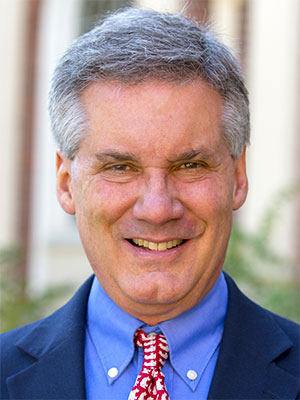
For A.G. Rud, the view beyond his window is alarming.
Rud sees George Orwell’s dystopian “1984” coming to fruition. He sees “a landscape of information, misinformation and disinformation.” He sees “authoritarian regimes disposing of information that’s not complimentary of them.”
And that, he says, is trouble.
“This is really where we live today,” says Rud, Distinguished Professor Emeritus of Cultural Studies and Social Thought in Education at Washington State University.
“We live in this world where we’ve got deepfake photographs. We’ve got people going online and posing as other people,” he adds. “It’s not like people haven’t been imposters before in history, but it’s really ramped up because of technology and how easy it is for everyone to do this.”
Consider his level of alarm towering.
“Democracy depends on factual information – upon people agreeing on certain things,” he says, “and if they’re all suspicious of everything that they read? We should all read critically, of course, but if everyone thinks that, like some people say, ‘I can’t believe that. That’s all fake news,’ then we’re in real trouble.”
Named the 2025 recipient of NIU’s James and Helen Merritt Distinguished Service Award for Contributions to Philosophy of Education, Rud will speak at 4 p.m. Thursday, Oct. 16, in the Sky Room of the Holmes Student Center. A reception begins at 3:30 p.m.
Rud’s talk on “How Do We Fight for Democracy in a Post-Truth Infosphere?” is sponsored by the Department of Leadership, Educational Psychology and Foundations as part of its long series spotlighting scholars who have deeply influenced educational thought and practice.
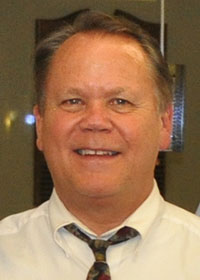
Kerry Burch, a professor of Foundations of Education, is “appreciative of the innovative and cosmopolitan directions of Dr. Rud’s work.”
“Our Merritt Award committee is particularly impressed by the ways in which his boundary-crossing and prodigious record of scholarship embraces virtually every significant facet of our disciplinary tradition – and then some,” Burch says. “His writings, taken as a whole, reflect an admirable form of ‘doing philosophy’ that we find deeply democratic, social justice-oriented and positively situated in this historical moment.”
Probing the concept of “a post-truth infosphere” is not just political, says Rud, whose areas of academic expertise include the moral dimensions of leading, learning and teaching.
Education is also part of the conversation, he says, calling its role “a strong one – but a limited one.”
“It’s strong because, ever since I got into philosophy and teaching, I’ve been very interested in critical thinking and people being able to really discern for themselves what’s true, what isn’t and what people are saying and how to understand it,” he says.
“I want all of my students to have this energy and focus about thinking for themselves,” he adds. “Don’t accept things your parents tell you without thinking. Don’t accept things your pastor tells you without thinking. Don’t accept things your government tells you without thinking. You might come to agree with it, but just don’t say, ‘Oh, well, Donald Trump said that, so it must be true,’ or, ‘Joe Biden said that, so it must be true.’ ”
Yet the limits of education partially come in the rise of artificial intelligence and technology such as ChatGPT, which remain new enough that teachers at all levels still have questions.
“When ChatGPT first came out, faculty went crazy. ‘How am I going to prevent my students from using it to submit papers?’ That is an issue, but I don’t think it’s the main issue. The main issue has to do with being able to use that kind of tool well,” Rud says.
“I think it’s just important for us to know that things are fluid. They’re changing very rapidly, and we just have to adapt to this new world of information technology,” he adds. “The train has left the station. We cannot put it back in the bottle. AI is part of everything.”
That resonates on a personal level for Rud.
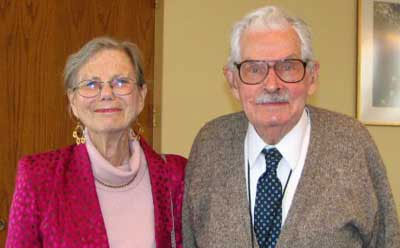
 His father, Anthony, was “a small-city newspaper man” who spent most of his career at the Berkshire Eagle in Pittsfield, Massachusetts. He started as a reporter and eventually wrote editorials.
“He was very committed to journalism. He was very committed to local coverage of events,” Rud says.
“He’s deceased now, but I think he’d be rolling in his grave if he found out that newspapers are generally not published on paper anymore – they’re online – and a lot of people aren’t reading newspapers. They’re getting their news from other sources, and we’ve got to keep up on that,” he adds.
“If people are getting their news from TikTok videos, what does that say? Are they getting good stuff? A lot of the stuff on TikTok is good – I’m not criticizing any of this new stuff because I don’t know a lot about it – but there are advantages and disadvantages with any media, and that concerns me. Where are we going with all of this?”
All are welcome to attend the Oct. 16 lecture. For more information, email ktburch@niu.edu.
