

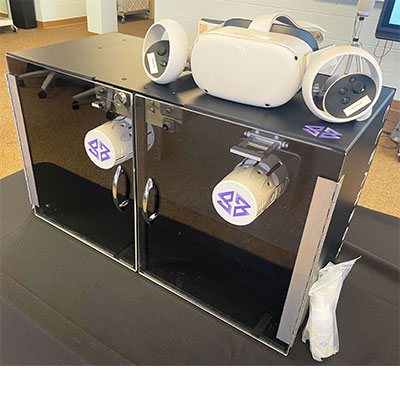
A 2023 alumnus of the College of Education’s B.S.A.M. in Instructional Technology degree has honored his alma mater with a gift of Oculus Quest 2 virtual reality headsets and a large cleaning unit.
The donation from Ray Schaefer, who works in global operations training and development for Redwood City, California-based Equinix, raises the Department of Educational Technology, Research and Assessment’s supply of VR headsets from two to 16.
Schaefer’s notions about the powerful potential of virtual reality to boost his day job blossomed in NIU’s ETT 459 Learner-Centered Educational Courseware, taught by Ros Adulseranee.
“During one of my classes with Dr. Ros, we were developing virtual reality programs and, to me, it was really interesting. It was fun,” says Schaefer, an assistant project and program manager at Equinix. “I asked Dr. Ros if there was any equipment that we could use to test those programs out on, and she said, ‘Unfortunately, not necessarily.’ ”
Now, thanks to Schaefer, “unfortunately” is no longer the – pun intended – reality.
 Fourteen headsets purchased by Equinix for its Chicago-area facilities that later were deemed unneeded gave Schaefer to idea to transfer the immersive, interactive and 3D equipment to NIU rather than “somewhere else.”
“I said, ‘You know what? Let me donate these to the school – and, that way, other students will have that access,’ ” he says.
“My hope is that they figure out what’s next; what else is out there; what else we can do; how we can use this technology to benefit humans, students, learners; just to find a benefit for them in some way, shape or fashion so that somebody else can further the technology even more,” he adds. “It’s passing it on.”
Wei-Chen Hung, chair of the Department of Educational Technology, Research and Assessment, is grateful for the donation and the innovations it will foster, including those studies faculty will undertake.
“Our students engage in using VR to support classroom learning, and we offer VR classes on a regular basis every semester. We have students who actively use these devices to conduct research and to engage in a K-12 environment in support of classroom learning,” Hung says.

“I attribute this to Dr. Ros, the instructor who first provided this opportunity – meaning the VR headsets – for our students to learn, ‘OK, this tool is not just for training but for learning as well.’ That allowed students to see a broader scope of the usage of this technology, especially in educational environments, and because of the quality of the class and the quality of that kind of learning experience, it triggered Ray to think about providing support to the department.”
Hung also credits Judy Puskar for “providing proper advising along with way, making the connection and building rapport with Ray.”
“Ray and the other students were excited to use VR in the classroom, and then that carried over to their workplaces, where they saw the relevancy,” Puskar says.
“These are really state-of-the-art pieces of equipment, and in having them accessible for students, they’ll be consistent for the students to use at a level that is professional as they exercise learning design and in parts of their research,” she adds. “It was just so generous of Ray to remember us.”

Schaefer and his teammates develop and deliver employee training for about 5,000 operational Equinix staff members worldwide, a responsibility that led him to DeKalb from his corporate base of operations in Elk Grove Village.
“I have a little bit of common story where I was a subject matter expert inside one of our data centers and was asked to provided training for new employees who were coming in,” he says.
“Not necessarily having the skill set or the education or the background, I did that for about a year, or a year and a half, and decided, ‘You know, I really need to bolster myself. I need to understand exactly what I’m doing,’ ” he adds. “So, I started looking at what programs were available at different colleges. I saw the BSAM-ITTE as NIU and said, ‘That’s it. That’s the one that fits me the most.’ ”
He now applies his degree “extensively, especially in research development and project planning to understand not only the education and the background of adult-learning theories in particular but, also, how you actually develop those types of programs.”
 Puskar calls Schaefer “an example of who this program is designed for – a professional working in the field and a high-level student.”
“While taking our classes, such as ETT 459 as well as ETT 310: Instructional Design Models, Strategies and Tactics with Dr. Ying Xie, and ETT 430: Survey of Instructional Technology with Dr. Cindy York, he paired his vocational projects with the educational focus of our classes and excelled,” she says. “He’s still working the work and doing exactly what the design of this program is meant to support: current knowledge and current practice.”
And, Hung hopes, this is only the beginning of a rekindled relationship that might cultivate paid summer internships, mentoring collaborations between ETRA students and Schaefer’s colleagues at Equinix and invitations to those professionals as guest speakers on campus.
“This is something the students will benefit from,” Hung says, “and so will the faculty.”

