During Kristin Lee’s 13 years as a bilingual special education teacher, she shepherded multiple high school groups on global trips.
Her chance this spring to flip the script was not one she could pass up.
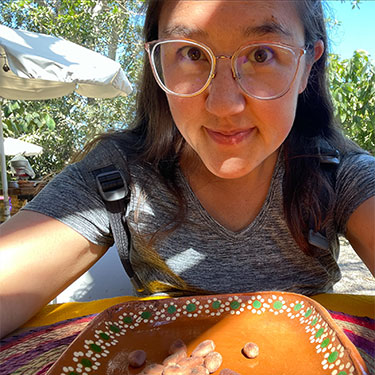
“I’m a huge world traveler. I love traveling, any way possible. I’ve been to Mexico eight or nine times, and I have family who live there,” says Lee, in her first year of NIU’s Ph.D. in Counselor Education and Supervision program, “so I was very excited to go from the student perspective.”
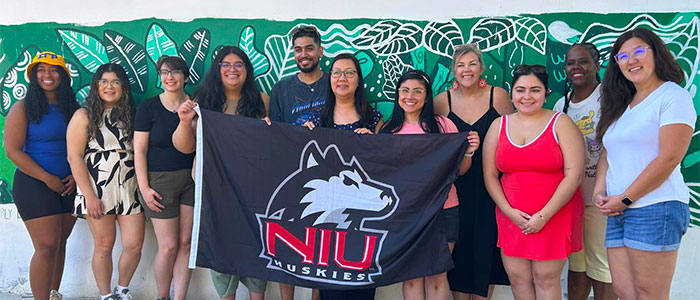
Lee was among 11 graduate students from the Department of Counseling and Higher Education who journeyed to Bucerías with Associate Professor Carrie Kortegast for a cultural exchange with Human Connections, a social enterprise committed to engaging local people with international travers for curated experiences that “empower local communities while fostering conversations that shift perspectives and increase understanding.”
April’s week-long visit was the fourth for Kortegast, who teaches Higher Education and Student Affairs, and immersed her students in lessons and demonstrations of how to work ethically and equitably with community partners as well as a glimpse at teaching and learning in Mexico.
“We met with nonprofit organizations that provide supplemental education. We met with individuals who worked at two different colleges and two different universities in the region. We met with individuals to learn about their lives and livelihoods, and also their, and their own children’s, experiences with the educational systems in Mexico,” Kortegast says.
“Throughout it all, we ask these big questions. How do we engage in socially responsible approaches to community-based learning? And how do we engage in critical reflection throughout?” she adds. “For me, travel and the opportunity to learn about cultures that are similar or different than your own allows you to gain new insights.”
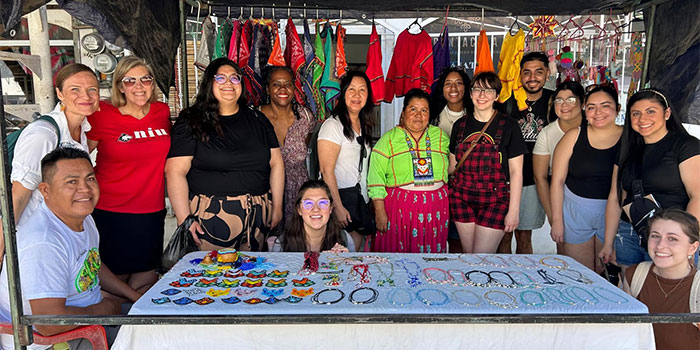
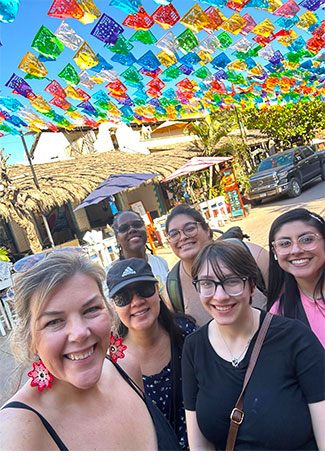
NIU’s group made outings to Centro Universitario de la Costa, a branch of the University of Guadalajara; Entreamigos, a community center dedicated to providing educational and leadership opportunities to the San Pancho community; and to chat with artisans who peddle their handcrafted wares outside of traditional stores.
Something new this year was a meeting with faculty from UTBB Escuela Universidad Tecnológica de Bahía de Banderas.
“Being there was very cool,” says Lee, a licensed professional counselor in practice at Conventions Psychiatry and Counseling in suburban Warrenville.
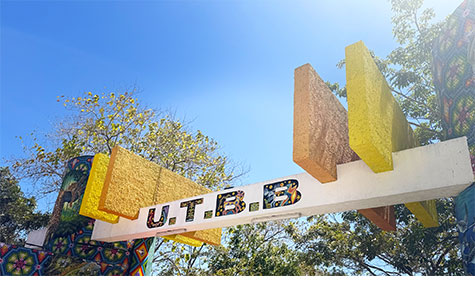 “UTBB has a language center, which is one of my main focuses, so to go there and speak with them specifically about language allocation, and how they use those models, was very interesting to me,” she adds.
“They were teaching courses for people who want to work in the area of tourism – so they were teaching English – and they also had the opposite side, where they had so many tourists in the area who are there trying to learn Spanish. I was very fortunate that I had an extra day in Mexico, and I spent that day back at UTBB with the teachers, and I got to observe different classes.”
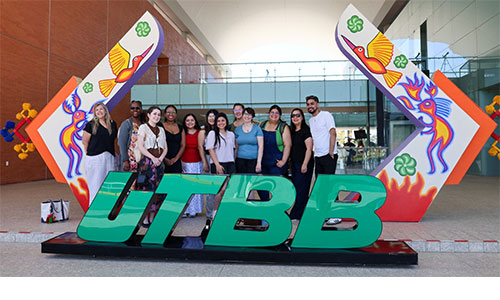
One of those instructors, Lee says, is referred to as “a counselor, so we talked about the different roles, because the role of counselor in the U.S. versus Mexico is very different. It was cool for us to compare and contrast how we work with students.”
“We were able to talk about language and how we utilize language with clients,” she says. “I’m currently a therapist and I see children – adolescents, mostly – and I do a lot of my sessions in Spanish, so it was very interesting to talk with someone who’s so knowledgeable in language and culture.”
MELISSA OUIMETTE, A FIRST-YEAR doctoral student in Higher Education, also went south of the border with a fluency in Spanish.
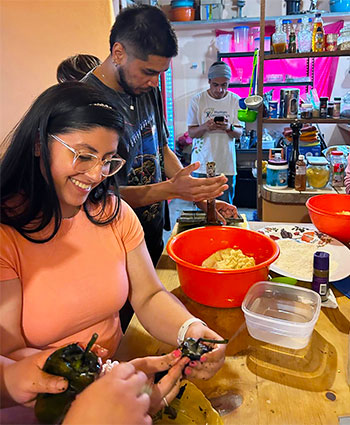
“Going on this trip meant a great deal to me. I am half Mexican and I never really got to know that side of my heritage. I felt like going on this trip would give me an opportunity to see where half of my family is from and experience the culture,” Ouimette says.
“While the Human Connections staff did a wonderful job translating from Spanish to English (and vice versa) for the group, I am extremely grateful to be fluent in Spanish because sometimes things are just better said in Spanish,” she adds. “While there may be a good translation, it is not always the same, so hearing and understanding conversation in Spanish makes for a great experience.”
Ouimette appreciated NIU’s hosts at Human Connections and their mission, values and goals.
“This was not just a job for them,” she says. “You could tell they were truly passionate about the work they do. This made all the difference in the experiences. It was also wonderful to see how loving the families we visited were toward the Human Connections team. They showed their commitment to the organization and the appreciation for having the opportunity to be part of it.”
Her week in Bucerías also accomplished one of Kortegast’s objectives: “We learn about ourselves when we are in new locations and expand our understanding of the world around us,” the professor says. “I think that’s valuable in a time where are asked to sort of villainize people we don’t know.”
For Ouimette, that moment came in a personal encounter.
 “One of the wonderful people we were able to meet said something that left a strong impression on the group: ‘Education may not pull you out of poverty, but it may pull you out of your ignorance,’ ” she says.
“This was incredibly powerful and definitely added to my understanding on how to be a better practitioner,” she adds. “Education opens the door to new perspectives and gives people the tools to navigate challenging situations that present themselves. Education may not change circumstances immediately, but it will empower people to think critically, make informed decisions and better advocate for themselves and others.”
Good to hear, Kortegast says.
“It benefits students who are going into helping fields to think about different lives and perspectives, and that people have to make choices – and choices within their context,” she says.
“A couple of the folks we met with were artisans who sell their crafts on the beach,” she adds, “and it’s very easy to think about these people as annoyances rather than thinking about the ways they are hustling: They are making their own crafts. They’re selling them. They’re trying to market them. They’re trying to know what is going to sell and what is not going to sell. They have to interact with people all the time.”
 NIU’s travelers turned those conversations and observations into “reframing and rethinking about people within the context they have.”
“That builds compassion and humanity,” Kortegast says, “and that is what we want our students to do when they work in Student Affairs – student activities, residential life, academic affairs and all of these higher ed administrative roles. We want to be able to think about how we work with individuals in ways that are right and responsible.”
Also on the trip were Peregrin Capriglione, Kristen Carranza, Jesus Guzman, Alexus Hughes, Amy Orona, Tawanda Paul, Alma Pizano-Onofre, Yasmin Ramos and Vivien Vu.