
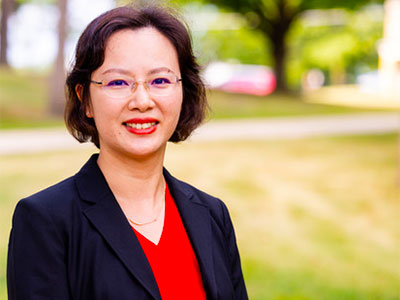
A new member of the Department of Special and Early Education faculty arrived in DeKalb with a cool “What I Did This Summer” story.
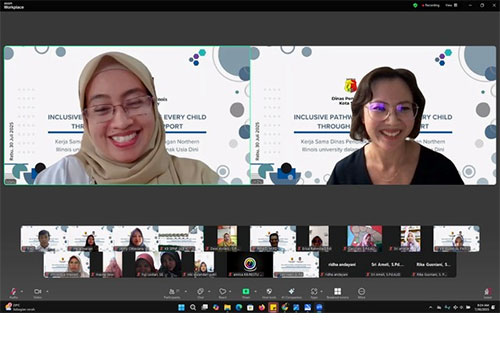
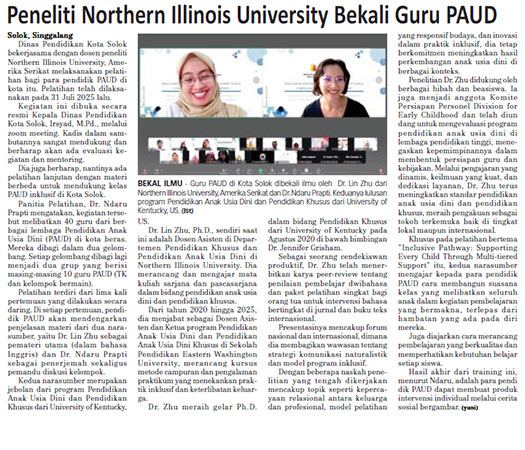
Lin Zhu, assistant professor of Early Childhood Special Education, designed and delivered professional development via Zoom to empower 40 teachers in the city of Solok in West Sumatra, Indonesia.
She also met with local government leaders to discuss how to sustain these practices and integrate them into the city’s ongoing initiatives to enhance the skills of working educators.
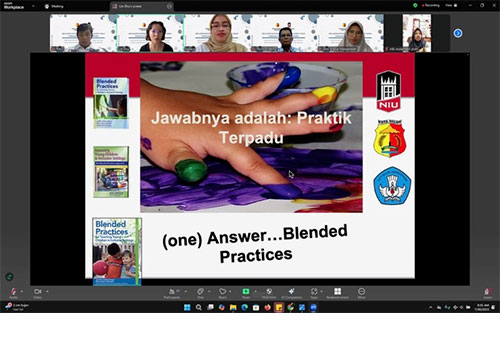
Zhu’s training sessions focused on practical, blended practices for creating inclusive classrooms from preschool through third-grade.
“In terms of the early childhood years, inclusive education really refers to multi-tiered support to all children, with or without disabilities, because in the early years, they all are developing emerging skills and functional skills that they use in daily life,” Zhu says, “and they still need that intentional, additional dosage of support in classrooms.”
Consider this, she says, posing questions that apply to early childhood teachers throughout the world.
 “How are we holding 20, 30 or 40 hands when we have only two hands – or, with your assistant teacher, you might have four? Four adult hands in the classroom. How are you holding all those hands and making sure that they are all making progress and meeting all of the learning and developmental needs in the classroom?” she asks. “This is where the multi tiers of support comes in.”
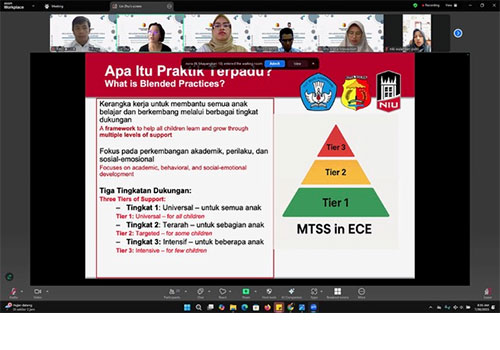
Participating teachers learned about the Multi-Tiered System of Supports framework in early childhood: Tier 1 universal strategies such as Universal Design for Learning, Tier 2 targeted supports through accommodations and modifications and Tier 3 individualized interventions using behavior functional analysis and social stories.
Universal Design for Learning is something all teachers should practice, Zhu says of the Center for Applied Special Technology-developed guidelines to ensure that all learners are able to access and participate in meaningful, engaging learning opportunities.
Next, the Tier 2 tools focused on accommodation adaptations.
“There might be a small group of students who are almost ‘there,’ and teachers just need to twist things a little, or adapt things a little, to give them that extra push,” she says. “We gave them examples of what accommodations and adaptations look like and what are the things they could do with their classrooms with them. We also had case studies that were developed by ChatGPT, which was very culturally relevant to their setting.”
 Finally, she says, the workshop participants explored methods to support individual learning needs.
“We taught the teachers to collect data and analyze children’s challenging behavior and the function behind the children’s behavior,” Zhu says. “We find out why they’re doing those things, and then we teach our students a new, replacement behavior so the students are less likely to display those challenging behaviors.”
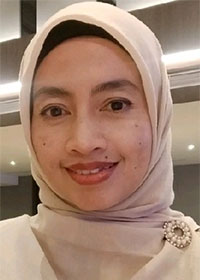
Zhu’s collaborators in Indonesia were Ndaru Prapti, superintendent of the Education Department in Solok, and Irsyad, head of the Solok City Education Office, both of whom have prioritized inclusive early childhood education.
She knows Prapti from graduate school at the University of Kentucky, where she earned her Ph.D. in Special Education in 2020 and her master’s in Literacy Education in 2015.
“We share the same academic advisor, Dr. Jennifer Grisham, who is one of the founders of early childhood inclusive education,” Zhu says. “We spent about five years not just taking classes together but also working back-to-back in the Early Childhood Education lab, where we were classroom teachers.”
Zhu’s curiosity and fascination about early childhood education took root as she became a mother to her daughter, Emily, who then attended the university’s child care center.
“That’s where I met my advisor and started looking into the field of early childhood education,” Zhu says.
“It’s really fascinating all the things that they’re developing. It’s not just academic. In the early years, it’s also the functional skills. Everything is new to them. They’re learning all the prerequisite skills to be more successful in school and later in their adulthood.”
Following graduation, Zhu and Prapti stayed in touch.
 Conversations with Prapti eventually touched on “some of the struggles they have in Solok” and her belief that the West Sumatra city’s teachers needed additional support and professional development to help them build on educational opportunities provided by children in their classrooms with “different backgrounds, different abilities and different skills.”
“Dr. Ndaru asked if I would like to deliver some virtual sessions to the teachers,” Zhu says. “I said, ‘Sure. Why not?’ The summer before, I collaborated with a university in China that made some very similar requests for just small dosage, rapid teacher training.”
Zhu, who is from China and does not speak Minangkabau, addressed the participating teachers in English while the visual aids were in both languages.
Prapti, meanwhile, was on site in the Solok classroom to translate and explain.
“Ndaru told me that the teachers were really engaged and asked a lot of questions,” Zhu says.
 “She is their superintendent, and they work together every day. There’s a relationship there already. They are not afraid to ask questions or to ask her to clarify things,” she adds. “They also asked me to review their interventions and to give them some feedback. We’re still in that stage right now.”
Also in progress?
More professional development sessions next summer to begin a citywide expansion of the strategies and practices, follow-up evaluations, mentoring and a research study to determine how the training is supporting teachers and their self-efficacy as well as to learn how Zhu can update and upgrade her sessions based on feedback from participants.
“This ongoing partnership positions NIU as an active contributor to global education initiatives,” Zhu says, “with the potential for significant, long-term impact in Indonesia and beyond.”
