
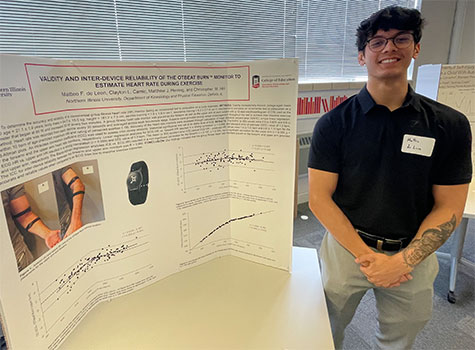
When Matteo de Leon came to NIU to earn a bachelor’s degree in Kinesiology, he wasn’t sure where he wanted that path to lead.
Now he knows.
“I knew that I loved personal training, but I knew that I could always do more,” said de Leon, a senior from Vernon Hills. “I walked through Anderson Hall, looked to my right and saw student-led publications, and I then I looked to my left, and there were research posters. I knew it was something I wanted to get into. I thought I was very interesting.”
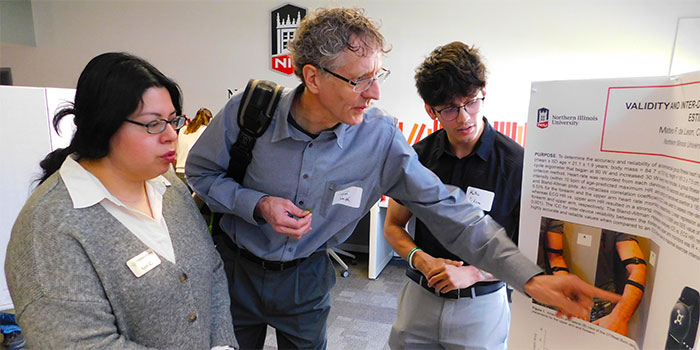
That opportunity came this spring when de Leon collaborated with Department of Kinesiology and Physical Education faculty Clayton Camic and Chris Hill as well as graduate assistant Matthew Herring for a study of “Validity and Inter-Device Reliability of the OTBeat Burn Monitor to Estimate Heart Rate during Exercise.”
De Leon’s project was among 11 poster presentations at the 2025 Student Research Symposium.
“Culturally Responsive Teaching to Support Students with Visual Impairments in Illinois: Are We Ready?” took the graduate-level award for Mary (Molly) Zurkowski, Dionna Ford, Charmaine Martin, Jessica Jackson and Eric Junco.
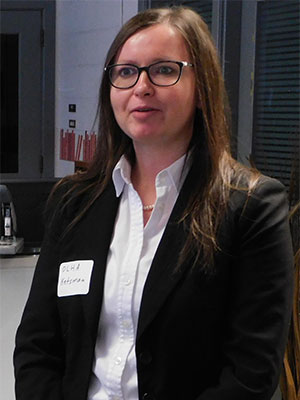
Held in the Learning Center of Gabel Hall, the April 11 event also featured five oral presentations and a pair of workshops conducted by Mary F. English Scholars on interactive assistive technology.
Associate Dean of Research, Resources and Innovation Todd Gilson opened the proceedings by thanking the students for their participation.
“Much like the Student Research Symposium, your work didn’t come together in one day,” Gilson said, “so we’re really excited to see the time that you spent with your faculty mentors, the research you engaged in, the findings that you share with us and the passion you have for how it relates to your field.”
For de Leon, whose study was named winner of the undergraduate prize, the real reward was discovering just that: passion. “I’ve always had a want for research and finding out my own stuff because I have questions, and they’re not really answered by randomized trials,” he said. “With research, especially in exercise science and supplements, I feel like they’re very polarizing. One study will find one thing and the other study will find something else.”
Graduate degrees are now on his radar.
“I want to continue in school and just do research the rest of my life. I loved this. It was great, and I want to help other students going through research, especially for kinesiology. I think it’s still in its infancy,” de Leon said. “There’s so much that’s always being found out and is changing. You see how people worked in out in the 1980s compared to now, and it’s a night-and-day difference.”
He is grateful for his mentors.
“They meant everything,” he said, “uplifting me, educating me and going the extra mile instead of just caring about the work to caring about me.”
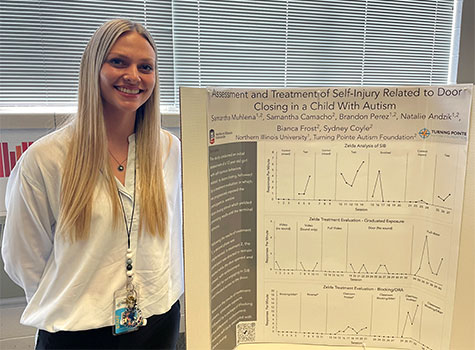
Samantha Muhlena was a member of the team that presented “Assessment and Treatment of Self Injury Related to Door Closing in a Child with ASD,” mentored by Department of Special and Early Education faculty Natalie Andzik and Brandon Perez. Also on the team were Samantha Camacho, Bianca Frost and Sydney Coyle.
The study conducted an initial assessment of a 12-year-old girl with self-injurious behaviors related to doors closing.
Next came a treatment evaluation in which the researchers progressively exposed the participant to aversive door-closing stimuli that yielded promising results until the terminal stimulus.
Phase Two directed the participant to remain seated while the door opened and closed, with reinforcement provided for not engaging in self-injurious behavior and blocked access to the exit.
“Autism is really hard to understand. Every kid is so different,” said Muhlena, an M.S.Ed. in Special Education-Behavior Analysis student and a teacher at the Turning Pointe Autism Foundation Day School in Naperville.
“She’s been hitting her heard really hard, and no one wants to see anyone hurting themselves,” she added, “so just getting a little glimpse of what could help her, and just seeing how this was proving to be effective, was really great.”
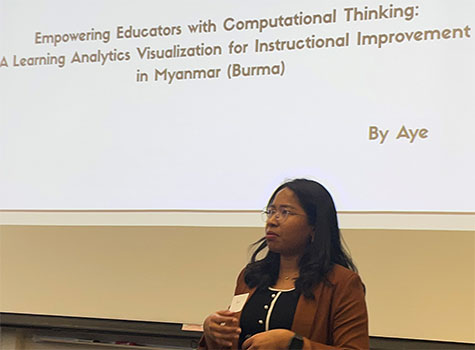
Aye Myat Mon, a Ph.D. in Instructional Technology student from Myanmar, delivered an oral presentation on “Empowering Educators with Computational Thinking: A Learning Analytics Visualization for Instructional Improvement in Myanmar (Burma).”
Her work is only beginning, however: “I want to publish a paper in the future about this topic,” Mon said.
The symposium offered a great starting point.
“My friend, Riyani, said, ‘Hey, there’s a student research symposium, and you should go.’ I said, ‘I have nothing. I have only the topic. I don’t think I’m ready.’ And she said, ‘That’s the reason why you have to go,’ ” Mon said.
“And then she forced me to the submit the paper, so I submitted the paper, and she was right, because a lot of people gave me what are the possibilities, what can be done, what can’t be done, and they gave me guidance,” she added. “I know now how to narrow down to my topic, what to focus on and how to continue my study.”
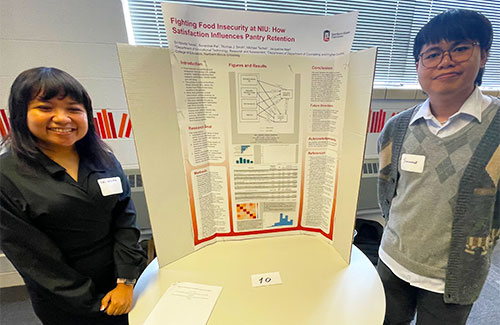
For Sovannak Ra, a M.S.Ed. in Higher Education and Student Affairs student from Cambodia, engaging in research provided personal realizations.
Ra and collaborator Sri Novita Yanda, a graduate student in the Department of Educational Technology, Research and Assessment, presented “Fighting Food Insecurity at NIU: How Satisfaction Influences Pantry Retention.”
“There is a lot of impact we can make through our research,” said Ra, a graduate assistant at NIU’s Asian American Resource Center who helps to conduct program assessments. “I find research as a way we can embark on making this available for more of the scholars working on it to use as a rubric for more study by like-minded people with similar questions.”
Considering the time constraints – Ra and his partner “pulled this together in less than two months” – he also learned about “being mindful, resourceful and direct” in determining “precisely what we want to do, what we want to know” and tapping into “theory that is already available.”
And, with plans to eventually pursue a Ph.D. and further scholarly articles, he appreciates the college’s opportunity to launch.
“This is only the beginning,” Ra said. “This as a stepping stone for me, because I’m still growing and I’m still learning as a person, and I hope to explore so I can tackle other topics that I really feel resonating with me and that can be helpful and impactful for people to make changes.”
Other oral presentations:
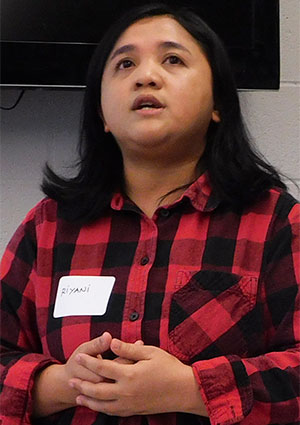
- “The Impact of AI Tools on Creativity in Lesson Planning and Teaching Materials: A Mixed-methods Study of Indonesian EFL Preservice Teacher Training.” Riyani Riyani, ETRA
- “Examining the Effects of AI-infused Mentoring on Preservice Teachers.” Jeonghwa Oh, ETRA (winner)
- “ ‘I Had to be Like an Actor’: Thai Preservice and Early-career Teachers’ Classroom Management and Identity.” Duangkamon Winitkun, LEPF (winner)
- “Integrating Sport Education with Incarcerated Youth: Evaluating Psychomotor, Cognitive and Health-related Outcomes.” Luc Charelebois, Karolina Ryczek, Zachary Wahl-Alexander and Jennifer Jacobs, KNPE (winner)
Other poster presentations:
- “Looking at the Relationship between Set Location, Attack Success and Pass Tempo in NCAA Division I Women’s Collegiate Volleyball.” Katie Nepil, KNPE
- “Navigating Early Intervention: The Experience of Spanish-speaking Parents.” Diana Sandoval, SEED
- “Teaching and Learning to Read: A Study of the Reading Endorsement Program.” Emi Overton, CI
- “AI for Visual Impairment: A Holistic, Student-centered Approach to Access, Inclusive Teacher Training and Social Belonging.” Dionna Ford, Jessica Jackson, Charmaine Martin, Mary Zurkowski, Eric Junco, SEED
- “Examining Amotivated Students following their Participation in Three Consecutive Sport Education Seasons.” Amanda McMurray and Zachary Wahl-Alexander, KNPE
- “What Matters the Most in Reducing Procrastination among Students with Dyslexia? The Moderation of Grit.” Sri Novita Yanda, ETRA
Members of the College of Education Research Committee are Wonock Chung, Alissa Droog, Olha Ketsman, Jacki Mac, David Paige, Michelle Sands, Teresa Wasonga and Gilson.
