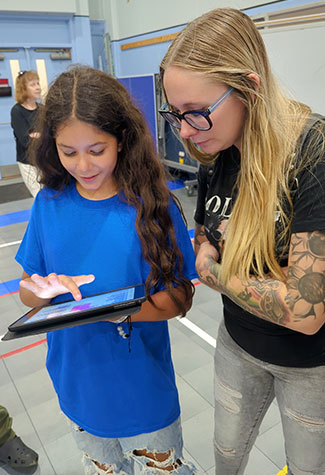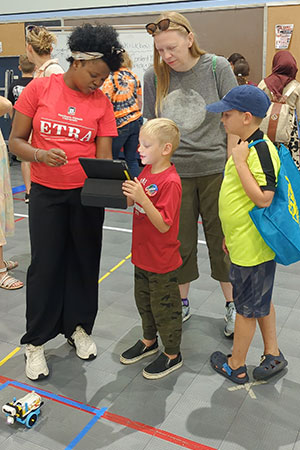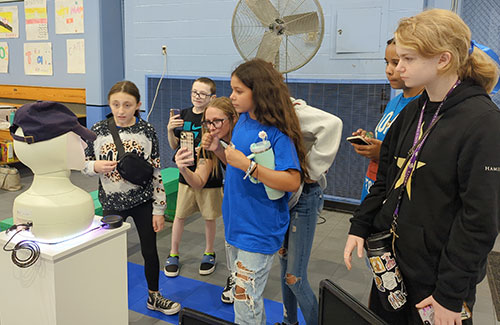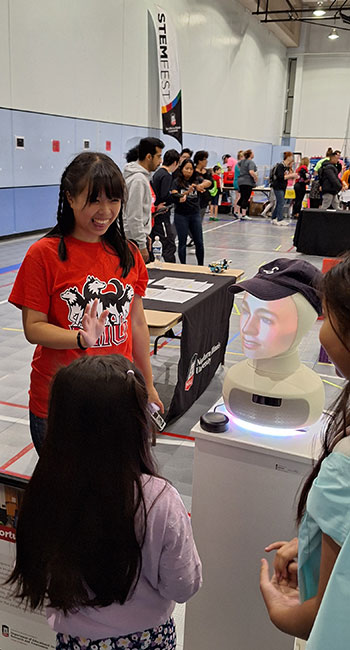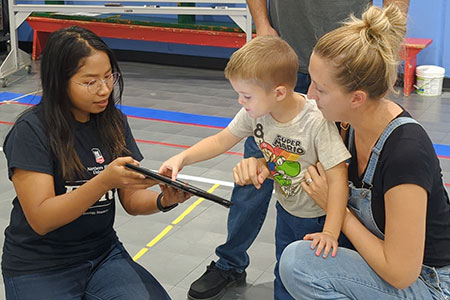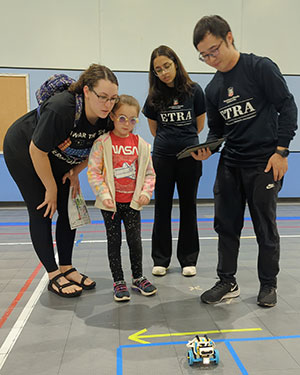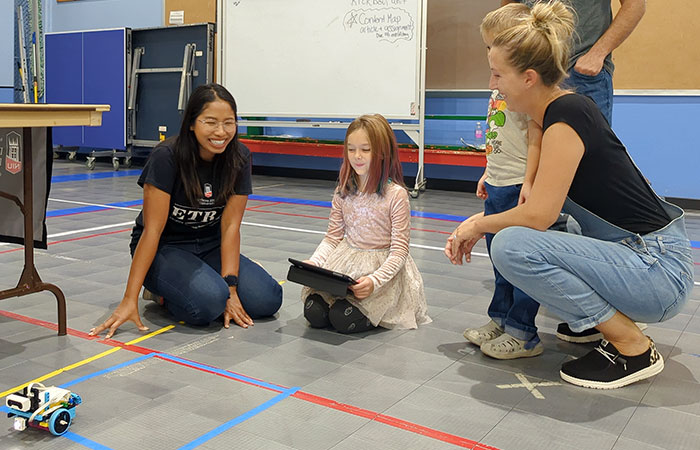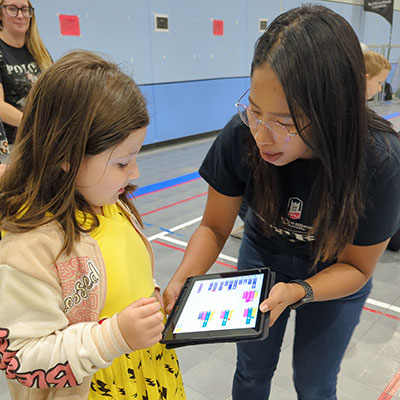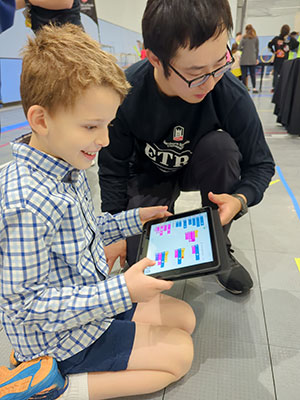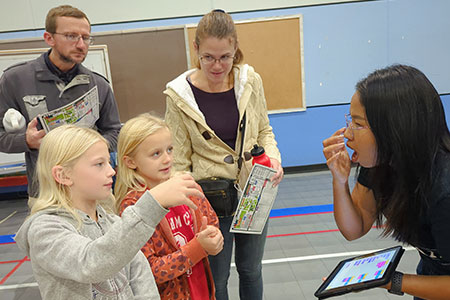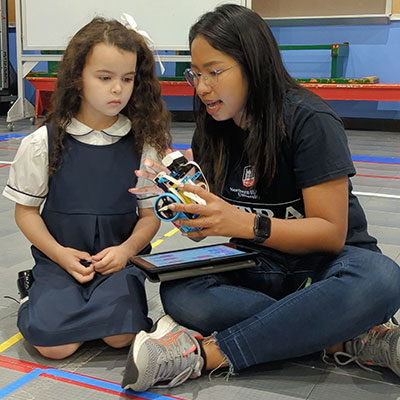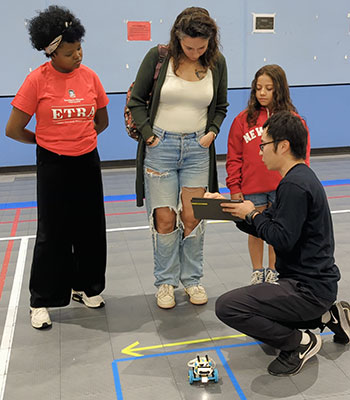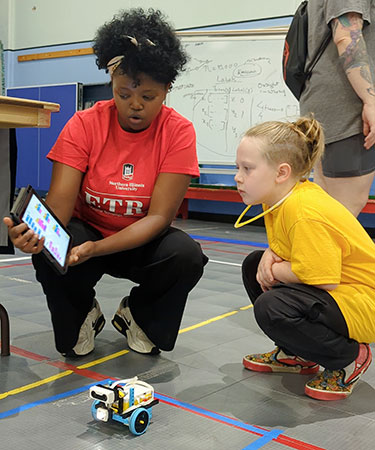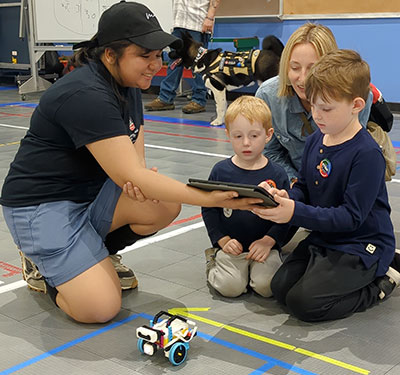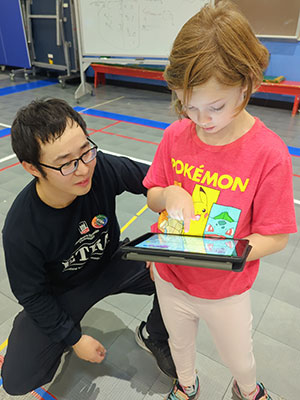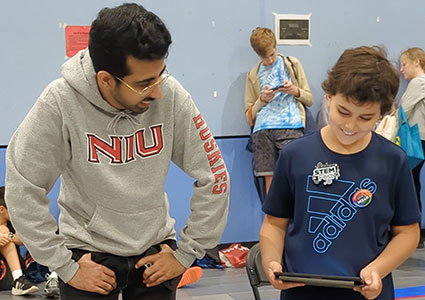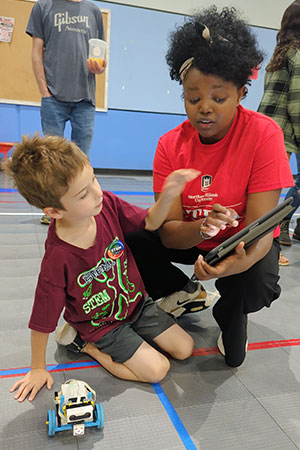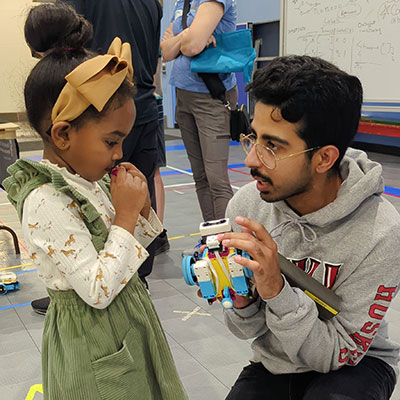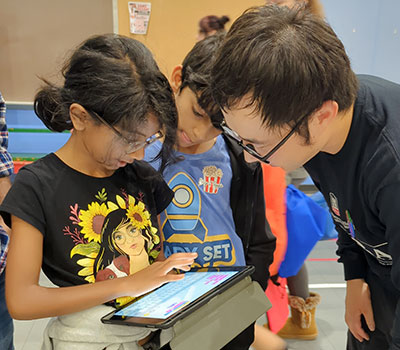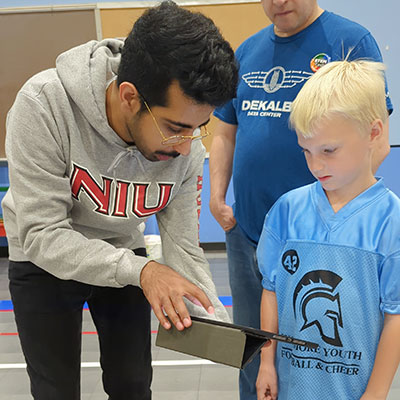
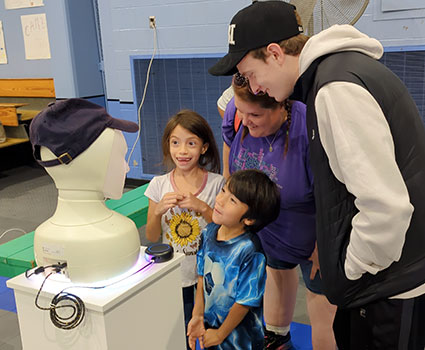
Hundreds of children of all ages visited the Department of Educational Technology, Research and Assessment’s STEM Fest booth Sept. 28 in the Anderson Hall gym.
And the learning – along with the smiles – was not limited to the guests.
“This is the 15th year of STEM Fest, and ETRA has been a part of it for 10 years,” says Judy Puskar, the department’s academic program advisor.
“It’s a fantastic event sharing enthusiasm and interest in STEM. We look forward to it every year, and this year was again amazing,” she adds. “It’s a great opportunity for our master’s and Ph.D. students to get involved in the planning of a community event for different audiences, from little kids to elderly and everything in between, and in using technology.”
STEM Fest, a program of NIU STEAM in the Division of Outreach, Engagement, and Regional Development, celebrates all things science, technology, engineering and math each fall with more than 100 exhibits and speakers.
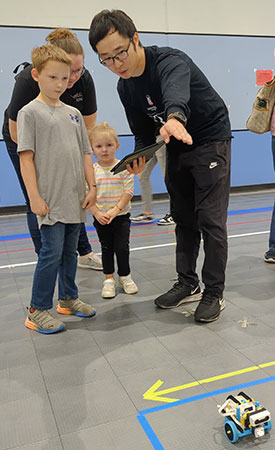
Lida Niu, a first-year Ph.D. student in Instructional Technology, was among the first to volunteer for event duty and led some of the training for his counterparts.
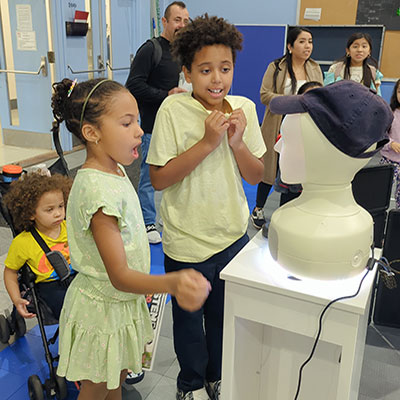
Niu and his fellow graduate students brought a remote-control Lego car as well as a “Furhat” head powered by artificial intelligence that swiveled in response to visitors’ movements and talk directed at it.
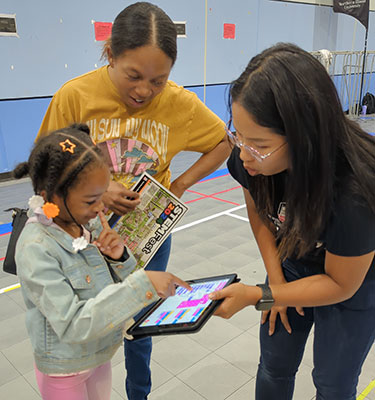
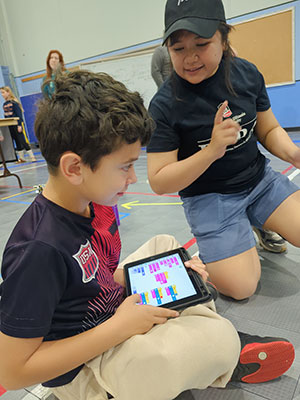
“For primary school students or pre-K students, our goal was just to show them something different. They’ve probably never seen Lego cars with batteries, Bluetooth engine motors and wheels, and that we can use code on the iPad to communicate with the car to control it,” says Niu, who is from China.
“Most of them are pretty excited about this. They can not only watch the car go, but they also can control it. They can change the speed on the iPad, and they can type their name into the code, and then once the car reaches the specific area, it shows their name on the back of the car,” he adds. “We’re cheering for them, and they’re just so happy.”
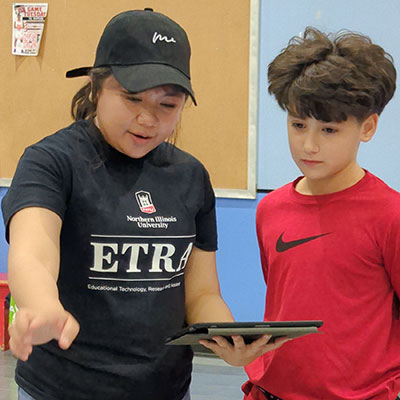
Visitors in their teens seemed eager to understand the programming and for permission to experiment, Niu says: “We explained the coding – what it means – and they could try on their own to put it together or to change it a little bit and see how the car goes.”
Yen-Jung Chen, also a doctoral student in Instructional Technology, confirms that.
“Our booth featured a Lego car driven by coding, which not only combines the fun of Lego bricks and engine power but also stimulates logical thinking in children. The hands-on activity brought a great sense of accomplishment to the participants, making it one of the best options for learning through play,” Chen says.
“During the event, I was truly amazed by the potential of the children. With enough support and encouragement, I believe each of them can show significant progress and performance,” she adds. “It was a rewarding experience, and I appreciate the opportunity to be part of it.”
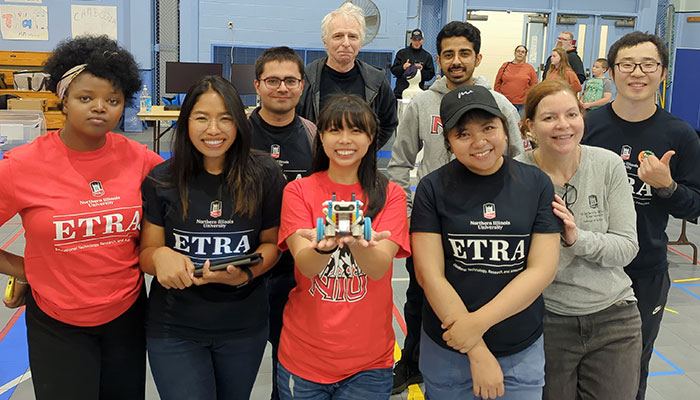
Back row, from left: Saurav Mukhopadhyay, Michael Tscholl, Omar Alshuredah and Lida Niu.
Chen and Niu were joined by Omar Alshuredah (Ph.D. student in Instructional Technology); Faith Bitok (Ed.D. student in the Department of Curriculum and Instruction); Alfred Machingambi, Aye Myat Mon, Saurav Mukhopadhyay and Jeonghwa Oh (all Ph.D. students in Instructional Technology); and Sri Novita Yanda (M.S. in Educational Research and Assessment).
Puskar and Michael Tscholl, instructor of Educational Technology, were impressed by the NIU students.
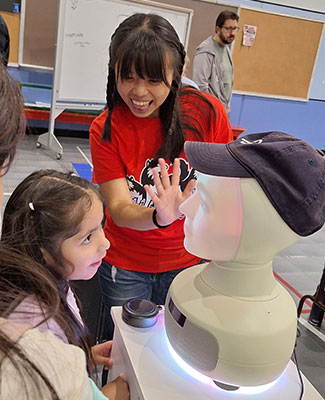
“They did a really great job of being patient and of differentiating their instruction to how old the child was,” Puskar says. “They told them, ‘If you want to do this, then do this,’ and the children and toddlers were able to move it and get the cause-and-effect idea.”
“It’s logic programming,” Tscholl adds. “If it’s red, you turn to the left. If it’s blue, you turn to the right. The car essentially drives autonomously, so the children need to plan ahead, and then transfer the instructions to the robot, and then the robot drives autonomously.”
For Niu, whose background is in electronics, information engineering and environmental education, and who is interested in a career focused on artificial intelligence, the STEM Fest experience enhanced his skills in teamwork and problem solving.
Hands-on interactions, meanwhile, tapped into his skills as a teacher.
“We had different groups of people. Some kids came with their families, some came with their schoolteachers,” Niu says, “so I played it by ear based on their age. I learned a lot through this, which is pretty cool.”
Click on any image for a larger view: