The first students from Southeast Asia arrived on the campus of what then was known as the Northern Illinois State Normal School in 1903.
“One of the really interesting things about Indonesia, and really all of Southeast Asia, is how deep and how long our commitment is to the region,” says Bob Brinkmannn, dean of the NIU College of Liberal Arts and Sciences.
“These students came to us as part of group from the Philippines who came to NIU to get education degrees, and from all accounts that I’ve seen, it went extremely well. They were very welcome in the area,” he adds, “and, ever since then, NIU has had a connection to that part of the world.”
More than a century later, Brinkmann is part of nurturing and growing that connection.
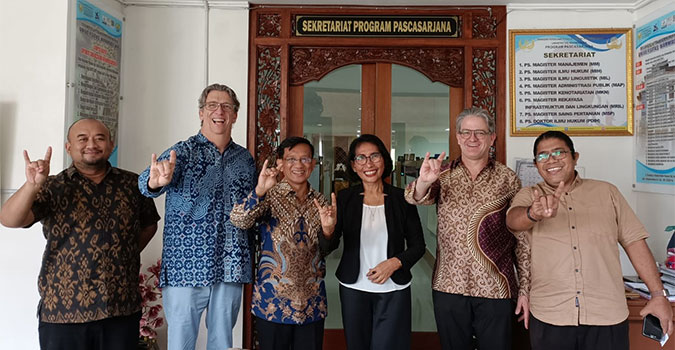
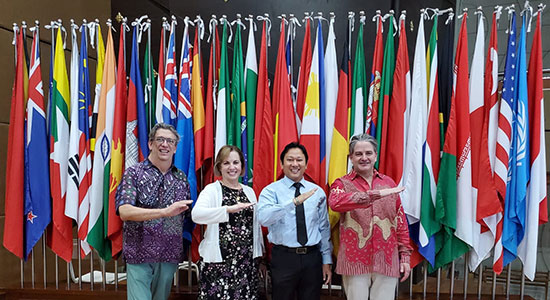
He traveled with Eric Jones, the college’s executive director of Global Initiatives and faculty associate of NIU’s Center for Southeast Asian Studies, and NIU College of Education Dean Laurie Elish-Piper this spring to do just that.
Events on the busy itinerary included meetings at the U.S. Embassy in Bangkok, the National University of Singapore, the mayor’s office in Makassar, Universitas Negeri Makassar, Hasanuddin University and Universitas Muhammadiyah.
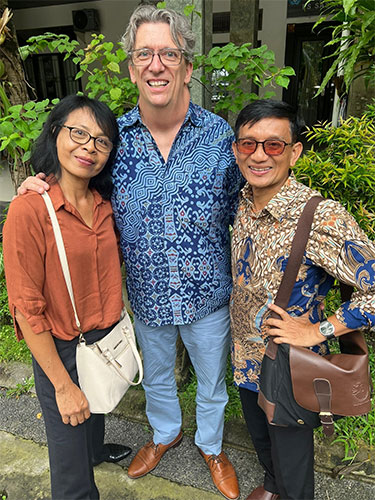
Discussions regarding an international collaboration were held with leaders of Universitas Widya Mataram in Yogyakarta.
Next on the agenda was a conference, “After the 2022 G20 Bali Summit: Indonesia on the Global Stage,” held in Yogyakarta.
Brinkmann delivered the introductory speech, moderated the first plenary session and helped to preside over the closing ceremony.
Jones presented a plenary session with NIU colleagues Shupei Yuan, Abu Bah and moderator Dan McCoy. He also moderated the “Technology for Good: How Technology can Help Allocate Green Capital Efficiently to Drive Sustainability” session, during which Elish-Piper presented “Education as A Lever for Digital Transformation and Sustainable Development.”
The trio also met with several NIU alumni who are prominent and influential leaders in their native country, including Anies Baswedan, governor of Jakarta from 2017 to 2022 and a 2024 presidential candidate.
Other Huskie alums include Nico Harjanto, special staff of the Minister of State Secretariat, Office of the President of Indonesia; Andi Malarangeng, former minister of Youth and Sports at Second United Indonesia Cabinet; and nearly a dozen leaders of higher education.
“They created democracy there: the majority of the authors of the constitution and Indonesian election law, who enshrined democracy and representative government in this dictatorship that had not seen it; the first head of the National Election Commission; the presumptive next president. They’re all over politics and government, and in good ways,” Jones says.

“That one of the vibrant democracies in the world is a direct result – a majority result – of our alumni is quite spectacular,” he adds, “and our continued engagement at all levels of government and academics, and across all sectors, speaks to a deep content knowledge. It speaks to applied engagement in training in the public and private sectors as well as to abiding the best parts of international cooperation.”
Such cooperation will attract more Indonesians to DeKalb in the future to tap into NIU expertise, he says, and will foster a climate of mutual learning that benefits NIU faculty.
Brinkmann expects only positive outcomes.
“Given the significance of Indonesia in the region as a leader of the non-aligned movement in that part of the world, a new member of the G20 and hosting G20 Indonesia, Indonesia is indeed on the global stage,” Brinkmann says, “and because of NIU’s presence in the country, and the history that NIU has had through the work of our alumni, we are joining Indonesia on the global stage.”
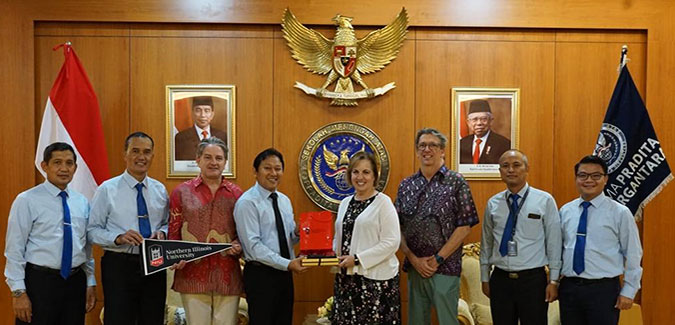
FOR ELISH-PIPER, THE TRIP provided an opportunity to visit one of the destinations of last summer’s Educate Global travelers: Central Java’s private SMA Pradita Dirgantara High School, operated by the Indonesian Air Force.
“We met with our partners there, and they were very complimentary. They loved having our students come, and they’re excited to host students this summer. We’ll have 10 students from the College of Education, the College of Liberal Arts and Sciences and the College of Visual and Performing Arts who will be traveling there from June 26 to July 14,” Elish-Piper says.
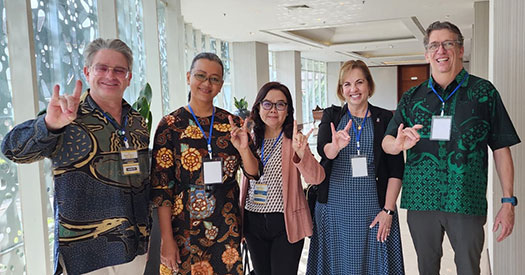
“They’re also interested in the possibility of having us deliver a master’s degree in Curriculum and Instruction for their teachers and for teachers at nearby schools to provide them with professional development and degrees opportunities in areas of global competencies, education and STEM teaching.”
Elish-Piper, who will serve as interim executive vice president and provost for Academic Year 2023-2024, appreciated her first-hand look at part of NIU’s ongoing legacy in Southeast Asia.
“I don’t think everyone on our campus knows about the rich, deep relationship,” she says, “or the amazing, accomplished alumni from Indonesia who are in incredibly important positions as well as the collaborative opportunities we have had and that we will have.”
Much of the credit goes to Dwight King, Jones says.

King, who joined NIU in 1978 and retired 30 years later, served as director of the Center for Southeast Asian Studies from 2006 until 2008.
Fluent in Bahasa Indonesia, he was awarded a Fulbright early in his career and later served as a visiting scholar in Thailand and Indonesia. Widely published on Indonesia, he consulted for the U.S. Agency for International Development, the Ford Foundation, the World Bank and the Mennonite Central Committee.
From 1999 to 2007, King was an adviser and election monitor in Indonesia and East Timor for The Carter Center; in 2012, he received a lifetime achievement award from the Indonesian government.
“He was a real mentor these students from Indonesia,” Jones says. “He recruited them, brought them and was an incredible shepherd to them.”
Similar impacts are happening for current Huskies who grew up in the United States.
Brinkmann witnessed that at SMA Pradita Dirgantara High School, where the director made sure that NIU students enjoyed an “amazing” time while so far away from home.
They saw a fashion show featuring costumes from different parts of Indonesia – with their faculty wearing them. They learned some Indonesian phrases. They learned about Indonesian food. They went whitewater rafting.
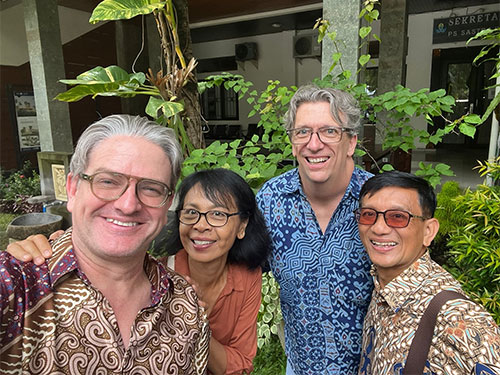
“Those one-on-one experiences are so beautiful and life-changing,” Brinkmann says. “I had the opportunity to go on that whitewater rafting trip, and many of the students who were on that trip said, ‘This has changed my life in incredible ways. I want to work in international education,’ or, ‘I want to work with students who are from other countries.’ ”
Many never had experienced a Muslim culture before, he adds.
“This school is a mix of Muslim, Christian and others, but certainly the Islamic world dominates in this part of Indonesia, and they had a great experience getting to know that culture in a deeper way,” Brinkmann says. “Now they can bring this understanding back to our country so, as we work our own diversity issues in our nation, we have champions for understanding and peace.”
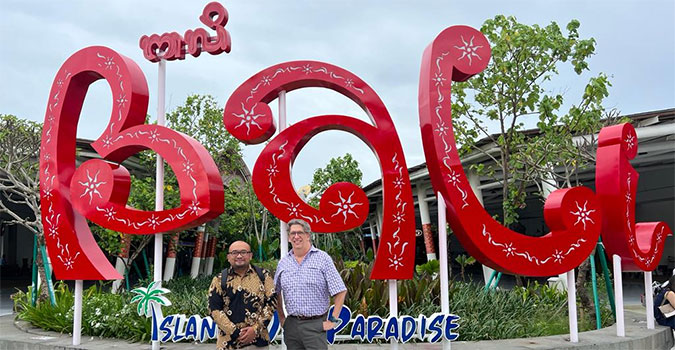
JONES BEGAN HIS OWN career in search of learning about other places and ways of life.
“I grew up on a ranch in Wyoming, and I had never gone anywhere,” he says. “The day after I graduated high school – and because of National Geographic – I went to Indonesia randomly, and I was completely bowled over.”
The world’s largest Islamic country. The world’s largest Buddhist monument. Seventeen thousand islands. Seven hundred languages. Delicious food. Gorgeous weather. Beautiful scenery.
“It’s this incredible crush of diversity that, when you go, you realize how these people are making it work, and it’s fascinating,” Jones says.
“And if you look at the conversation around diversity, equity and inclusion, international engagement with students and faculty is one of the best ways to actually expose people to other people and other ideas,” he adds. “It’s an incredible opportunity for us, and with this special one, which has been so curated over many decades, you see that the love goes both ways.”
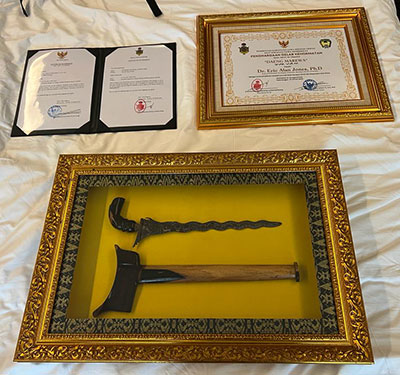
For Jones, his long and close relationship has resulted in an extraordinary recognition: knighthood.
His title, Daeng Marewa, means “Bravelord” in the Makassarese language.
“Bestowing royal title, or being knighted, is a longstanding Southeast Asian tradition dating back to the earliest recorded sources. It is a way for traditional kingdoms to engage and diplomatically connect,” Jones says.
“The Kingdom of Gowa-Makassar, where I was knighted by the Raja Gowa (the 38th king of Gowa), is one of historically powerful kingdoms controlling the Spice Trade from its strategic port in what is now eastern Indonesia,” he adds.
“I have been coming to this part of Indonesia for more than 30 years, including my first intensive language program, and have a close relationship with many students, families and friends in the region. Andi Malarangeng and Ryaas Rasyid, two of the four NIU Department of Political Science alumni who wrote Indonesia’s constitution, are from there as well.”
Brinkmann, who joined NIU in 2020, appreciates his opportunity to help advance the heritage his colleagues and predecessors built.
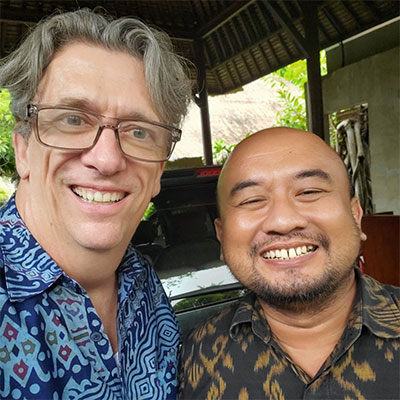
“It says a lot about our Southeast Asian Studies program that, for generations now, we can show up in a country, be known for our work all throughout Southeast Asia and be respected for it,” Brinkmann says. “NIU, from the middle of the cornfields, is able to consistently and doggedly do work, send students to do research, welcome students, provide a home for them and create an environment where there is cross-cultural dialogue that is respectful and that allows us to move forward.”
Visitors from Southeast Asia to campus recognize the global impact of their homeland when they realize how many of their languages are taught in the Department of World Languages and Cultures, he says, or when they hear their songs performed by ensembles in the School of Music.
“The fact that we’re teaching our students the cultural aspects of those countries means the world to them,” he says. “They feel respected. They feel understood. They feel heard.”