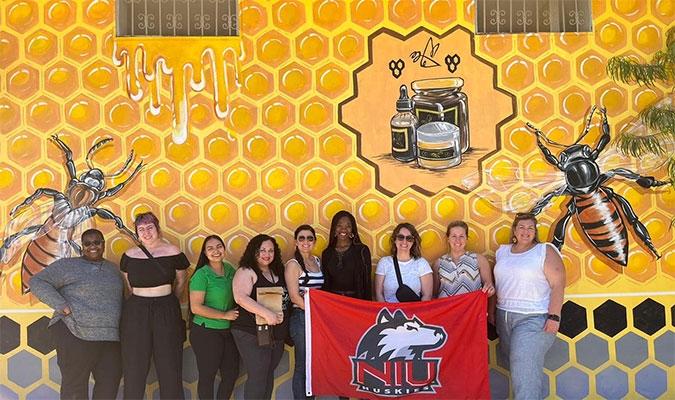

Spring break trips to Mexico typically involve beaches, bathing suits and beverages.
None of that was on the itinerary this month for Carrie Kortegast, associate professor of Higher Education and Student Affairs, and seven of her graduate students in HESA 590: Workshop on Community-Based Learning and Study Abroad.
The Department of Counseling and Higher Education group traveled to Bucerías for an immersion in socially responsible approaches to education abroad and tourism; education system and opportunities in México; and community-based approaches to learning and working with communities.
Although not all of the five doctoral students and two master’s students will work specifically in in managing study abroad programs, the experience will prove invaluable no matter their paths.
“Many of the principles around community-based learning can be applied to other types of educational programs domestically,” Kortegast says.
“We talked a lot about needing to build trust with communities – needing to listen, needing to engage, needing to think about how you approach them – and then relationship development,” she adds. “We also talked about how many of the lessons we learned were applicable in thinking about our own work on college campuses, and in working with our college communities, around the importance of trust and the importance of listening to individuals who know their own stories and experiences best.”
Doing so leads to “making meaning” and a deeper awareness.
“I think that when you go to, and learn about, other cultures that it makes you reflect on your own culture and cultural assumptions,” Kortegast says. “We talked about education and learning in a variety of different ways, both informal and formal learning, and met with people across the spectrum of education. Knowledge is not only people with degrees. We met people who are experts in their areas, and that doesn’t necessarily equate to a degree.”
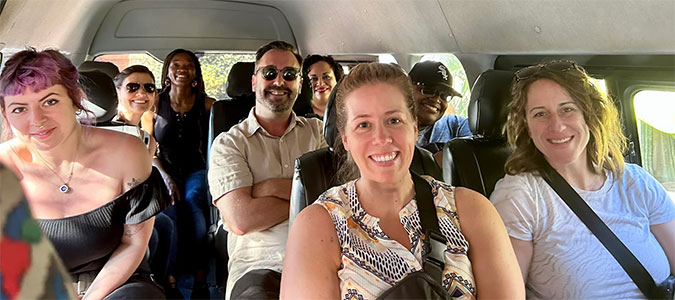
Lamia Shapiro, a second-year master’s student in Higher Education and Student Affairs, is one of the travelers who is planning a career in delivering international opportunities – and who now finds herself equipped with insight for a lifetime.
Visiting Bucerías “was absolutely an incredible experience. It was incredibly vivid and enriching,” Shapiro says. “We met some really incredible partners who had some inspirational stories, and it’s those stories that are going to stay with me for the longest.”
Her toolkit includes glimpses of academics and the administration of academics in Mexico, as well as discussions of “what student support looks like there,” she adds. “What I was able to listen to and learn I’m going to carry with me for the rest of my life.”
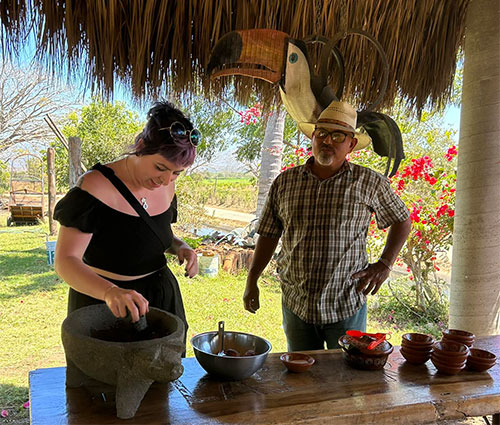
Fellow traveler Dora Escobar, who was born in Colombia and moved to Orange County, Calif., at age 7, appreciated the chance to see the power of bilingualism.
“The most impactful thing for me was to realize my privilege in terms of speaking two languages, because when I was growing up, that was not seen as a strength. I didn’t speak my language because I was laughed at, and that was something I’ve had throughout my education,” Escobar says. “Going there, and actually being able to do that, really put that into perspective for me, and I absolutely loved that part of it.”
Meanwhile, she adds, “I loved the authenticity of the relationships that were being displayed for us, the ability for me to ask questions to the partners from Human Connections and then giving them the floor and the space so that they could tell their stories – and they asked us questions. It was this real and beautiful interaction between human beings.”
HUMAN CONNECTIONS IS a non-profit organization committed to socially responsible approaches to educational programs and tours, to provide the Bucerías trip to her students.
Each day focused on a different aspect of community-based learning, with Thursday’s outing at the Entreamigos Community Center and Fundación Punta de Mita in San Pancho reinforcing the overall theme.
Monday examined responsible tourism and education abroad. Tuesday explored gender, migration and indigenous identity. Wednesday looked at public art and community engagement, while Friday studied higher education in Mexico.
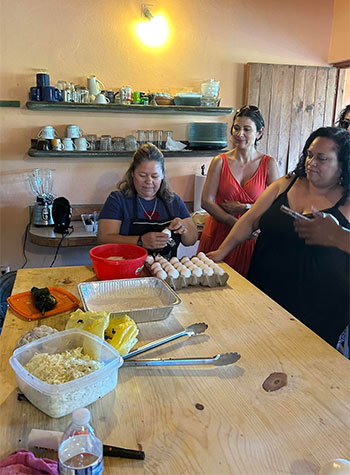
Photos posted to Facebook told the story.
- “On Monday, we met with Adela and Alberto at their huerto, a fruit and tropical flower orchard in San José del Valle. We learned how they shifted Adela’s hobby of growing exotic flowers into a wholesale flower business. We also learned about how their university age children help out and support the business. For instance, their daughter, who is studying marketing at the University of Guadalajara, runs their social media and website applying and is applying what she is learning in school.”
- “Next stop was to visit with Gilari, who co-owns Baymel, a store that sells honey-related products from her beehives. She shared about how she learned about beekeeping and how to make different products from her honey. She also discussed her educational experiences including getting a bachelor’s in accounting as well as the ongoing workshops she attends to learn to make products such as candies, cosmetics, beer, wine and different types of honey.”
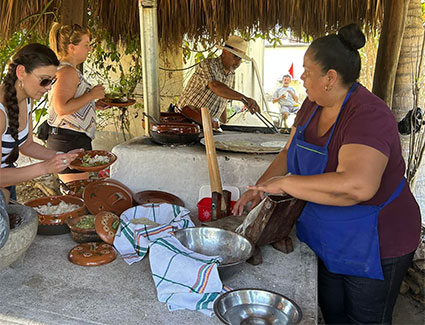
- “We visited Rancho Las Parotas in San Juan de Abajo, run by Segis and Yadira. Las Parotas is a sustainable ranch created from the founder’s discomfort with the environmental degradation caused by livestock and farming. Segis led us in a salsa making workshop and shared about the ranch. Segis and Yadira served us lunch on the ranch which included homemade tortillas from corn they grown themselves. They shared about their vision for the land and their goals to make it sustainable.”
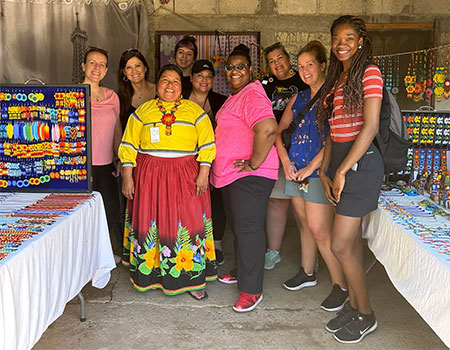
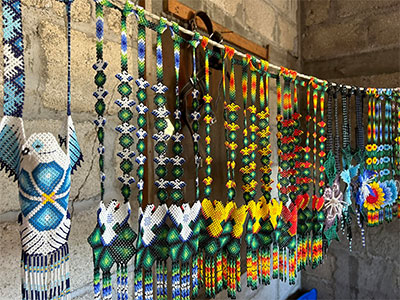
Separate trips introduced the Huskies to Leonarda, a member of the Wixaritari indigenous community who makes beaded necklaces, and Rolando, a weaver whose family migrated from Oaxaca to Nayarit to expand his business selling woven rugs, linens and other items in his store.
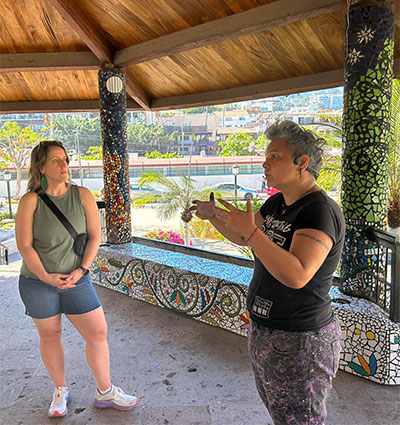
They toured El Parque de los Azulejos, a community-supported art installation that covered park benches and walls with mosaic tiles, and ArtVallarta, a nonprofit, bilingual art center founded by expats living in Puerto Vallarta.
Natasha Moraga, the artist who developed El Parque, talked about the project and her work in garnering community support and managing volunteers.
At ArtVallarta, meanwhile, the NIU group saw how the space was used to teach classes, host social events and spotlight local artists in its museum.
Various meetings in San Pancho brought to life the Entreamigos philosophy: “Everyone has something to teach, and everyone has something to learn.”
Entreamigos provides educational programs for all ages, houses the only free public library within a 50-minute drive, administers a scholarship program for local children, provides job opportunities for residents and coordinates the town’s recycling program.
A chat with cooking school owner Eve, who demonstrated the preparation of chile relleno, revealed how the influx of tourists and expats has changed San Pancho.
Leaders of Fundación Punta de Mita told the visitors about “the ways the collected data from community members around educational programs they wanted,” Kortegast says.
“Instead of assuming that they – the organization – knew what community members wanted in terms of educational programs or supplemental educational programs, they went to the community member asked. ‘What are your needs? What do you want to learn? What would help with your business? What would help with your children? How can we support you?’ ”

Friday’s focus on higher education meant a tour of Centro Universitario de la Costa, a branch of the University of Guadalajara, which includes a nursery where plants are grown for the campus and for students to sell.
While there, the NIU students ate lunch with and heard personal stories about college from Centro Universitario student Emiliano, who is studying video game design, and Jair, who is majoring in tourism at another university.
FOR GRETCHEN TAYLOR, assistant registrar at Aurora University, the journey to Bucerías nourished her appetite for volunteering.
Taylor, a doctoral student in the Ed.D. in Community College Leadership program, has volunteered for the last three years at Naperville-based Loaves and Fishes – an activity that never has felt like work to her.
She’s also taken two mission trips to Haiti, she says, “and I just remember who I was and who I became on those trips and what I learned. When this trip to Mexico came up, which was a combination of the educational piece and the service piece, I’m like, ‘This is singing to me.’ ”
Her favorite moments came during Thursday’s visit to San Pancho.
“We went to two different non-profit organizations that were grassroots types of establishments. Both of them serve the community that is right there, and there’s something about that that I found to be a blessing,” she says, “because that’s kind of what I wanted to do in my mind. I wanted to open a non-profit that serves women and children – women who are escaping abusive situations – and then add the educational piece and the opportunity for them to increase their socioeconomic standing.”
The latter is key, she says.
“I’ve witnessed women stay in situations because they couldn’t financially support themselves,” Taylor says, “and so if we are able to give them a hand up – not a handout – where they can take care of themselves with the knowledge and the confidence, that’s what I would want.”
Visiting Mexico reinforced her desire to make such a positive impact.
“Everyone is the same,” Taylor says.
“We may do things differently, but if you can go to another country, and learn from them, and also maybe shift to a ‘we don’t know everything’ perspective, and go into a space of learning with a spirit of gratitude, I find this mindset to be beneficial,” she adds. “What may work for us here may not be something that works in Mexico, so it’s important to gain other perspectives and learn from them, and then the ability to pivot will be a tool you can apply in your life moving forward.”
Maria Aguilar Beltran, a member of the Counseling Department faculty at Santa Ana College in California, shares that philosophy.
“Professor Kortegast set the course with some readings that really challenged our thinking. They were grounded in understanding how to look at a study abroad experience through a decolonizing lens and how to think about partnering with people,” says Aguilar Beltran, who is pursuing her NIU Ed.D. in Community College Leadership.
“It’s not us coming in as ‘American saviors,’ but more so, ‘How do we partner when we visit the country? How do we really learn from them and have this collaborative relationship that would help nurture our own learning and development?’ ”
She appreciated the requirements for critical self-reflection and each night’s discussions with classmates on the day’s experiences and conversations.
“That was really transformative for me personally, reflecting on what we heard and how it related to our own parallel experiences in the educational system,” Aguilar Beltran says. “They were really encouraging, and it motivated me to think about how I can take this information and apply it to the work I do.”
For example, she and Escobar could create a course with a study abroad component that “focuses more on mental health and social services, and how we develop that partnership, which took a long time to come to fruition. You have to have patience. You need to understand people’s cultures and dynamics. You need to build trust.”
Mexico provided a good example.
Leonarda, the Wixaritari woman who crafts necklaces, demonstrated a “heartwarming” and “authentic passion and love” for sharing her truth and her motivations.
“She said something that stuck with me. She wants people to see her for the human that she is – the person that she is – that there was a story to her, and that she wasn’t just a vendor selling these products with no name, family, aspirations or challenges,” Aguilar Beltran says.
“I hope that will continue to challenge us to be humble, to be open and to be willing to look at multiple perspectives and how we can leverage each other’s strengths to change the systems and structures that are not equal for all people and especially for people who come from disproportionately impacted backgrounds.”
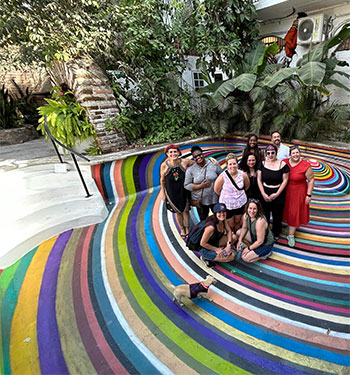
Escobar, faculty member in the Counseling Department at Santiago Canyon College in California, returned with similar observations.
The visit with Leonarda showed a woman with the “ability to just keep going, regardless of what’s put in front of her. I found that resilience just oozing out of her.” The visit with Segis, the rancher, showed a man who clung to his dream despite the naysayers, trials and tribulations and who not only achieved it but remains excited for the work.
Never having the opportunity for study abroad herself “as a first-generation student trying to work full time and do all these things to help my parents,” Escobar is now a champion for such programs “if they’re done the way it was done for us.”
“If they incorporate the critical reflection exercises, it will be changing lives,” she says. “If we wouldn’t have had that, I wouldn’t have had these ‘aha’ moments, because when we go into another country, we cannot assume that we know everything. We cannot assume that they have the same values that we have, and if they have different values, we cannot assume that our values are better than theirs.”
SHAPIRO, WHO WAS BORN in Turkey, moved to the United States with her family in 2003. She then grew up in Minneapolis, where her mother still lives.
As an immigrant, engaging across borders is obviously important to her – as is providing others with the opportunity to join her.
“It helps everybody, just by the sheer exposure to different cultures and in working to develop that cultural competence that can be applied in just about any setting,” Shapiro says. “I want to take as many students into study abroad with me as possible.”
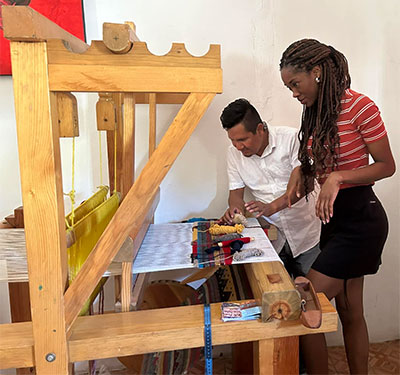
Visiting Bucerías advanced that ambition.
She absorbed “conversations regarding what ethical study abroad looks like, or on sustainable study abroad that doesn’t perpetuate any kind of western colonialism, or on meaning-making activities that don’t actually have a negative consequence to the local population or that don’t feed into the tourism aspect that a lot of students engage in.”
“The core of study abroad is being education-based and community-based,” Shapiro says, “so to be able to learn a bunch of the theories, and then to apply the theories to practice through the trip, has been absolutely invaluable.”
Kortegast enjoys the validation – along with a common thread she’s identified among many of her Bucerías travelers.
“What I’ve noticed about many of our NIU students in the master’s and doctoral programs is that they did not have a chance to study abroad in their undergrad experience because of financial circumstances or family circumstances … but they wanted to,” Kortegast says.
“So, part of my commitment has been to create a program in a time frame that works for working adults. I don’t think the answer is to not do it because it’s not the ideal way,” she adds. “We need to think about how we create short-term programs that are robust, are educationally sound and provide access and opportunity to students who did not have that before.”