What provides the key to driving solar-powered model cars to the finish line?
Observations and questions, apparently.
At least that was the case for a dozen Rockford middle-schoolers who spent a week with Pi-Sui Hsu this June.
“The purpose of the summer program was to introduce students to the engineering design process,” says Hsu, an associate professor in the Department of Educational Technology, Research and Assessment. “We wanted to see how they engage in the process, and also how they learn from productive failure and improve from that.”
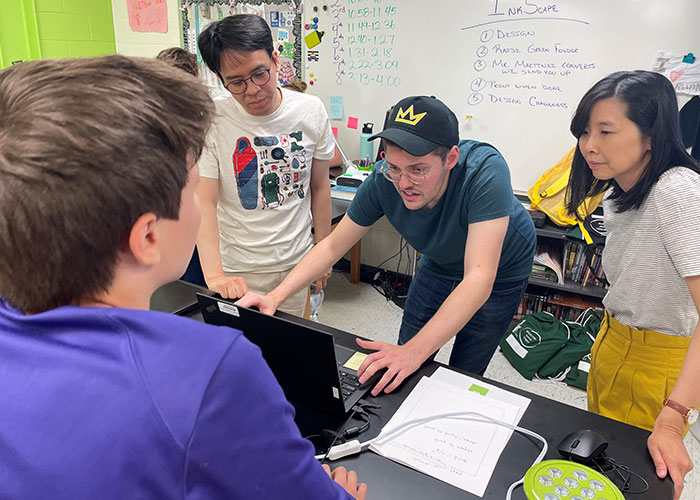
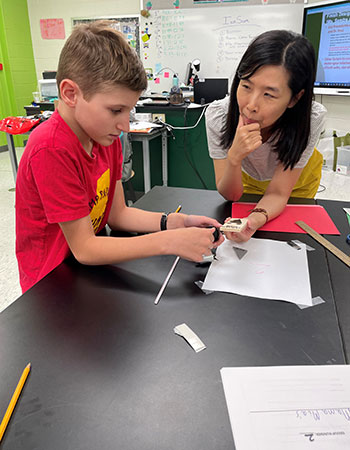
‘Gathering in a makerspace-like classroom at the Rockford Environmental Science Academy, the preteens spent the first two days hearing about their task for the week and the engineering concepts behind it before collaborating in small teams to design their prototypes.
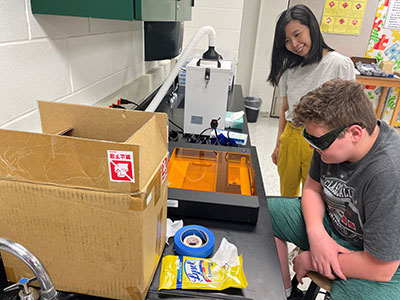
By Wednesday, they were using 3D printers and laser engravers to forge their racers before putting them to the test under the sun in the school’s parking lot. It was their first opportunity to glimpse the morning angle of the sun in comparison to the tilting of their solar panels.
“After that, we had a lot of discussions – why their designs worked or did not work – and, surprisingly, the students were really engaged in that,” Hsu says. “They made really good observations about their own cars and compared the strengths and weaknesses of their own cars to the other teams’ solar cars.”
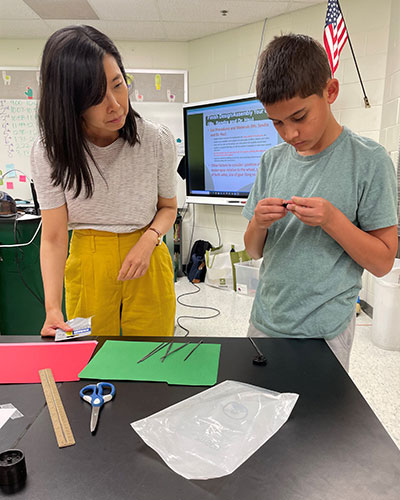
On Day Four, she says, “they put a lot of effort into modifying their solar cars. Some teams decided to take apart their cars and rebuild, and some teams decided to kind of just modify by identifying the weaknesses of their cars and starting from there.”
Friday brought a second, and final, opportunity to put the cars through the paces.
Despite some teams still not reaching the finish line, the overall results pleased Hsu.
“I think they made really good observations on where the angle of sunlight will come from during different times in the morning, and they also had looked into the weight of their solar cars because they have observed that the weight might impact their cars because they race on the uneven pathway,” Hsu says.
“They did a good job observing why their cars didn’t run fast or were unable to reach the end point,” she adds, “so I was really happy to see that they put a lot of thought into their redesign process.”
REDESIGN DELIBERATIONS AND DECISIONS engaged the preteens in scientific argumentation, a concept integral to Hsu’s work.
“On Wednesday, before they went outside for our solar car race, I showed them my car. I asked them to come up with a claim that their car will run faster than my car, and then asked them to show the evidence and the reasoning,” she says.
“After we came back, we had another round of scientific argumentation, and I asked them to weave that discussion into their redesign process so they could come up with good claims and use their observations as the base for their evidence and then consider the scientific principles as their reasoning.”
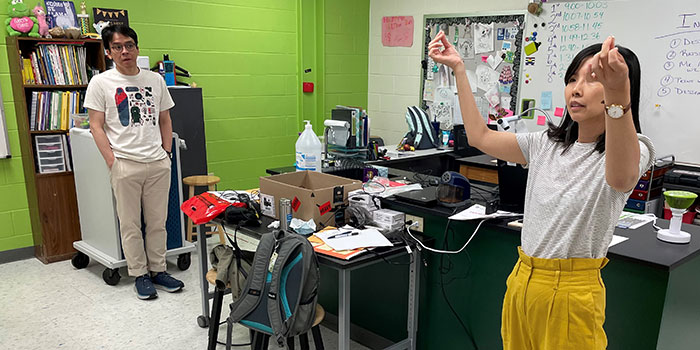
Joining Hsu in delivering the camp were:
- Co-PI Eric Monsu Lee, an assistant professor in the NIU College of Engineering and Engineering Technology’s (CEET) Department of Mechanical Engineering.
- Cassandra Sendra, a Middle Level Teaching and Learning major in the science content area.
- Jacob Martinez, a CEET graduate student in the Department of Industrial and Systems Engineering.
- Rebeccah Dyer, a Rockford Environmental Science Academy teacher.
Lee and Martinez played an important role, she says: “Without them, the program couldn’t be successful.”
“Dr. Lee provided a lot of guidance and instructions on the design tasks with 3D printers and the laser cutter,” she says. “Jacob did a good job assisting Dr. Lee and me on building the 3D printer, providing instructions to the students on both 3D printers and the laser cutter, and facilitating the solar car races.”
Sendra, meanwhile, enjoyed the opportunity to expand her repertoire of instructional strategies, practice her teaching skills, work with maker tools and learn about scientific argumentation.
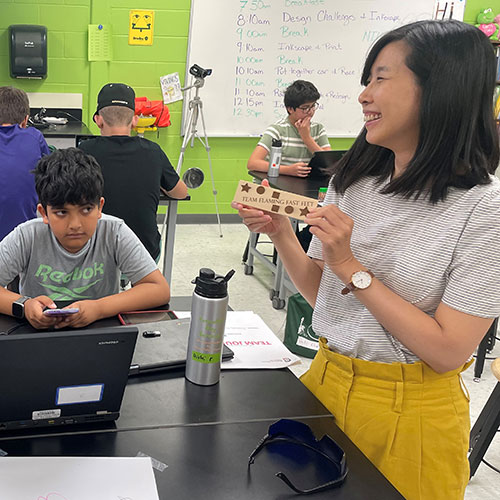
She also infused Hsu’s lessons with a contemporary pedagogy of science education: “I would say the benefits were mutual,” Hsu says.
FUNDED BY AN $11,283 GRANT from Rockford Public Schools 205, Hsu’s program accomplished several objectives.
“One advantage is to help them build their critical thinking skills, which definitely will help them with their schoolwork,” Hsu says, “but the most essential aspect of the program is to introduce them to different types of engineering and to help with college and career readiness. We introduce them to majors they can work on when they pursue college or consider engineering careers.”
She also examined their notions of who can become an engineer while also raising their awareness of what the profession encompasses.
“At the beginning of the program and at the end of the program, I ask them to draw an engineer and I ask them to fill out our Engineering Identity survey so that I can look into their perceptions of engineering,” she says.
“When some of the female students draw an engineer at the beginning of the program, they draw a male engineer. At the end of the program, some of them add a female figure to their drawing. I can see changes over just that one week,” she adds.
“In terms of engineering identity, I think it’s important for students to be aware that female and male students can pursue engineering majors and careers.”
Hsu says that lifting career aspirations is critical in Rockford, where 61.8% of students are considered low-income.
“Based on my past experience, when I talk to them, they all know mechanics – ‘Oh, my uncle is a mechanic’ – but when we talk about engineering, I think they have no idea that the two are connected, and that when we talk about ‘engine mechanics’ that we are talking about a more-advanced term and advanced skills,” she says. “By introducing this concept to them, we broaden their perceptions of what an engineer is capable of doing, that what they’re actually interested in doing belongs to the field of engineering and that they actually can become engineers.”
Already impressed by their creativity and their diligence to the task at hand, Hsu is optimistic for such an outcome.
Given that the camp also returned them to a school building and a classroom during summer break, she adds, their levels of interest, attention and focus surprised the professors.
“They were really thoughtful when they put together their argumentation and their design of the solar cars. Most students kind of stick to their first designs, but they kept modifying until the last minute before the solar car race,” she says.
“I saw a lot of strengthening there. They were truly learning the process and a lot of the principles that we talked about in class and trying to put those into practice,” she adds. “They really do want to come up with the solar car that they can race and that can race faster than the other team’s cars.”