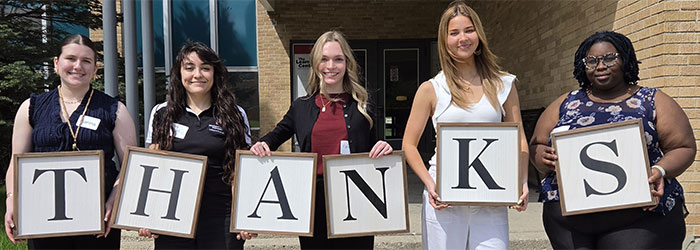
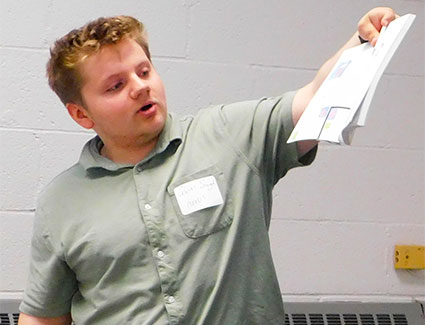
College of Education students in pursuit of teaching professions can apply for the Mary F. English Technology Award, which supports and encourages them in that goal while also furthering their use of classroom technology.
Participants – called Mary F. English Scholars – are given current technology for their academic, personal and professional use while they also connect with mentors, develop technical skills and gain experience using modern tools of learning and information.
Many also conduct studies into assistive technologies that empower learners with special needs, projects explained during oral presentations at the April 17 Student Research Symposium.
Kate Haupt, a junior Middle Level Teaching and Learning major from Rochester, Illinois, spoke about tools that meet the sensory needs of children with autism.
“I have always known that I wanted to go into education. I love the feeling of helping people, and especially children. There’s just nothing like it. It’s so impactful, and being in the classroom now working with kids just solidifies that for me. I know this is the career path for me,” Haupt says.
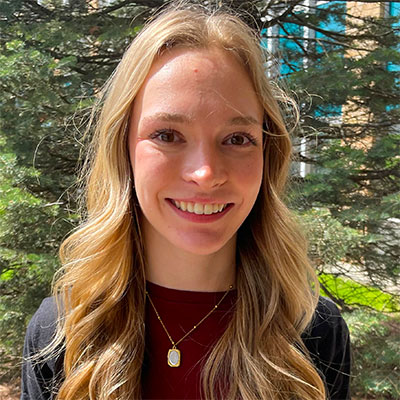
“Because my minor is Special Education, I haven’t been taking as many classes as a Special Education major would be taking, and so I wanted to feel better equipped to work with all students in my classroom and, specifically, my students with IEPs and 504 plans,” she adds.
“This program allowed me to a deep dive into those resources that are available for those students to meet the unique needs of every child.”
Haupt saw “incredible” differences during her research interactions with eighth-graders at Canton Middle School in U-46, where she is in her clinical placement.
“I’ve seen kids who would not talk to me in the classroom, who wouldn’t talk to their teachers in the classroom, who now have an outlet to speak. They feel comfortable speaking, and they have a way to express their feelings,” she says. “They’ve just been so much more involved with the content, the materials and with their peers than they’ve been the entire school year.”
Olivia Nieves investigated the potential of those same tools.
Nieves, a non-traditional student from suburban Oswego who is majoring in Physical Education, works at a private school as a paraprofessional for first- through third-graders.
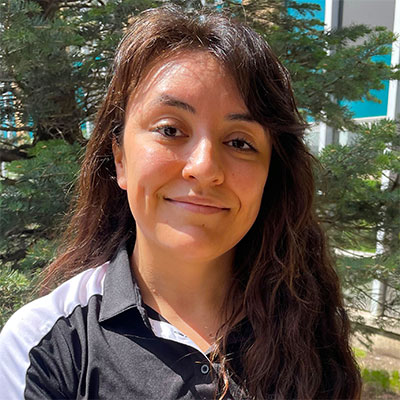
“As a physical education teacher, I won’t be really using iPads often, but I think offering, and learning how to offer, substitute teaching tools for students who need extra help is important,” says Nieves, a junior.
“I learned a lot. I learned that there are a lot of different levels of accommodations that can be met – hearing, visual, motor disabilities – and that all of those can be met and helped with different tools and assistance,” she adds. “At my school, I do have a few students who are on the spectrum, so learning how to meet their needs better made me feel confident.”
What changes did she observe?
“They truly thrive,” Nieves says.
“Prior to getting the tools or using the tools, they’re suffering. They’re not learning in the best way,” she says. “Once they get these tools, they’re truly able to learn and to focus on their growth and to be happy. Once they get these tools, they get confidence.”
For Hanna Lengquist, a Special Education major, the project – and the major – are personal.
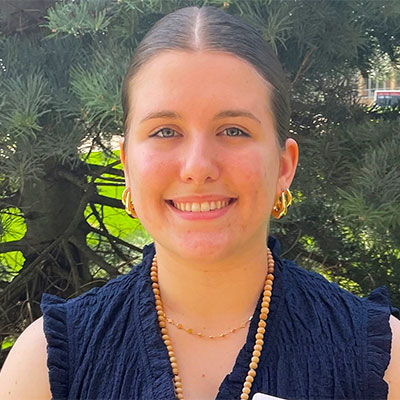
A junior from Dixon, Illinois, she is the daughter of a classroom paraprofessional and the sister of a brother with autism.
“I’ve grown up in the environment, says Lengquist, who plans to work with second- through fifth-graders, “and I want to be able to be an advocate and make sure that students get what they need.”
Beyond that, she previously worked with a paraprofessional whose students used TouchChat, a high-tech Augmentative and Alternative Communication (AAC) device.
Meanwhile, a good friend of hers who is a speech-language pathologist is a fan of AAC and strongly recommends its use.
“The Mary F. English program gave me the tools to create the low-tech AAC and the mid-tech ACC,” Lengquist says. “It gave the knowledge of how to implement it for different types of students and how to individualize it so that my students will have more access to language.”
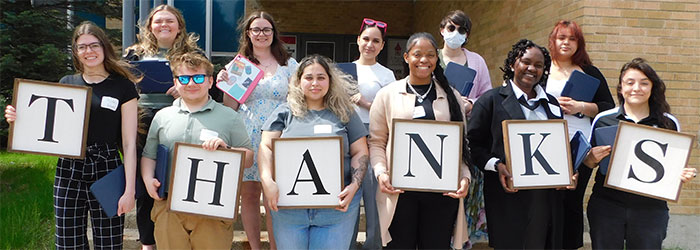
MARY F. ENGLISH SCHOLAR PRESENTATIONS
- “Assistive Technology to Meet the Sensory Needs of Children with Autism.” Marjorie Perez, Olivia Nieves and Kate Haupt.
- “Assistive Technology and Communication, Part 1.” Mary Baier, Jessica Zweifel and Sarah Sandrok.
- “Assistive Technology and Communication, Part 2.” Joci Hasson, Olivia Frieden and Jazmyn Frausto.
- “Assistive Technology and Communication, Part 3.” Hanna Lengquist, Zaria Townsend and Hannah Schori.
- “Assistive Technology for Vision Support.” Monica Moreno, Hailee Cox and Parker Myers.
- “Assistive Technology and Physical Disabilities.” Jasmine Griffin, Emily Lindenborn and Mia Malave.
- “Assistive Technology in Schools, Part 1: Adapted Book.” Ashley Adams, Haley Dahlstrand and Quin Singh.
- “Assistive Technology in Schools, Part 2: Adapted Science Lesson.” Anna Tyschenko, Staicy Okech and Roxanna Perez.