
Eleven students in NIU’s program in Visual Disabilities gained close-up exposure this fall to a career option they might never had considered.
Molly Pasley, assistant professor in the Department of Special and Early Education, drove the group to the Wisconsin School for the Blind and Visually Impaired (WSBVI) in Janesville.
A state-operated school, WSBVI offers a comprehensive education for its special population of students, providing small class sizes, highly qualified teachers and dedicated paraprofessionals along with fully accessible materials and the latest assistive technology.
For the Huskies, however, a day in Janesville heightens awareness – and, for the first time, two students in the Vision Rehabilitation Therapy track joined the future teachers.
Observations included lessons in braille, cooking and an orientation-and-mobility class where students safely navigated their community’s streets and sidewalks, all of which are parts of the Expanded Core Curriculum that is compensatory in nature and addresses the disability-specific needs of people with vision loss.
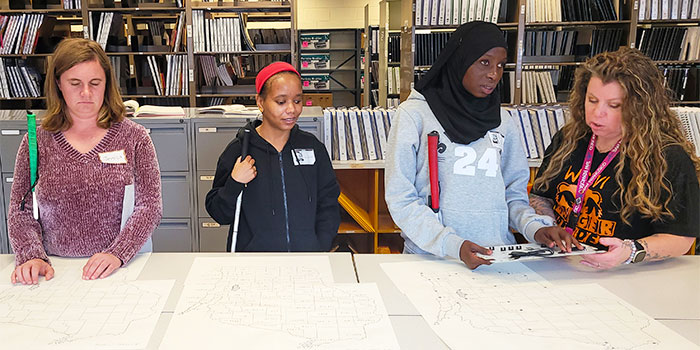
“We’re trying to provide our NIU students with as many opportunities to observe quality instruction as possible,” Pasley says.
“NIU pre-service teachers are responsible for observing an itinerant teacher – one who goes to the kids, who travels between schools to provide services to the children in their home school,” she adds, “and now they have experience in a residential setting, and in some cases to a resource room setting, before they get into their clinical placements.”
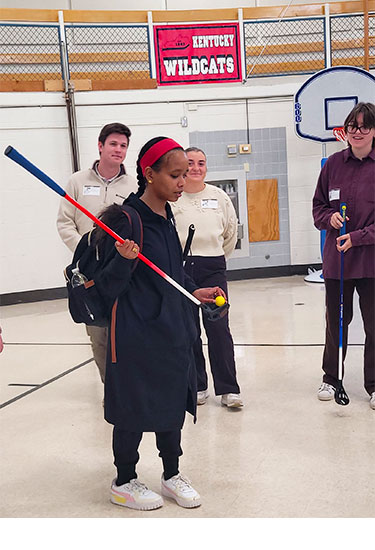 Students at WSBVI “are at various stages in their vision loss journey and of various ages.”
“You have some folks who maybe have graduated from high school, or aged out of high school, and are now getting the ‘expanded core’ – those areas as their primary focus in what we would call a transitional living skills program or a ‘fifth-year program,’ ” Pasley says.
“It’s an opportunity for those students who may not be ready to start going full time at a college,” she adds. “They can build up some of those activities of daily living skills – budgeting, money management, cleaning, caring for their home, making meals. The transitional living skills program can also set them up with a job on or near campus.”
NIU students also saw some new and different instructional strategies and were able to ask questions of WSBVI students and staff during a panel discussion.
Responses of the WSBVI students “were overwhelmingly positive in terms of their experience at the school for the blind. Where they had lived and the services they were getting in their home area were not necessarily great because of the limited resources available in their home district,” Pasley says.
“When they came to the Wisconsin School for the Blind, they found that they didn’t have to think about being visually impaired because everything was adapted to meet their needs – that’s what the school is built for,” she says.
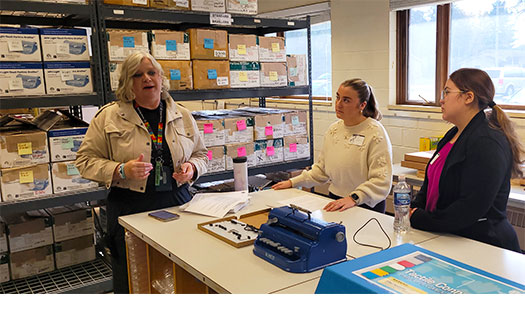 “It was really powerful for our NIU students to hear that coming from their future potential students and not just us as instructors and professors telling them about the importance of independence and the importance of these extra skills that we teach outside of academics.”
Bonus?
Confirmation of a job market continually confronting a critical shortage of workers.
“They have a job opening – I believe it’s been for two or three years that they’ve not been able to fill – and so, if people are willing to relocate, they’re happy to scoop them up,” Pasley says. “The last two semesters, we’ve placed student-teachers there. It’s been a very supportive environment, and our current student-teacher? They want to hire her.”

