
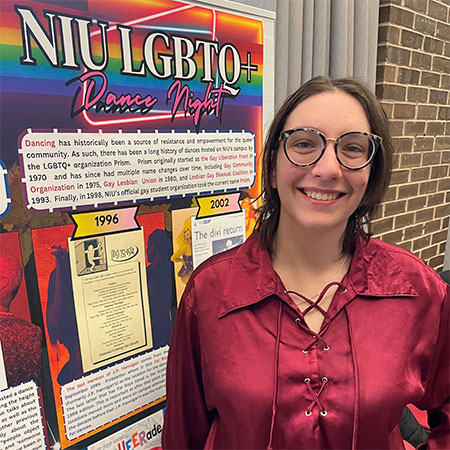
As a member and leader of Prism, Peregrin Capriglione is fully familiar with the campus organization’s work to provide educational and social activities for LGBTQ students and their allies.
Now, thanks to their HESA 500: Foundations of Higher Education course, Capriglione is aware that it wasn’t always so easy for their predecessors – including the scheduling of dance parties.
The assignment from Associate Professor Carrie Kortegast required first-year graduate students in the Higher Education and Student Affairs program to plumb the Founders Memorial Library archives to research various aspects of student life at NIU from the past.
“We noticed early on in the org’s history that dances were usually held off campus,” Capriglione told the audience Dec. 6 at a “Looking Back: Stories of Student Life at NIU” poster presentation. “The earliest one that we have represented on the poster is from 1986, just because it was one of the first ones that actually listed a location on it. Before that, it was usually, ‘Call for location,’ which was a safety thing that they did to make sure that no one would interrupt them.”
Their project, in collaboration with Juana Naa Akosua Appiah and Sovannak Ra, shared space with others that examined such topics as the African Students Association, the CHANCE Program, NIU student activism at 1968 Democratic National Convention in Chicago, an underground publication called “The News from Nowhere,” William the Goose and more.
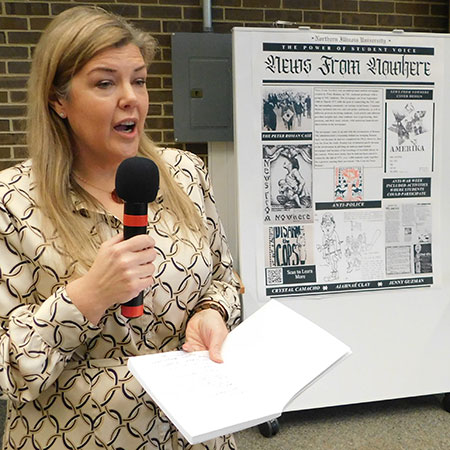
Kortegast liked the results, both the posters and the realizations.
“One of the things that we try to do in this class is to think about how we resist ahistoricism within our work – to think about contemporary practice, how colleges work or student life or why do we have particular processes. A lot of the time, there are historical reasons for it,” said Kortegast, whose assignment was loosely inspired by one she was given during her master’s program at the University of Massachusetts.
HESA 500 confronts that ahistoricism, which is defined as “historically inaccurate or ignorant.”
“Part of the goal in this class is to go back and see what it might have been like in a particular time frame at NIU and how that may inform the work and experiences of students today,” Kortegast said. “We see legacies – traces of student experience – from the past into today.”
Equally important for the future Student Affairs administrators to see, she added, is what’s missing.
“This project reminds me, both as a faculty member and former professional, that we have evidence of the official university records because the university is good at keeping records of itself,” she said.
“The harder thing, that we don’t have as many records of in the archives, is students – student life, student experiences, student organizations,” she added. “As a practitioner, one of the things you can do is try to find ways to share information, photos, ephemera, documents – and encourage student organizations to give some of their materials to the archives because that is a way we can document this, and a way we document it beyond the institutional perspective of events.”
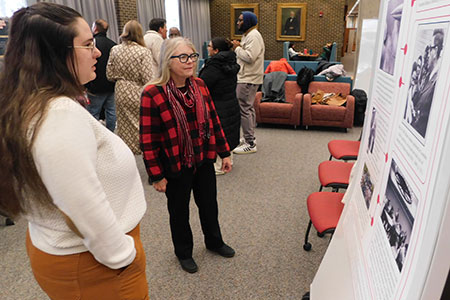
Some of last year’s posters, which were added to the archives, have been pulled from storage to display at appropriate campus events.
“It’s spectacular to see student work that is ‘beyond the moment’ and used in larger ways,” said Kortegast, a faculty member in the Department of Counseling and Higher Education since 2014. “The students are also putting together blog posts about each of their projects that will be housed online.”
Research support came from Founders Memorial Library staff Bradley Wiles, associate professor and head of Special Collections and Archives Department, and Alissa Droog, assistant professor and Education and Social Sciences librarian.
“These are the kinds of things we want to do – these substantial interactions with departments across all disciplines, not just historians,” Wiles said, calling the posters “enduring resources.”
“What is impressive to me about this is that we have a group of students who mostly had no experience with any sort of primary research, or doing historical research, but they found that one source or that one fact or that one idea, and they really took the ball and ran with it,” he added.
“You’re seeing their interpretation of stories that we all have in abundance, like most places. Everybody’s got stories. You’re seeing that contribution to knowledge of the things that we know about NIU and about our past and about what makes this a special institution.”
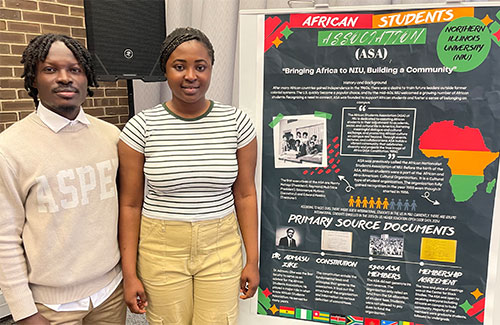
DEBORAH AHENKORAH AND Kenneth Amponsah, both of whom are from Ghana, examined the history of NIU’s African Students Association.
Established in 1983 to promote cultural awareness and unity, the mission remains the same more than 40 years later. That’s key for current for Huskies who travel more as many as 6,000 miles to live and learn in DeKalb, Ahenkoran and Amponsah said.
Both serve as graduate hall directors in NIU’s Patterson Complex, where they personally glimpse the benefits of that concept and realize a deeper appreciation for what the African Students Association advanced.
“One of the things that I believe is going to be very critical in my work is identifying students with challenges that they are going through and giving them help,” Amponsah said. “Going through this, we came across the reasons why the organization came to be: giving students a sense of community and giving them that belonginess. As practitioners, this will help us so that we can meet their needs to meet their challenges.”
“Having that sense of community is kind of nice,” Ahenkoran added. “It’s very important to encourage students to be part of an organization. They feel like they belong, find their community and are provided with the resources they need.”
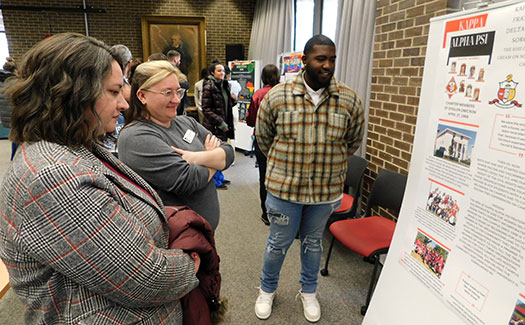
For Olivia Newman, Matthew McConnell, Tiffany Dixon and Michael Rojas, who explored the history of Delta Sigma Theta and Kappa Alpha Psi, the insight was similar to Capriglione’s.
Kappa Alpha Psi was the first Black fraternity at NIU to acquire a house on Greek Row, McConnell said, providing Black students “a safe place to go.”
“It makes me have a greater respect for the people who came before me,” said McConnell, a member and officer of the current group. “Seeing the fight they had to put up to get everything for us kind of inspires me, in my position, to pay things forward in the same way they did so we can set up the people who come after us.”
Jenny Guzman, who researched “The News from Nowhere” with Crystal Camacho and Ajahnaé Clay, also got a glimpse of the late 1960s and early 1970s and the anxieties that the social and political upheaval caused on college campuses.
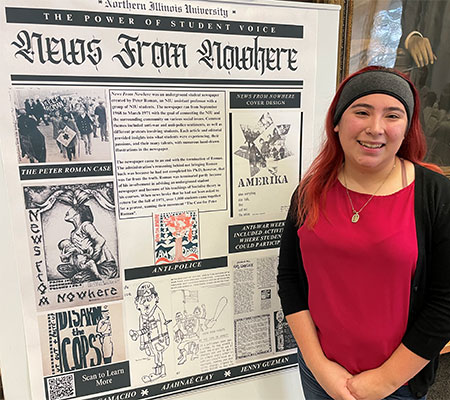
“Usually when we come to school, our intentions are to learn about all the different subjects, whether that be math or psychology,” Guzman said.
“These students had to learn how to find antidotes for getting teargassed or maced. They were getting thrown into jail. They had to learn their rights. They were trying to find ways of not getting enlisted or into the draft,” she added. “That’s something very impactful because, for good or for bad, we don’t see those types of protests anymore on campuses.”
Not every project was as serious, although even the lighthearted determined “how student advocacy can get things accomplished.”
William the Goose, anyone?
“In William’s saga, he was incarcerated and kind of banned from campus because of some indiscretions,” said Sarah Sweet, who with Tahsa Neisewander and Nina Osborne looked into the critter’s story. “The campus community and DeKalb community came together to sign petitions, protest and get William released from his incarceration and allowed back on campus. The AP published a story about William, so this was nationwide news.”
While publicity was what the Prism members of decades ago were trying to avoid, Capriglione said, that gradually changed as attitudes evolved.
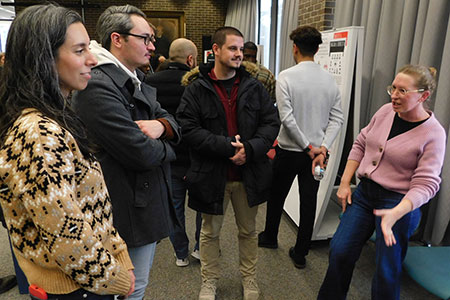
Events no longer needed to take place in clandestine spaces.
“The dances slowly trickled to being on campus, and I think that just shows how much more inclusive campus has gotten over time. It’s safe to be on campus rather than worrying about getting outed,” Capriglione said. “It’s also a lot more accessible because it’s easier for some people to get to these on campus than it is off campus.”
They also realized the same call to action McConnell felt in his group’s study of Black fraternities and sororities.
“For people who are queer, it’s good to know your history, because I feel like we take for granted a lot of the rights and freedoms we have now,” they said. “We need to understand where we came from, and that might also help us understand other members of the community and how they feel.”
Other graduate students who presented their work were Jennifer Agyeman, Brian Herrera Rivas, Teslin Kerley, Sophie Miller, Charles Obiakor and Amanda Quinonez.
