
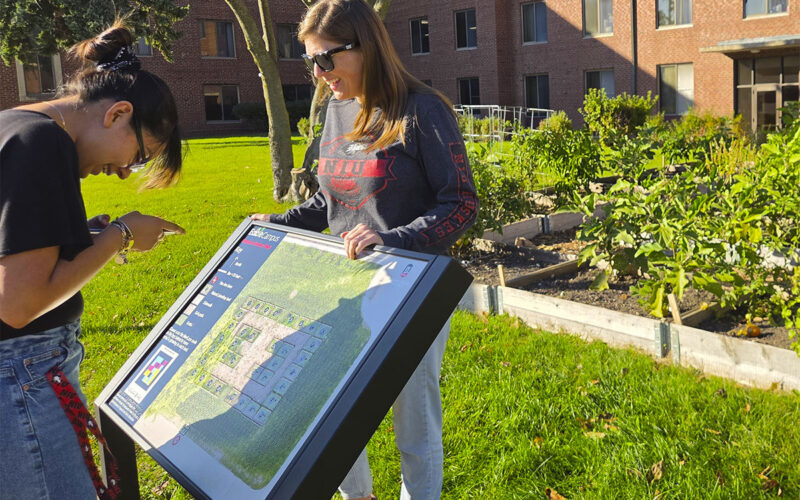
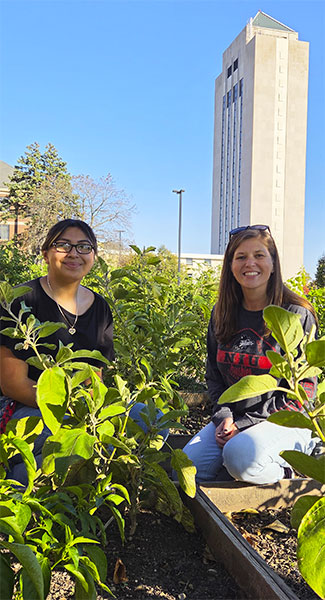
Locating, choosing and picking fresh produce from NIU’s Edible Campus garden near Neptune Hall has become accessible for people with visual impairments.
That happy harvest is possible through newly installed, weather-resistant physical signage in durable braille and large print next to digital signage designed for NaviLens, which allows users to independently find points of interest in their environment and to learn more about these via an app that scans their surroundings for specific NaviLens QR codes.
Although anyone can use NaviLens free of charge, the technology was developed especially for people with visual and hearing impairments, people whose native language is not English and people who are unfamiliar with, or simply curious about, where they are.
Faculty in the Department of Special and Early Education’s Vision Studies Program planted these seeds after initial meetings with members of the Edible Campus team in 2024.
“Stacy Kelly and I spoke with the folks from Edible Campus early in the process and thought it would be a good idea to also provide accessible signage at their ‘free-to-pick’ garden outside Neptune North Hall,” says Molly Pasley, an associate professor. “They did not have any plans for signage at this point.”
Pasley and Kelly then worked with Matthew McCann-Molina at the NIU Foundation to obtain drone images of the area and with Steve Landau at Touch Graphics Inc to create the accessible signs.
Financial support came from Kathleen Kengott Opportunity Fund for the Advancement of Special and Early Education; the longtime philanthropy of Raymond and Kathleen Kengott at NIU also includes scholarships for students studying special education.
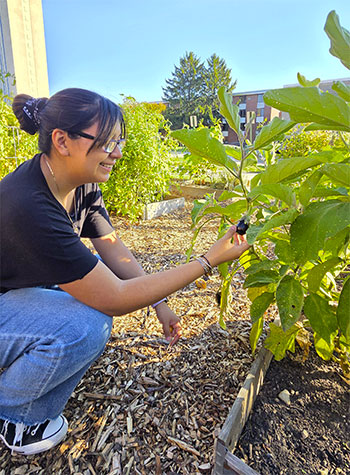
More assistance was provided by Department of Special and Early Education colleague Susan Dalton, a certified vision rehabilitation therapist and instructor who helped draft language for the NaviLens codes.
“When we planned the signs, we wanted to make sure that the physical sign reflected the physical environment – plant beds, walking paths,” Pasley says.
“However, we knew that the crops being grown in the raised plant beds had the potential to change so we knew we needed to have a ‘changeable’ element to the map,” she adds. “This is why we decided on using NaviLens codes to list the crops in each of the beds.”
In addition to a listing of the items, she says, “we also wanted to provide information about how to tell when a vegetable is ripe based on visual, tactile and olfactory descriptions. We think that this is vitally important for all people to be able to independently access the gardens to pick vegetables and herbs.”
Visual Impairments major Mayra Badillo-Mendez, a sophomore from Milwaukee, and Holly Nicholson, Inclusive Technology manager for NIU University Marketing, agree.

“NaviLens has been an important investment for accessibility and wayfinding on campus, and we are excited to see its use expanded to campus sustainability,” Nicholson says. “It’s essential for all students to be able to access the healthy produce our Edible Campus gardens offer in a way that that’s clear and easy to understand.”
Badillo-Mendez calls it “so cool to have a specific code for the garden with all the information,” adding that “having this service available is important because it is open to everyone.”
“As students living in dorms, we might want to change our everyday meals somehow, and with just adding some different toppings like chives, or different ingredients like onion or tomato, it really does change our meals,” she says.
“I have also used it just to see how the produce grows. The NaviLens lets me know what is in the beds of the garden so, instead of trying to figure out everything that is growing, I can listen to the NaviLens say everything to me.”
That’s why Badillo-Mendez, who was born with cataracts that were surgically removed, and who later developed aphakic glaucoma, encourages others who also have visual impairments to take advantage of the guidance NaviLens provides in terms of when produce is ready to pick and eat.
“Overall, this project shows that anything can be made accessible, so we should try to support it because if people see the interest in this project, it is more likely that other projects can be made accessible,” she says, “and that is a win for the visually impaired community.”

