Jayda Greiwe entered her Educate Global trip to Malaysia “with no expectations.”
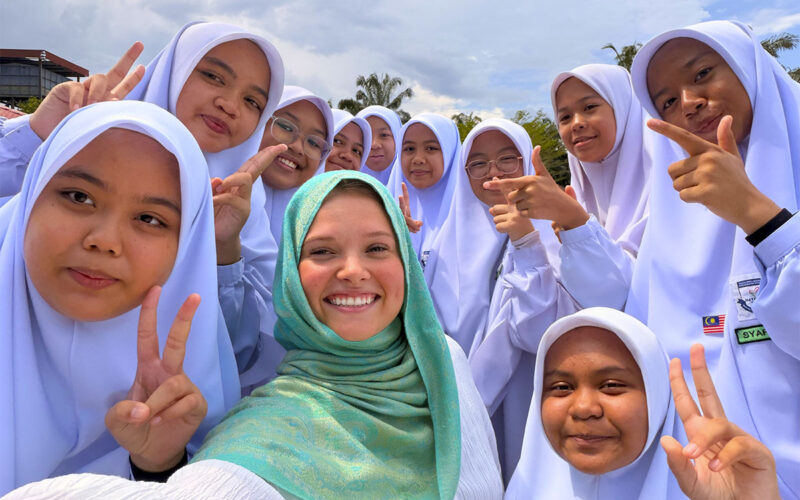
Yet the senior Elementary Education major from Palatine cannot say the same about the students ages 13 to 17 who she met at Imtiyaz Islamic School.
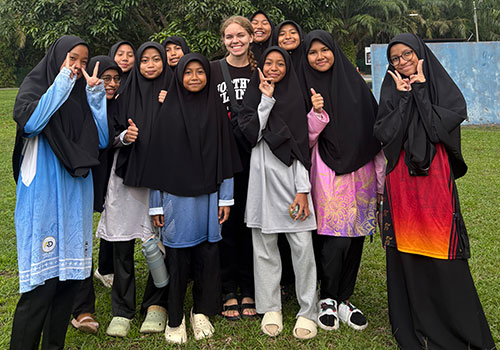
“They had a lot of pre-existing thoughts that we were going to judge them on their English,” Greiwe says, “and that’s exactly what we were not going to do when we were there because their English was not as strong as ours – us coming from America – and being able to have that connection with someone who is an English language learner was so important. We created a connection with every single student in our class and in all of the other classes as well.”
Same, says fellow traveler Julia Rozalowski.
“My main takeaway was how important the relationships were with the students,” says Rozalowski, a junior Elementary Education major from Plainfield.
“Being able to understand what they like and to bring that into the classroom was a way to make sure that they were engaged, and made it even more rewarding in that sense,” she adds. “I feel like I’ll become a better teacher just because I learned so much about how different every student is, and being able to pay attention to not only their interests but also their different needs in the classroom, and their different strengths and weaknesses to work on, will be really beneficial.”
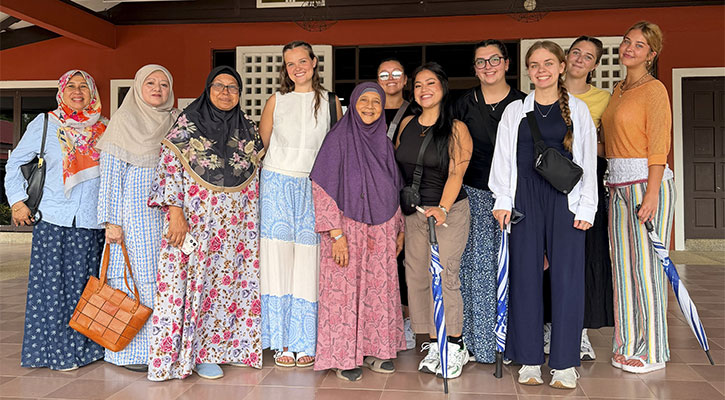
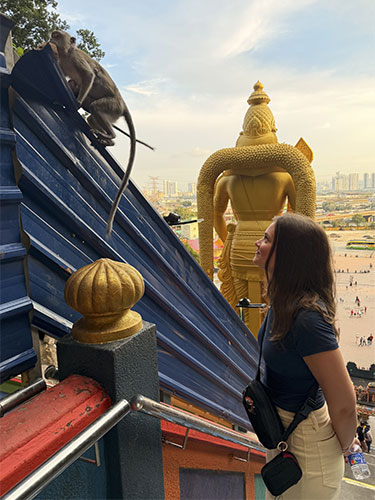
Greiwe and Rozalowski were among seven Huskies who made the first Educate Global trip to Malaysia. Joining them were Joy Hernandez, Anna Melik, Hannah Schori, Mia Raguay and Christine Venditti.
FOR GREIWE, WHO WILL graduate in December, “every day brought new perspectives, new challenges and new opportunities to grow.”
“Working with these students has shown me the importance of patience, empathy, adaptability and genuine human connection. They welcomed me into their lives with open hearts, and in return, they left a lasting imprint on mine,” she says.
“Knowing that I was able to be in a completely different country made me realize how schools work there. In America, we plan things months in advance. In my student-teaching, we have December writing plans already,” she adds.
“In Malaysia, it would be maybe two days before the day of – ‘All right, we’re just going to do this today.’ It was just kind of in the moment, very laid back, and so being able to adapt to a different learning style, not just as a student but as a teacher, was important.”
She thinks about the famous mantra of James Cohen, a professor in the Department of Curriculum and Instruction who oversaw the trip with Teresa Wasonga from the Department of Learning Innovation, Leadership and Technology.
“Dr. Cohen said to us that we need to replace judgment with curiosity, and that’s exactly what I did in every situation,” Greiwe says. “It made me take a step back and fully appreciate every single thing that we were doing there. Every moment was perfect and made me learn so much about not just who I want to be as a teacher but also who I am as myself. I feel like I grew a lot as a person while I was there.”
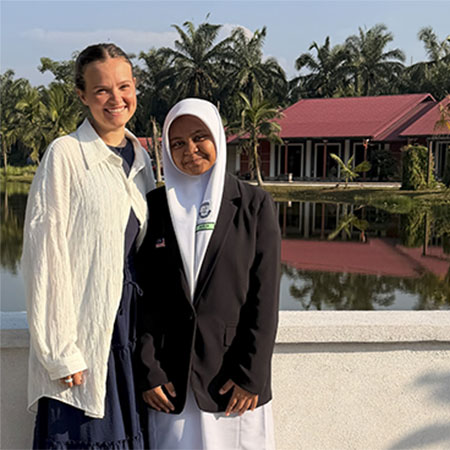
Her students helped advance that.
During one classroom lesson, she wanted them to think not only about how hearing words paints pictures in their imaginations but also how details power comprehension.
She started by saying, “The girl rode on the bike.” Then, she asked them to close their eyes as she embellished the story with the girl’s hair color, the time of day – “dusk” – and how quickly she was pedaling to reach home before dark.
Greiwe then told the students to write instructions for making peanut butter and jelly sandwiches before selecting five to read aloud with her props ready.
“They would say, ‘OK, grab the bread’ – and I would grab the loaf of bread. ‘Put peanut butter on it.’ I would grab the jar of peanut butter and put it on top of the loaf of bread. ‘Put jelly on it.’ I would grab the jelly and put it on top of the peanut butter jar,” she says.
“And we just kept going, and some would say, ‘Open the lid and scoop it out.’ So I would open the lid, and I would take my hand, and I would scoop the peanut butter out. And they said, ‘Spread it on.’ And I said, ‘Spread it on?’ I started spreading it on my arm, and then I would spread the jelly on my other arm. It was interactive, and they were laughing.”
During another lesson, the adolescents impressed Greiwe again.
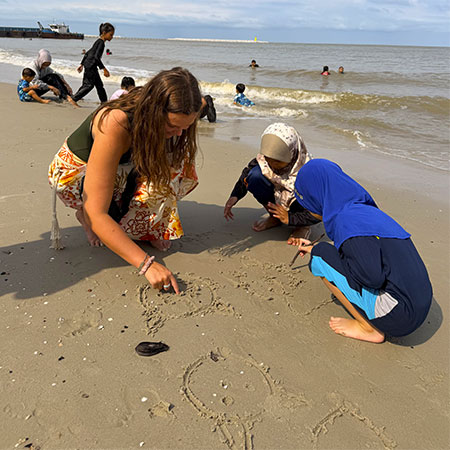
Her challenge for them was to “think of a problem in our world and what they could build to solve that problem.”
“Someone said, ‘We waste a lot of water bottles,’ so they made a water bottle that was made out of fish food so that if it was thrown into the water then the fish could just eat it and it doesn’t go to waste,” she says.
“Another group made a bookshelf that had a front cover on it. I was like, ‘A bookshelf? We have one over there.’ And they said, ‘No, we don’t have bookshelves. We have bins that are just on top of each other,’ and because it’s so humid over there, everything just breaks. All of their books end up deteriorating.”
One realization led to another.
“Being able to appreciate a bookshelf was eye-opening for me, and the way that every single person there put so much love and thought into everything,” she says.
“It wasn’t just because we were there. It’s how they treat their professors. It’s how they treat their friends. It’s how they treat their family. Everyone is so loving and outgoing,” she adds. “I was able to think about that in myself. I think of myself as a very loving person, but I was able to take that extra step of it, that I should be more like this every day.”
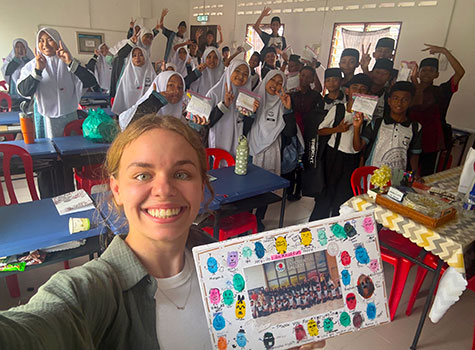
ROZALOWSKI DECIDED “to take a leap and apply” for a spot on the Educate Global plane despite not having clinical experience yet as a then-sophomore.
“I thought I would not even be considered, so I wrote about that – I listed other experiences I had working with students through working at a daycare and babysitting – and then I continued my application,” she says. “I’m very grateful that I did because it was definitely an experience to remember.”
Her path toward the NIU College of Education began in elementary school, where she routinely was pulled out of class for speech intervention.
“My second-grade teacher was the first teacher to recognize that I was really falling behind,” Rozalowski says, “and to then really make a connection with me and to give me one-on-one instruction and support in the classroom. Being able to see her impact on me, I wanted to pay that forward by building connections with my own students and changing their lives, and touching their lives, in the same way.”
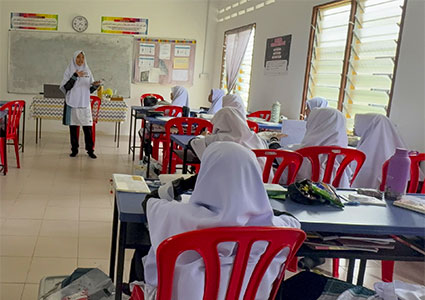
During her time in Malaysia, she taught phonics, public speaking, writing, science, math and more to 13-year-olds, the school’s youngest population.
Favorite activities include a volleyball extracurricular and “dialogue journals” where teachers and students wrote messages to each other.
“We started off with a prompt, they would respond to us, and we would respond to their responses,” Rozalowski says. “I am not a night owl at all, but I found myself at night wanting to stay up and respond to them fully. It was just so precious being able to see my students read their journals and then be like, ‘You wrote all of us in just one day?’ ”
Meanwhile, as she was teaching them, they were teaching her.
Because the native tongue of the students is Malay, Rozalowski started to learn some words in their language. And because she is Polish and fluent in the language of her immigrant parents and her relatives, her Imtiyaz students wanted to learn some Polish vocabulary.
“At the beginning of the classes, the students stand up and say, ‘Good morning, Teacher Julia,’ and at the end of the day, they say, ‘Thank you, Teacher Julia,’ ” she says. “After they learned how to say those things in Polish, they would say it in that language too as they walked out.”
Her memories from overseas now inform her learning back inside Graham and Gabel halls.
“If I’m learning something in my classroom management class, for example, I tend to think about the students I had in Malaysia. I look at the coursework and I try to relate it to them,” Rozalowski says.
“And now that I’m also in a clinical experience, I’m connecting it to both classrooms, trying to find common balance and making sure that I am meeting individual student needs, respecting their culture and creating a positive classroom environment,” she adds. “Before going into my clinical experiences, that outlook was there – but I didn’t have something to compare it to, or the different challenges or strengths that came up during my experience. This gave me new things to think about that I wouldn’t have thought about in the past.”
Practicing her future career in a foreign environment also equipped self-realization.
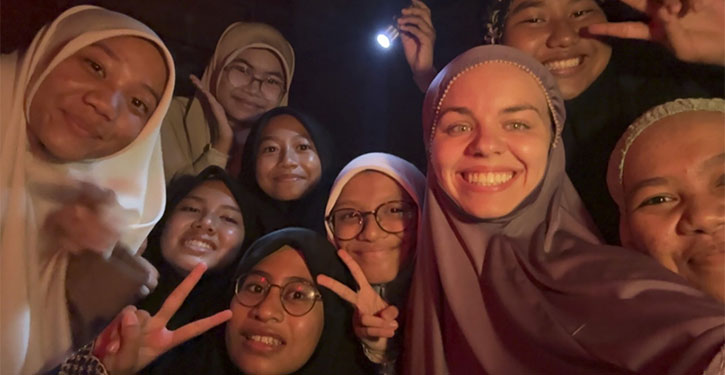
“I always enjoy learning about different cultures – that’s always been something that I’m interested in – but something that strengthened during the trip, and that I learned about myself, is how much I enjoy when I can do that with other people and we can exchange cross-culturally,” she says.
“Rather than just watching a video, or doing research on my own and trying to put the pieces together, I really enjoyed being able to connect with the students and the staff and even others in the community when we went out to the stores or for some food or on any cultural excursions,” she adds. “I learned that interaction is really important.”
BOTH STUDENTS WOULD RECOMMEND Educate Global to other preservice teachers at NIU.
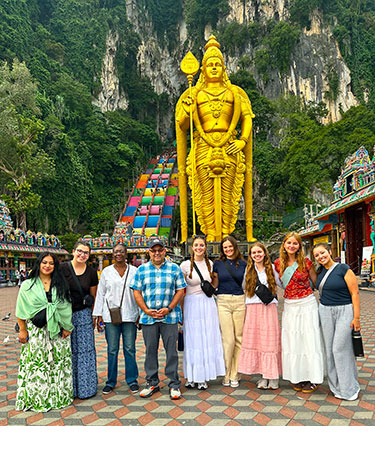 “Educate Global doesn’t only make you a better teacher but it makes you a better person as well,” says Rozalowski, who knew going in that international travel would deeply impact her.
“I feel like I look at life with a completely different lens now, and it just makes me appreciate life a lot a lot more. I work harder toward my goals, even though they seemed so much clearer in the past,” she adds. “And the students from NIU who were there formed really good connections. I also formed connections with my professors. It just made NIU feel like a bigger community.”
Greiwe found that as well.
“What makes this experience even more special is the privilege of sharing it alongside six incredible teachers,” she says.
“Together, we laughed, learned, supported one another and created memories that will stay with us long after we returned home,” she adds. “I am overwhelmed with gratitude for every student who welcomed us into their classroom, every teacher who opened their heart to us and every person who played a part in this journey.”
It was a journey that left her heart “full and heavy – full of gratitude for everything I have been given, and heavy because it was so difficult to say goodbye to a place and people who have changed me forever.”
“This experience reminded me that some of the most meaningful moments in life happen when we step into the unfamiliar and allow ourselves to be transformed by the people we meet along the way,” she adds. “Bagai bulan dipagari Bintang – like the moon surrounded by stars.”