Many years after NIU students began visiting Indonesia’s Al Azhar Yogyakarta Islamic School to practice their skills as preservice teachers, Professor James Cohen can describe that Educate Global program in three words.
A well-oiled machine.
Such was not the case, however, for the experience introduced this summer as an additional option for travelers.
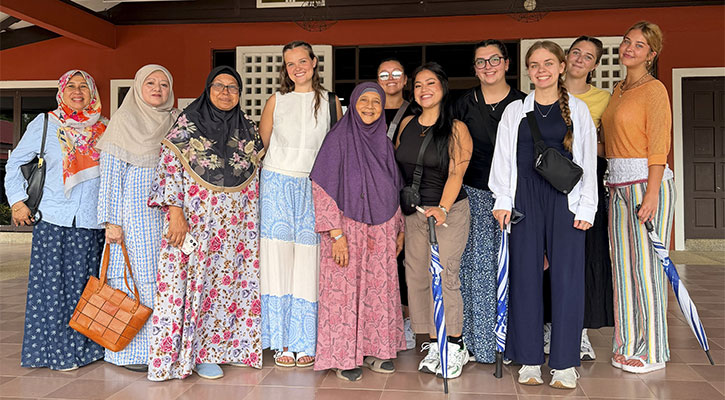
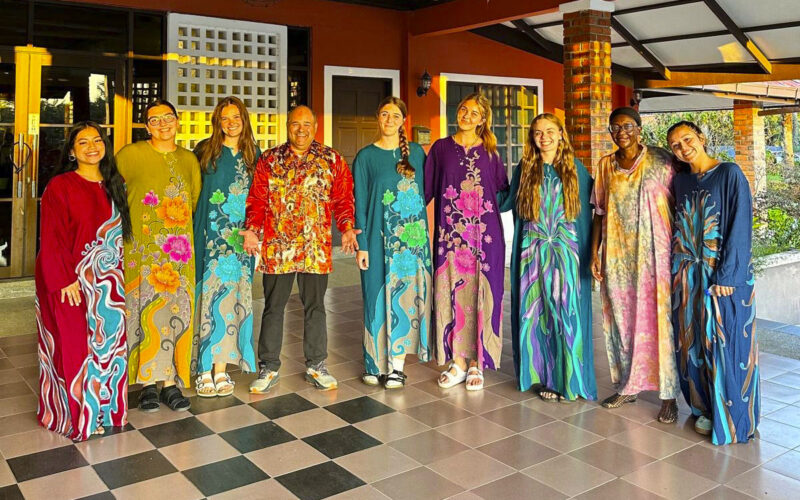
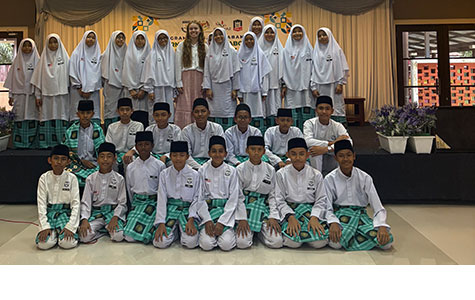
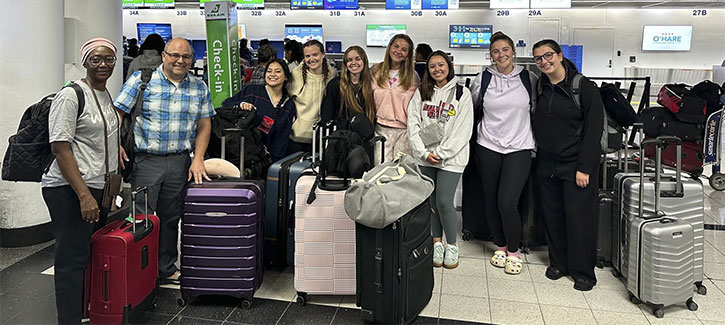
Jayda Greiwe, Joy Hernandez, Anna Melik, Hannah Schori, Mia Raguay, Julia Rozalowski and Christine Venditti blazed a new trail to Malaysia, where they taught at Imtiyaz Islamic School, an hour outside of Kuala Lumpur nestled within a forested palm tree plantation.
Huskies Hernandez and Melik are studying Art Education and Music Education, respectively, while the rest of the cohort are Elementary Education majors – and all of Imtiyaz’s students are of secondary school age.
What else did they encounter?
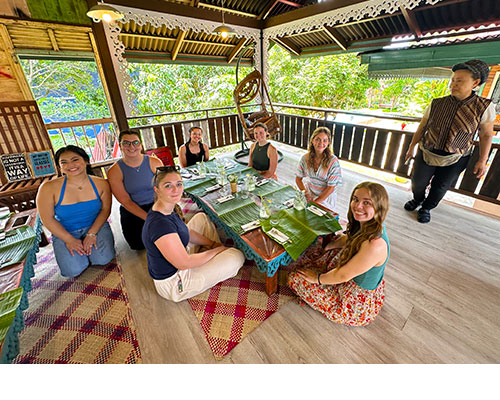 Nearly unbearable heat and humidity, only somewhat tolerable after dark. Classrooms without air conditioning. Curious locals who had never seen white people in person. Oversized, tropical insects in the dormitory.
But, Cohen says, “our students stepped up to the plate, big time. Each one of them.”
“It was a great experience,” he says. “They taught math. They taught science. They taught English. Anna, the music teacher who went with us – because they don’t have a music program there, she taught P.E. And she had the time of her life! She was like, ‘Hey, I’m only going to come to Malaysia once.’ Talk about a sense of humor. She had me and Teresa laughing constantly. So funny.”
Teresa Wasonga, an NIU Distinguished Engagement Professor in the Department of Learning Innovation, Leadership and Technology, appreciated Anna Melik’s enthusiasm in accepting and excelling in the unexpected.
Credit Educate Global’s ability to move future teachers “out of their comfort zone in so many ways,” she says.

“Our students were very willing. They were very flexible to just ‘go with it,’ ” Wasonga says.
“We talk about those things in pre-travel orientation – that we will have to be flexible, that things will be different, that they will have to put up with quite a bit and that the learning curve might be bigger than they think,” she adds, “but, as long as they open to learning and open to adjusting to things, it will work out. The amount of learning that takes place – the amount of growth that takes place – is unimaginable.”
As someone who grew up in Kenya, she understands the phenomenon on a personal level.
“The culture here, it’s almost that everything is predetermined. ‘On this day’ – almost a year out – ‘we will do this, and on that day, we’ll do that.’ The rest of the world really doesn’t go like that,” Wasonga says.
“So, for our students, I think the best part of this is that it puts them in that situation, and it forces them to adjust,” she adds, “and our students who don’t experience this don’t even understand their capacity to be able to do certain things because they’re always in an environment where they know what’s coming. And, if it doesn’t come, this is what the alternative is – and now you are in a place where you actually don’t know what’s coming, and you have to figure that out.”
GOING TO MALAYSIA resulted from Cohen’s chance encounter with a man named Shuhaimi Salleh, whose wife, Noripah Kamso, earned her B.S. in Management from the NIU College of Business in 1980 and is a member of the NIU Alumni Association Board of Directors.
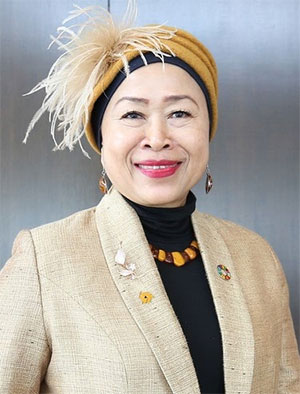
Cohen and Salleh became friends and, when the professor in the Department of Curriculum and Instruction later traveled to Kuala Lumpur for an international conference and spent a few nights as Salleh’s houseguest, they talked about Educate Global and what it was doing at the Al Azhar Yogyakarta Islamic School in Indonesia.
Salleh and Kasmo visited Al Azhar the next summer’s Educate Global and, Cohen says, they loved what they saw.
“They said, ‘If we can find a school in Malaysia, would you be interested in having it there, too?’ And I said, ‘Sure, if I can get the funding,’ ” Cohen says, “so they found the school.”
Funding, meanwhile, came from DXN.
DXN was founded in 1983 by Datuk Lim Siow Jin with core business activities that include the cultivation, manufacturing and marketing of health food supplements.
With more than 20 million registered distributors worldwide, DXN is solidifying its position as among the world leaders in Ganoderma products with lines that include dietary supplements, food and beverages, personal care products, skin care and cosmetics, household products and water treatment system.

Recent years have seen DXN diversify into other business activities, including information technology.
“People from the company actually came out and visited the school,” Cohen says, “and about 100 students from Imtiyaz visited the company one morning on a field trip.”
The partnership is possibly continuing: Conversations are underway regarding external funding that would send the next group of Educate Global travelers to Malaysia in Summer 2027.
NIU’S PROFESSORS, MEANWHILE, continue to find motivation from the students they select to make the journey.
Huskies in this summer’s Educate Global contingent to Indonesia were Vicky Gonzalez, Lorrayne Lightfoot, Hiriagnny Lorenzo Paulino, Mia Malave, Magy Ponce, Yaniz Rodriguez and Maria Tinajero.
All 14 between both destinations greet challenges as rare opportunities, Wasonga says, and know that whey will emerge as “a better person” from the circumstances.
 “They will definitely become a better teacher in the sense that they will become a lot more comfortable here because they’ve seen ‘the other side,’ and they begin to realize that the best teaching is spontaneous. It is not the prescription. It is not the expected,” she says.
“Because we train so much to deal with the expected and the prescribed, I think we are missing something,” she adds, “and that is what these students come back with: ‘I don’t have to be so stressed out just because I didn’t do what was expected. I think I’m a better teacher if I can be spontaneous in the classroom. I can now imagine that teaching is more than what I plan or what I’m given.’ ”
Wasonga heard that echoed from many NIU students who told her, “ ‘Being predictable makes teaching boring, but now that it’s so unpredictable here, it keeps me thinking. It keeps me going.’ Now it’s going to be part of their story. It lives in them. It’s going to move them forward.”
Cohen agrees: “It changes their whole view.”
“This experience changes their view on themselves and who they are as cultural beings. It changes their view on how they position themselves in society,” he says.
“It gives them their teacher voice. Each one of them found their teacher voice, which is substantial,” he adds. “You don’t have to worry about classroom management over there because the kids are behaving. They listen to you. They want to please you. You get to practice teaching without worrying about classroom management issues.”
Part of their transformation comes from the passion on both sides of the equation.
“The Indonesian and Malaysian kids are super excited to have American teachers there. The American teachers are super excited to be there,” he says. “The synergy, the energy and the relationships that the teachers make with the students changes the teachers. It opens their minds to difference, to diversity and to variations of understanding what the world is about.”
And, he adds, maybe nothing proved that more than what he and Wasonga witnessed outside the Imtiyaz school building.
“Their students were super, super, super shy when we first got there. By the time we left, all that timidity – all that shyness – just went out the window. These kids were talking and laughing, and their real personalities were coming out,” Cohen says.
“There was a road that walked all the way around the campus, and the night before we left, Teresa and I were trying to get our steps in way after dark, because that’s the only time you can go without dying from the heat. As we’re finishing our walk, we heard all these kids laughing and running and screaming and enjoying themselves. We’re like, ‘What’s going on over there?’ ” he adds. “And it was two of our students playing games with the kids. It was 8 o’clock at night.”