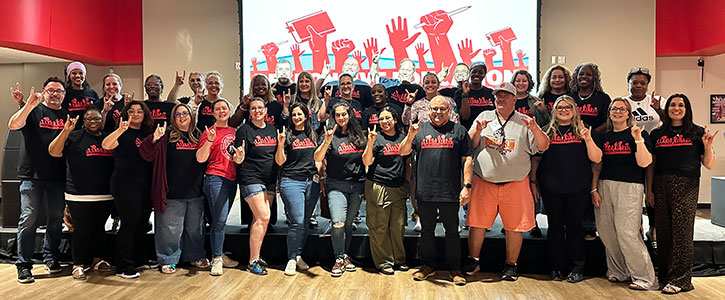
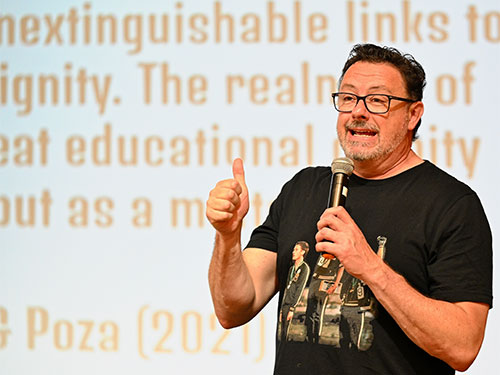
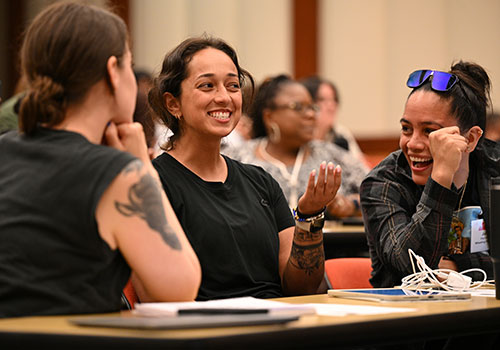
Graham, Gabel, Cole and Patterson halls came alive the week of June 8 to welcome and host NIU’s Summer Camp for Responsive Education.
The eighth edition of the camp focused on the Culturally Responsive Teaching and Leading Standards adopted by the Illinois State Board of Education in March 2021 as “research-based best practices for closing achievement gaps.”
Examining pedagogies and practices beneficial for all students, campers came together to foster an understanding of the unique and collective needs of individuals, groups and communities as well as how they can cultivate growth and success academically, personally and collectively.
“State standards give us a common language. They give us a common sense of vision and purpose,” said Mike Manderino, who joined faculty colleagues James Cohen, Joseph Flynn and Dana Isawi as camp organizers and counselors with the support of Jason Klein and Kate Swope from the college’s Learning Partnerships Office.
“How do you bring them into being in your classroom? In your office? In your school improvement plans? In your Board of Education conversations?” Manderino added. “That’s where the vibrancy comes.”
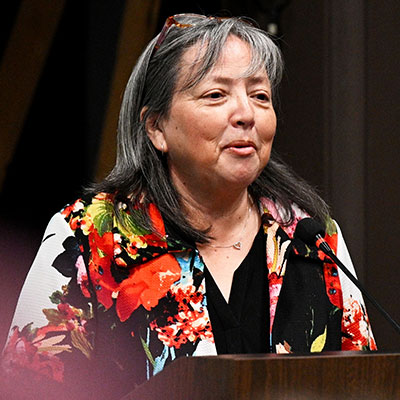
Keynote speakers were David E. Kirkland, founder and CEO of forwardED LLC; Margarita Jimenez-Silva, professor in School of Education at University of California Davis; Laura Ruth Johnson, professor in the NIU Department of Learning Innovation, Leadership and Technology; and alumna Rachael Mahmood, the 2024 Illinois Teacher of the Year.
Breakout sessions were led by NIU College of Education faculty, alumni and several invited guests, including from partner school districts and nationally known scholars who’ve interacted with the Huskie professors.
“Everyone who participated in camp is somehow connected to our NIU community,” Manderino said. “I think it speaks to our NIU community’s commitment to the values of camp.”
Among the more than a dozen topics were reimagining leadership for equity and justice; responding to prejudice, bigotry and stereotypes; how artificial intelligence shapes race, power and what we see; student voice in equity conversations; the myths and realities of undocumented immigration; responsive storytelling; and centering the lived experiences of LGBTQ+ and BIPOC students in educational spaces.
Other activities included a film screening and discussion, strategic planning sessions on operationalizing camp content within home school districts and a social event to enhance the sense of belonging among the campers.
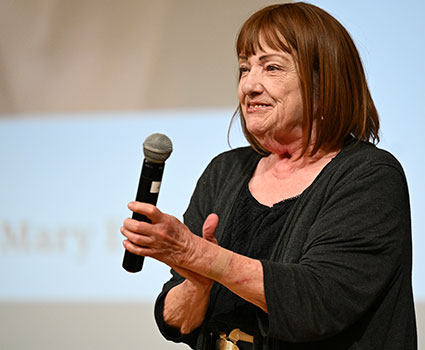
Woven throughout? The state standards.
“Cultural responsiveness improves student outcomes across a range of indicators from math and reading scores to attendance (and) to postsecondary enrollment,” the ISBE website states. “The standards encourage future teachers, administrators and school support personnel to engage in self-reflection, to get to know their students’ families, to connect the curriculum to students’ lives and to support student leadership.”
Moreover, “the standards will be implemented in educator preparation programs to help aspiring educators build the skills they need to engage all students respective of cultures and identities to create an environment most conducive to learning.”
Within the standards are “core” dimensions: self-awareness; systems of oppression; students as individuals; students as co-creators; leveraging student advocacy; family/community collaboration; content selection; and student representation.
“They are specific dimensions of teaching, and they’re explicitly framed as teaching and leading. They’re not separated,” Manderino said.
“And there are no standards for administrators and standards for teachers and standards for paras and standards for counselors,” he added. “They are broadly encompassing the idea that we are responsible. We are committed to teaching and leading along these dimensions. The standards are inclusive of not just what happens in the building but also of our partnerships with families.”
For Isawi, an associate professor in the Department of Counseling and Higher Education and not part of the college’s teacher preparation programs, the mandatory nature of the state standards resonates – and is something she expects the campers who are school counselors and social workers felt as well.
“I come with a human rights perspective. I participated in humanitarian work, and education is just a basic right, just like food, water, air,” Isawi said.
“What responsive education provides is this basic right but in a way that meets the needs of all students given – not despite – their experiences and narratives in life,” she added. “That right is to receive a responsive education, not just an education that is one-size-fits-all.”
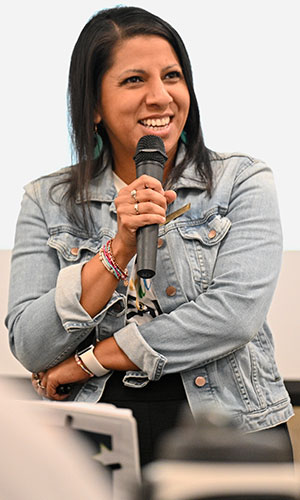
Mahmood, a 2016 alumna of NIU’s Ed.D. in Curriculum and Instruction program, reinforced those messages.
“I was very moved by the plenary session from Rachael Mahmood and how she took the idea of culturally responsive teaching and made it so practical – the things she’s doing in classrooms and how she supports her students. It was an inspiration and, arguably, one of my favorite sessions,” Flynn said.
“We wanted to make sure this year that all the workshops and breakout sessions were more practice-oriented, striking a good balance between theory and practice,” he added, “and after hearing all of those ideas, ending with her plenary was just icing on the cake.”
Faculty already play a role in promoting the standards, Cohen said: “They help us frame what we are teaching to make sure we’re including certain concepts.”
One example is “belonging – a sense of belonging with our students and how to teach a sense of belonging to our students so that when they become teachers, they know what to do: how to be inclusive, how to be equitable and not just equal in their instructional practices and in their engagement practices with their students. We model it and teach it.”
Doing so provides “an opportunity for students to understand their own value,” Cohen said.
“Too many students go through our K-12 system not knowing or not understanding their own value; not understanding why they are being treated or positioned the way they’re being treated and positioned by the community,” he said.
“Oftentimes, students don’t know why they’re being discriminated against, or students will discriminate and not understand that they are, or students will treat other kids by using slurs and not thinking that it’s bad,” he added.
“What these standards do is allow students to understand the systems of inequity and the systems of injustice that exist in our society so that they can become kinder people, more-aware people, more accepting people. There’s a reason why a tremendous number of kids drop out of school, and this addresses part of that.”