
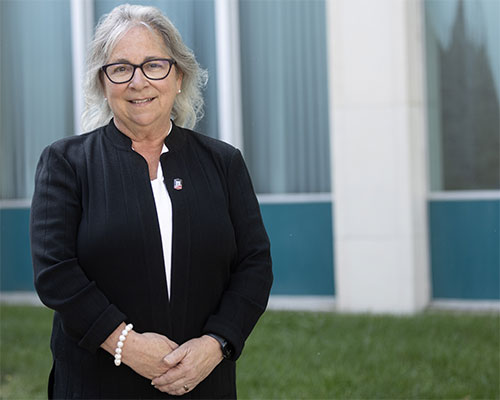
Dean Mary Earick provided a deeper look at her “1-3-5” action plan pathways Jan. 7 during the All-College Meeting.
Progress on the college’s roadmap toward thriving communities is “grounded in our Strategic Action Planning Framework,” said the dean, who showed how this “living document” connects to the college’s values.
“As I talk about each strategic priority and the possibilities of what could happen, and what is currently happening, it is interweaved with meaningful change, partnerships, belonging, authentic learning and student success, because they are an ecosystem,” Earick said. “I will work tirelessly to make sure we can bring resources in to keep that as the heart of the work we take forward.”
Nearly 90 faculty and staff already participated in surveys and focus groups, she added, and two more opportunities to give input are coming in the next few weeks, which will lift that number past 100.
Conversations have explored ways to improve graduation rates, add cross-cultural experiences, foster a greater sense of inclusivity, reduce bias, support social mobility and more.
Earick spoke of forging stronger relationships and partnerships in the community, including a goal to launch Montessori classrooms on campus as well as in lab schools envisioned in DeKalb, Elgin and Rockford.
 The college’s proud résumé of collaborations will enjoy the spotlight next month at the National Association for School-University Partnerships gathering in Crystal City, Virginia.
Several presentations from College of Education team members are scheduled, including “on this process that we’re beginning,” Earick said of the 1-3-5 blueprint that should vault NIU to national prominence for “impactful partnerships.”
“Universities get overwhelmed. They don’t know how to increase the impact of their partnerships,” she said, “so NIU is going to be up on stage at the national conference saying, ‘This is our first year, this is what we’re doing and here’s how we’re going to move forward.”
NIU’s group in Virginia also will develop a job description for the next Morgridge Endowed Chair, which will post in July with the expectation of hiring and onboarding that person by Year 3 on Earick’s timeline.
OTHER “1-3-5” ACTIVITIES planned to accomplish Year 5 ambitions will advance research initiatives with the University of Tetova, establish similar engagement with Kasetsart University in Thailand and receive state approval for NIU’s Center for Peace and Transcultural Communications.
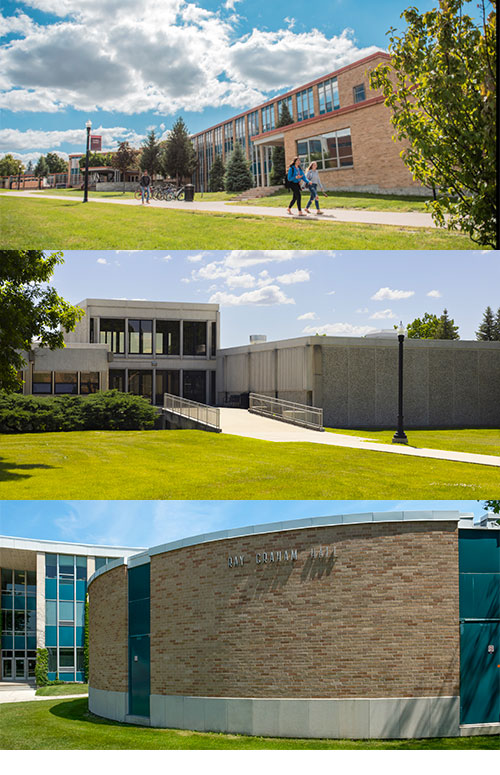 Meanwhile, Earick told the applauding crowd that her top priority in the “Intentional Growth” category is “funding in place for new buildings.”
“I have been working with the NIU Foundation. I have meetings on a regular basis, and they know a capital campaign is No. 1 on our list for our buildings. We have three buildings, and we want to make sure that all three are treated as one package when we move this forward,” she said.
“This will lead into our Year 3, and we want to make sure that by that year, we’re advancing that capital campaign,” she added, “because by Year 5, we want to make sure that funds have been garnered or are identified and promised so renovations can move forward.”
For now, she said, “we can start realigning spaces. What spaces can we optimize or use while we’re working on a capital improvements campaign?”
In other business, Associate Dean of Research, Resources and Innovation Todd Gilson provided updates on the merger of the Department of Educational Technology, Research and Assessment with the Department of Leadership, Educational Psychology and Foundations to launch the Department of Learning Innovation, Leadership and Technology on July 1.
The goal, Gilson said, is “a seamless experience for our students, our faculty and our staff.”

Carolyn Pluim, associate dean for Academic Affairs, spoke on updates to Educate and Engage.
The travel-based, hands-on learning initiative will focus on delivering more U.S. and local opportunities to expand the number of students able to participate in these transformational experiences; the application deadline for next year’s programs is Sunday, March 1.
Pluim also talked about the Office for Student Success, which is becoming more strategic and proactive in advising and support through early alerts and targeted interventions.
Meanwhile, she said, the team is working to boost enrollment of underserved students by thinking about ways to reimagine programs of study and recruitment activities.
Representatives from the college’s Belonging and Academic Equity committees spoke about their work and their plans while Laura Ruth Johnson encouraged her colleagues to apply for “community-engaged” designation for their courses that deliver that civic competence.
