

Twenty-eight students, faculty and alumni of the NIU College of Education attended the 47th annual meeting of the Mid-Western Educational Research Association.
Held Nov. 5 to 7 in Milwaukee, the conference focused on “Navigating the Future: Harnessing Artificial Intelligence in Education for Research, Teaching and Leadership.”
Biagio Palese, associate professor in the NIU College of Business, delivered the keynote address, “The Promise and the Puzzle: Making AI Work for Educators and Students.”
Representing the College of Education were Rahma Abassi, Ximena Burgin, Yen-Jung Chen, Sheila Coli, Mayra Daniel, Alissa Droog, Emelia Essumanba-Josiah, Md Tozammel Haque, Pi-Sui Hsu, Eric Junco, Stella Jung, Olha Ketsman and Michael Kuran.
Also in Milwaukee were Aya Myat Mon, Saurav Mukhopadhyay, Lida Niu, Sovannak Ra, Todd Reeves, Riyani Riyani, Alexios Rosario-Moore, Cody Alexander Schmidt, Sharda Sharma, Thomas Smith, Cansu Tatar, Haider Tahab, Stephen Tonks, Michael Tscholl, Tammy Wynard, Ying Xie and Sri Novita Yanda.
Participants describe the conference as a “warm and joyful” place of diverse perspectives, new research ideas and professional connections.

Yanda, who is pursuing her master’s degree in Educational Research, Evaluation and Assessment, credits Smith for support and guidance that made the MWERA experience “meaningful, motivating and filled with gratitude.”
MWERA “felt like a powerful and amazing application of my learning journey. I was able to truly understand and apply many of the concepts my professors have taught in class,” Yanda says.
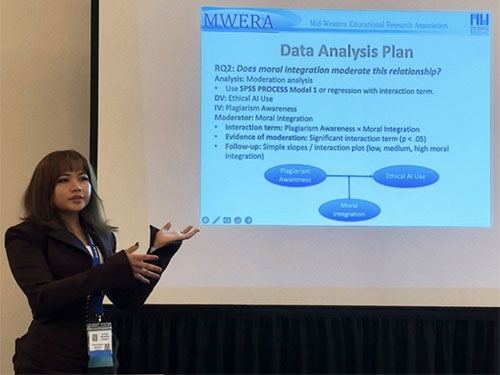
“It was a whole series of processes: preparing manuscripts, identifying problems, making research questions, developing sentences, deciding on analyses and methods, collaborating, revising and more,” she adds. “It was about applying everything and go beyond what I’ve learned from not just one ETR class but many.”
Niu, a doctoral student in Instructional Technology, enjoyed his first time presenting at an official academic conference – “a great start to my Ph.D. journey.”
“Being surrounded by scholars from many places within the same field in such a strong academic atmosphere exposed me to diverse concepts, ideas and perspectives was truly inspiring and rewarding,” Niu says.
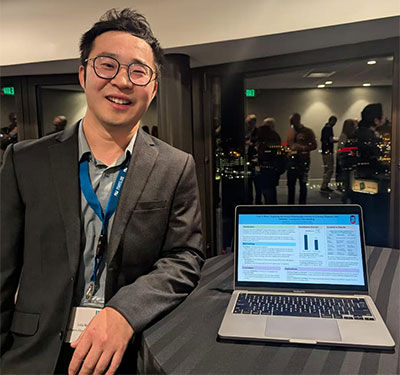
“The experience has motivated me to continue working hard and making progress in my research,” he adds. “I am deeply grateful to my advisors, Dr. Cansu Tatar and Dr. Michael Tscholl, as well as my partner, Yen-Jung Chen, for all their support.”
Chen agrees.
“It was both exciting and proud for Lida and me to represent our research team at MWERA,” says Chen of their study on “Less Is More? Exploring the Inverse Relationship between AI Literacy Exposure and Students’ Conceptual Understanding.”
“Our work received considerable praise and encouragement, motivating us to continue advancing in our research journey,” adds the doctoral student in Instructional Technology. “This passion for research, recharged through the conference, not only strengthened our confidence in AI education research but also revealed potential new directions for future development.”

For Ra, a M.S.Ed. in Higher Education and Student Affairs student, meeting other researchers “has significantly motivated me to further polish my own project.”
“Beyond the professional gains, I’ve had wonderful experiences connecting with friends, building rapport with professors from the ETRA department and gaining clarity on areas for self-improvement, both in my research work and in my professional aspirations as a researcher,” Ra says. “This experience has aspired my commitment to actively seek out future conferences and further establish my professional career trajectory.”
The three-fold mission of MWERA is to disseminate educational research conducted in the central states and provinces of North America; to promote a collegial research culture in the region; and to provide a forum for mentoring the research skills of graduate students and junior faculty members.
