
One year after representatives from the University of Tetova visited DeKalb to nurture and advance the longtime partnership, an NIU delegation continued the discussions during a September trip to Macedonia.
And, for new College of Education Dean Mary Earick, her first visit was eye-opening – and validating.
“When you went through their museums and through the Center for Peace and Intercultural Communication, there was a whole histography of NIU. We were documented brilliantly throughout all their materials,” Earick says.
“But what struck me, as far as someone in higher education, was their story and everything that they went through because of their belief that education should be for all. They wanted to make sure that their community had access,” she adds. “It really is an equity project, which is in perfect alignment with NIU.”
Earick saw that her counterparts in Tetova truly understand NIU’s philosophy in providing supports and services for all students.
“NIU has a clear vision and focus on making sure that students with the greatest needs are going to be successful at all levels. They really appreciate and respect our stance,” she says. “In addition, they feel the same way about their faculty and staff: How can we create an ecosystem where students, faculty and staff are all thriving? And then, how can that extend into the community? Tetova is very like-minded.”
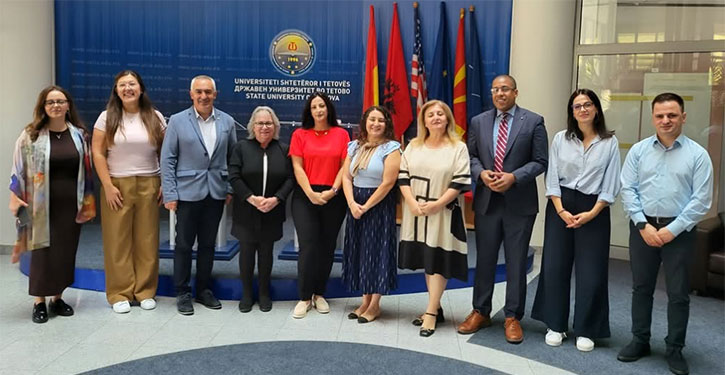
Relations between NIU and Tetova began more than a decade ago and, in 2016, resulted in the shared Center for Peace and Transcultural Communication to foster better social platforms for younger generations and a better society.
Joining Earick on the plane this fall were Dana Isawi and Yenitza Guzman of the Department of Counseling and Higher Education, Director of Academic Cultivation and Engagement Eric Junco and doctoral students Kristin Lee and Irem Pilgir.
September’s agenda included collaborative workshops, dialogues and research that furthered practice in socio-emotional learning and trauma-informed approaches for North Macedonian schools with co-designed strategies to strengthen professional capacity.
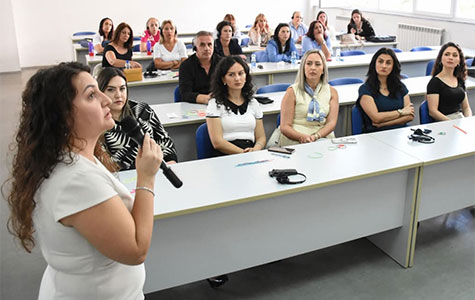
“They were really excited about the idea of working with their local schools to see how they could elevate socio-emotional learning with trauma-informed pedagogies,” Earick says.
“In their language, there is not a word for ‘trauma,’ so what was really fascinating was that if Tetova faculty hadn’t attended a workshop at NIU in 2024 led by Dana, Yenitza and Eric, and had time to interact face-to-face to unpack the possibilities of what trauma-informed research and professional development could offer, this project would not have happened in North Macedonia,” she adds. “We want to keep this exchange around problems of practice model up.”
Meanwhile, Earick worked with Tetova’s Vice Rector Vullnet Ameti, Dean Lulzim Mehmedi, Vice Dean Teuta Ramadani Rasami and Director Donika Kamberi to draft a five-year research and programming development plan similar to her “1-3-5” roadmap for the NIU College of Education.
Also moving forward is the establishment of a physical space to house a Center for Peace and Intercultural Communication on the NIU campus (as well as a website) that will function as a “home base” for research, writing journal articles, professional development and, eventually, the publication of a book.
Earick is assembling a task force to create an application to submit to the university first before seeking state approval.
With that work still in the future, the dean is still reveling in her initial exposure to Tetova and the long partnership with her new academic home.
“I am so impressed by our faculty – their deep commitment to intercultural research; deeply listening to their colleagues; planning with their colleagues,” Earick says.
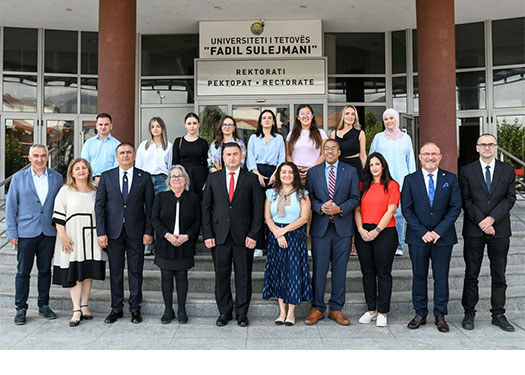 “One of the things we always have to consider and think about in intercultural research is that you don’t want to colonize someone in a different country,” she adds, “so the commitment of our faculty to truly work side by side collaboratively, and watching them sit back and reflect and learn in the schools with their colleagues, was fascinating and beautiful.”
Next, she hopes, is another milestone moment.
“The students in North Macedonian schools absolutely embraced us,” Earick says. “I was in one class when a young lady came up to me and wanted to know how many NIU students came from North Macedonia. I let her know, ‘I don’t know. I’m going to go back and find out.’ And she said, ‘Don’t worry. I’d love to be the first.’ ”
Further reading
- Fall 2024: Faculty, students from Tetova visit NIU to explore topics in teacher preparation
- Fall 2017: Camera’s eye: Blackwell photo exhibition to tell tale of Tetova
- Center for Peace and Transcultural Communication
