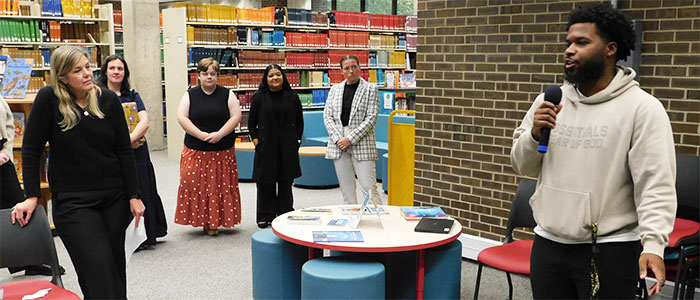
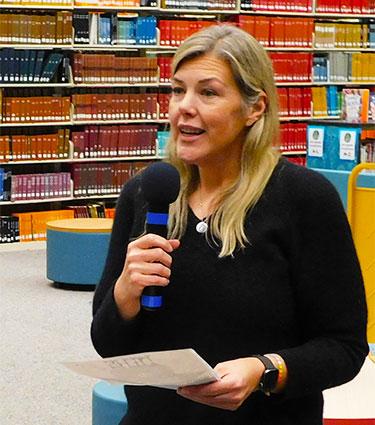
Aspiring practitioners in Higher Education and Student Affairs continue to examine the past to inform their future professional approach, thanks to an assignment in their NIU master’s degree program.
For Lauren Asbury, it’s watching how a university president can tread successfully in serving students as well as the local community. For Kate Hagenbuch, it’s seeing the power of stepping up. For Jeremiah Johnson, it’s realizing how positive and valuable traditions can carry on seamlessly, and almost invisibly, to following generations.
Great stuff, according to their professor.
“I’m really delighted by the good work,” Carrie Kortegast, associate professor in the Department of Counseling and Higher Education (CAHE), told the crowd at an Oct. 15 poster exhibition in Founders Memorial Library.
“This year’s theme was to focus on ‘NIU in the Community: In Service of the Public Good,’ and the students really built upon work that the other students in our program have done in the past,” Kortegast said.
“We see examples of ways in which community has responded to tragedies. We see examples of entertainment through basketball. We see examples through educational programs and through student protests,” she added.
“What’s been exciting about this is, one, to allow students to dig into the history of NIU and, two, to find those moments in time and think about the ways things are similar and different to today and how we can see traces of the history in the work we do every day at NIU.”
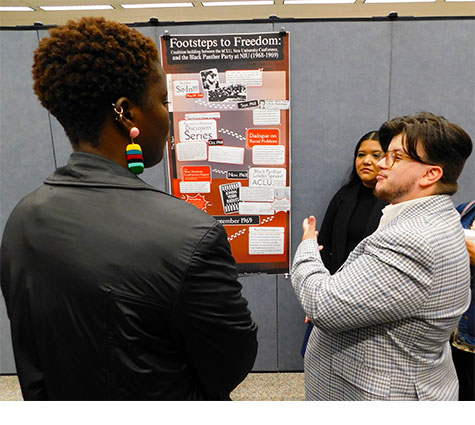 Kortegast introduced the archival research assignment to her HESA 500: Foundations of Higher Education course three years ago.
Projects submitted this fall included Mother Sunshine; the Network of Nations; the “golden era” of NIU Women’s Basketball; the legacy of Apha Phi Alpha; rallies in opposition to the Vietnam War and the Kent State shootings; and the Feb. 14, 2008, mass shooting at NIU.
“Our institutions are not ahistorical but are built upon historical legacies, so part of our goal in this class is to think about that and to take that seriously,” Kortegast said.
“This has allowed us to think about ways in which people have grappled in the past with the most consequential topics related to education, related to access, related to participation,” she added. “What can we learn from that? How do we think about that today?”
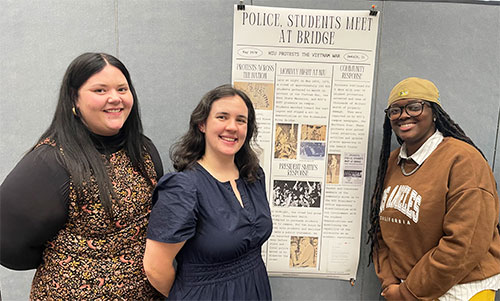
Asbury enjoyed her group’s look into how former NIU President Rhoten A. Smith handled the civil unrest of May 1970.
“There is still a lot of relevance to things occurring now,” said Asbury, who hails from North Carolina and Florida but is the daughter of two NIU alums. “When you read the reporting from that time and the community reactions from that time, it kind of echoes.”
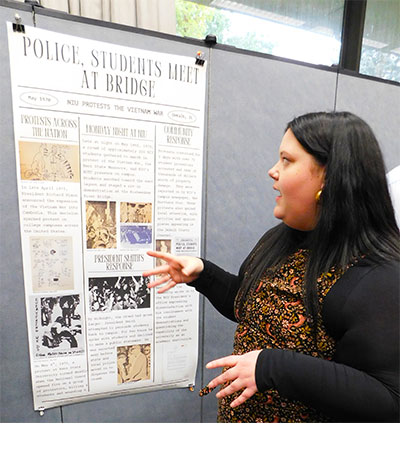 Smith famously placed himself among student-protestors who were blocking the Kishwaukee Bridge at Lincoln Highway. His presence over a few hours that began at midnight brought a positive resolution to an uncertain situation.
“One thing we found really interesting and admirable was that Rhoten Smith sat with students and encouraged them to disperse peacefully. He was with students for, according to various sources, somewhere between three and four hours, hearing them out,” Asbury said.
“He also struck a balance between supporting students’ First Amendment right to free speech and political demonstration, defending them when necessary, while also acknowledging community and administrative concern regard the nature of the protest and the impact it had on the greater DeKalb community,” she added.
“His commitment to his values, while also respecting the concerns of the oppositional parties, is a quality we respect and will keep in mind during our careers as Student Affairs administrators. We believe it is important to center your practice in your values.”
HAGENBUCH, AN OFFICE ADMINISTRATOR in the Department of Accountancy in the NIU College of Business, found reason in her current job to pursue her next one through her master’s program.
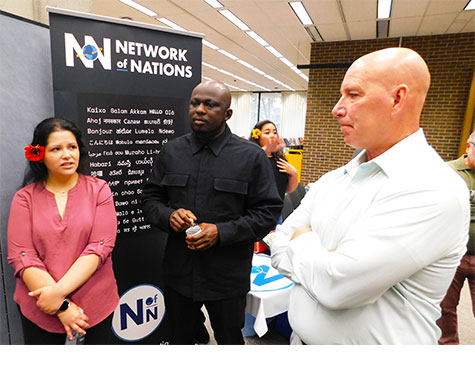 “I’ve been working in higher education for about 10 years now, and I love helping our students during this big transition period in their lives – going out into the world, discovering themselves. I want to be a resource to our students and provide as much help as I can,” she said. “Because I have a quite of student contact and one-on-one interaction, that just made me even more passionate about wanting to go further in this career and do more to help students.”
She was part of a group that studied Network of Nations, a “para-church ministry dedicated to forging friendships between international students and the local community” in the wake of an enrollment boom in the 1990s.
Joining her were Gideon Abban, who is from Ghana, and Samantha Guirola, who is from San Francisco.
“Network of Nations is making a huge impact for international students, so we wanted to learn more about them,” Hagenbuch said of the mostly volunteer organization.
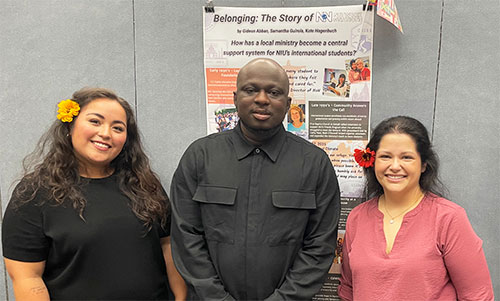
“Because the international population kept growing and growing, NIU wasn’t able to meet all of the demands, so it was the local community through the churches and the ministries that really stepped up,” she added.
“They provide everything from helping them find a place to live, making sure that they have food and, most importantly, making sure that they have community – somewhere safe to go and interact with their fellow students.”
That philosophy resonated with Abban.
While still in West Africa, he struggled to juggle academics, work and family, but an advisor helped him – and inspired him to follow suit. Working in student housing, he assisted residents from marginalized families to secure scholarships.
Now, with knowledge of the Network of Nations, “I feel like I can replicate it, like a mirror, to use in my home country.”
Riley Coughlan and Aster Oliver collaborated with Lexie Alt to learn more about Mother Sunshine, a former DeKalb County-based initiative founded by two Huskie alums and focused on substance abuse treatment, prevention and education.
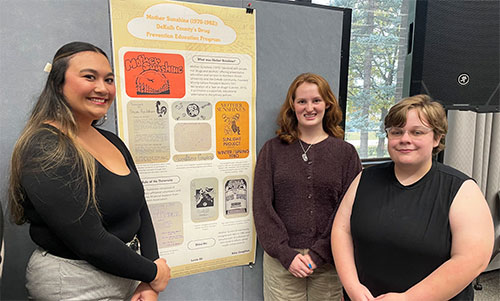
“Instead of approaching drug education by stigmatizing it and with disciplinary measures, it was more of an alternative take – providing education but also alternative programming, such as wellness, health and just well-being in general, like yoga programs, dietary changes and advocacy,” said Coughlan, who is from northwest suburban Woodstock.
“Not only did Mother Sunshine provide this to students in residence halls, but they also provided it to the community as well, helping anybody who was struggling with drug use or who just wanted information.”
Mother Sunshine served another function, Oliver added.
“Something that we thought was really cool was just how much NIU students were involved,” Oliver said. “Students were able to work there for internships.”
THE OCT. 15 RECEPTION and the students’ posters are co-supported by CAHE, the University Libraries and the Department of Special Collections and Archives.
Returning for their third year of assistance were Bradley Wiles, associate professor and head of the Special Collections and Archives Department at Founders Memorial Library, and Alissa Droog, assistant professor and Education and Social Sciences librarian.
“I cannot express my gratitude enough for both of them in the way they have supported the students throughout the project as well as this being a collaborative effort to utilize NIU resources to engage in the archives,” Kortegast said.
Plunging through the historical documents should reveal to future Student Affairs practitioners what’s missing from those files, she cautioned.
“The archives tend to be institutional records, and the people who do the best of that is the institution – so, the administration. Sometimes what feels absent – the holes – are the student voices,” she added. “So, if you work with students and student organizations, think about encouraging them to share information with the archives to help preserve records of their presence and of their engagement.”

Wiles called the work “wonderful” and thanked the students for their assistance in knowing “more about what’s actually in my custody.”
“This project, I think, is really important. Having that historical perspective, particularly with everything that’s going on in higher education right now, is very essential,” Wiles said.
“As you can see from the topics of these posters, there are just a lot of analogies between what happened then and what is happening now,” he added. “The history is always present. The past is always with us. You helped uncover these things that would be otherwise completely forgotten or unnoticed indefinitely.”
Other students presenting projects were Samuel Addai, Kweku Aggrey, Lauren Duval, Lyla Hall, Moushumi Haque, Ann Marie Kamps, Sarah Lindell, Daniel Mrzena, Darius Murray, Makayla Roberts, Kyla Thompson, Roxy Valero and Caitlin Zimmerman.