

Pi-Sui Hsu is celebrating a $100,000 grant from the National Science Foundation to advance her study of teaching scientific argumentation with technology.
The federally funded, one-year project with teammate West Aurora School District 129 will examine challenges to that practice but also determine ways to strengthen and enhance it and develop a model for building design research partnerships between K-12 and public universities.
Scientific argumentation is among the Next Generation Science Standards as it encourages students to think collaboratively and foster a deeper understanding of how scientific knowledge is generated.
“I’m really honored to receive this recognition from the National Science Foundation, which has been a tremendous milestone in my career and a complete surprise. This is one of the most prestigious and competitive research grants in the United States and globally,” says Hsu, an NIU Presidential Engagement and Partnerships Professor and the grant’s principal investigator.
“Reflecting on the journey, I’m reminded of the hard work and dedication that led to this achievement,” she adds. “I never anticipated it would happen at this moment, but I’m deeply grateful. This honor not only elevates my professional profile but also brings national visibility to our college.”
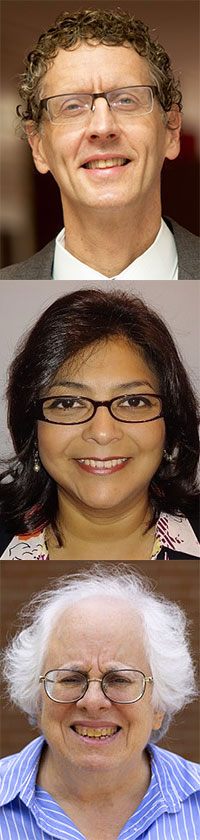
Joining Hsu, who teaches in the Department of Educational Technology, Research and Assessment (ETRA), are ETRA colleague Tom Smith, Marianna Ricklefs from the Department of Curriculum and Instruction and longtime collaborator Reva Freedman from the NIU Department of Computer Science.
West Aurora, meanwhile, will supply six middle school science teachers, six students from sixth- through eighth-grades, six parents, a building administrator and David Allen, the district’s department administrator for middle school science and social science.
NIU’s team will travel frequently to West Aurora to conduct interviews, participate in teacher institute days, attend monthly meetings of the science faculty, host steering committees made up of students and parents and seek input from focus groups.
By this time next year, Hsu says, her team will have held a retreat for all involved and designed their scalable model for design research partnerships that will benefit the larger community and yield “a broader impact on middle school science teachers’ practice and a broader impact on student learning.”
First on this month’s agenda as work begins?
Conversations.
“In Stage One, we will get perspectives from the teachers about how they teach scientific argumentation and from the students on how they learn scientific argumentation. Then, in October, we will engage all the teacher-leaders in the data-coding process, and then we will come up with a short report,” Hsu says.
“Then, we move on to discuss what supportive pedagogy could be used to support teaching scientific argumentation. We will start with value-mapping activities and focus-group discussions to get some perspectives from the teachers,” she adds. “Then, we will have a workshop where we will teach about various supportive pedagogy, such as project-based learning or collaborative learning, and will follow with a workshop on emerging application of emerging technology.”
From parents, she says, “we would like to see if they have any ideas about how we can support their kids in learning scientific argumentation.”
 “We will be pretty open-ended. We will talk to them and learn from them about what strategies we could leverage to better prepare students for scientific argumentation,” Hsu says.
“We will use this opportunity to understand what technology those students are using at home, and build from that. For example, game-based learning could be one of the potential ways,” she adds. “Also, the kids might use AI at home, so I would like to know how the children use it at home and how we can leverage that tool to support the teaching of scientific argumentation.”
Questions about games will help Hsu and Freedman to further their ongoing project to create a game that teaches scientific argumentation, funded by a grant from the NIU College of Education’s Morgridge Endowed Chair Office.
Meanwhile, middle school science teachers in West Aurora and far beyond will gain professional development in their pedagogy along with strategies to continue the work.
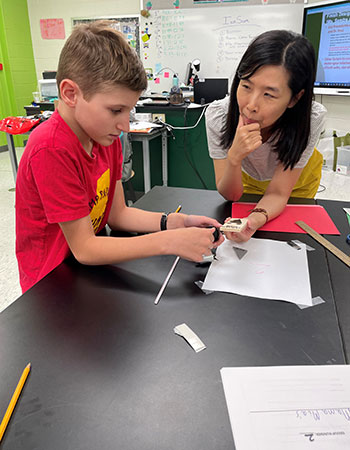
“They will be able to implement our ideas in the classroom and see if those ideas are effective or not – or to contribute better ideas,” Hsu says. “One of our other goals is, for those public universities with limited research resources, how can they establish partnerships like this to bring together the knowledge from both sides to advance theory and to benefit educators in the classroom.”
Hsu is confident in such results thanks to her partners.
Among them are West Aurora science teachers Kimberley Andrews, Emily Deppeler, Annessa Martina, Andrew McCann, McKenzie McCart and Cyndi Urbanski; advisory board members Liz Wendel, Meg VanDyke, Donna Werderich and Carla Zembal-Saul; and consultants Ben Kluga and Dean LaBarbera, both of whom are NIU graduates who have remained on Hsu’s research team at NIU.
“I’m very fortunate to have these incredible scholars on the project,” she says. “I have this amazing team and I have great support from the school district, and I think it’s with their support that I was able to come up with a strong proposal for NSF.”
