Whether pizza truly is America’s favorite food is the stuff(ed crust) of hopeless debate.
But considering the infinite personal preferences for preparing a pie, it’s no surprise how many ways that creative teachers can slice it up for the sake of learning.
Science. Math. History. Spelling. Literacy. Vocabulary. Research. Agriculture.
For 17 students from the NIU College of Education who probed those concepts with children and adolescents during two visits this spring to the Chana Education Center, an additional purpose adorned the table: hands-on practice for their own eventual careers.
Project TENT (Teams Exploring Nonfiction Together) transported the Elementary Education majors enrolled in LTRE 350 course to the rural K-12 school, which supports the academic, emotional and behavioral needs of students within Ogle and Lee counties.
On the menu?
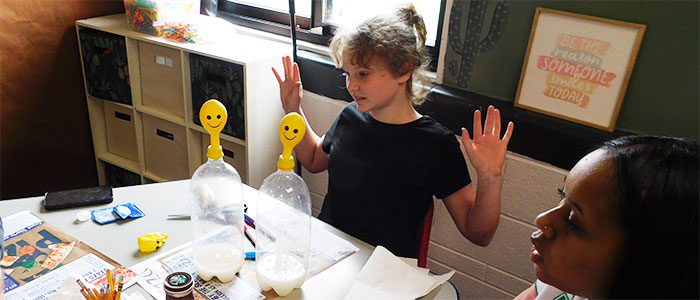
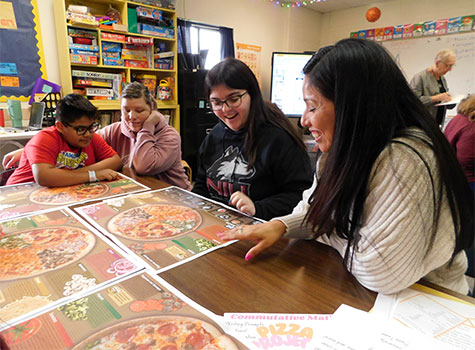
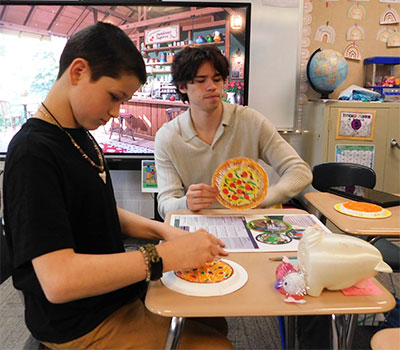
Lessons about making yeast rise, reading aloud the chronology of pizza, calculating fractions to determine serving portions, conducting surveys on topping choices, spelling words related to food preparation, learning the recipe for butter (and manually shaking the jar of heavy whipping cream and salt to mix the ingredients), understanding that groceries come from farms and more.
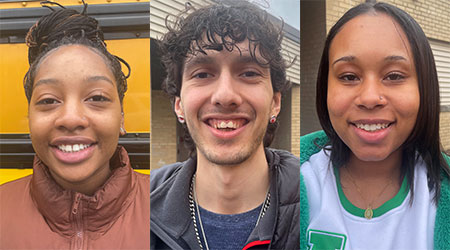
Kaylin Williams, a junior from Grayslake, appreciated her Educate Local opportunity: “It’s always good to have extra experience.”
“I feel like I sometimes struggle to relate to students who are not the ‘typical’ students,” Williams says, “so to be able to actually get that one-on-one time, and to be able to bond and foster relationships with them, provides me with skills that I can take into my general education classroom. There are going to be different personalities in there, and different behavioral issues as well, so to be able to experience diverse learners is something I hope to take with me.”
Volunteering to play soccer with children with disabilities as part of the Cary-Grove Buddies program in high school didn’t prepare Mateo Nunez for the Chana immersion.
“This gave me a whole different perspective – a whole different outlook. We’ve got kids with disabilities, but there’s another tier that I never got to see,” Nunez says. “I feel like I’ve got a range now where I can somewhat look at a kid and relate to them, no matter what they’re going through. I feel like that, from this experience, I have that understanding now.”
Classmate Imani McCurine was grateful to observe “why students act the way they do.”
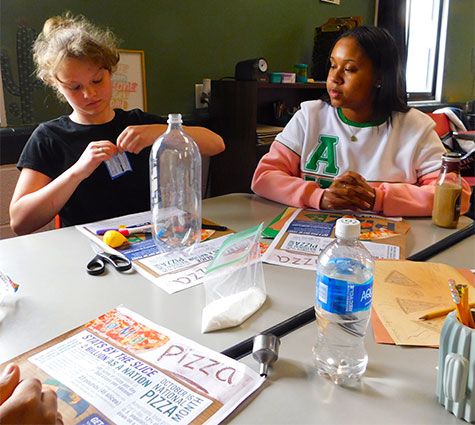
“Right now, I’m taking a class called ‘Development of Adolescents,’ and basically it teaches us about how childhood affects adulthood,” said McCurine, a junior from Chicago. “I can use this as a teacher because I will understand different perspectives of how students act and how to create my lessons to differentiate to different students.”
McCurine offers herself as an example: “I’m not a good listener, but I am a great visual learner,” she says, “so being able to come here to see the different ways students learn will help me when I teach.”
Good news, say Mary Gardner and Hyoju Ahn, faculty in the Department of Curriculum and Instruction.
“This is the second time I’ve taken students to Chana, and one the reasons I like doing it is because I want them to see how much the staff loves these students and how they know them,” says Gardner, an instructor. “They treat them with respect. They help them learn how to self-regulate to be able to be in a regular classroom and to go back to their home classrooms eventually – and that’s the goal.”
NIU students were able to “see how that can be done,” she adds: “Even in a regular classroom, you’re going to have a diversity of students and you’re going to have students who might have behavior issues or difficulties at some point.”
Ahn, an assistant professor, read in reflections submitted by her undergraduates that they were impressed by the engagement of the Chana students in the learning process as well as the rapport their teachers already had built.

While watching the action from the sidelines, Ahn was excited by how her students turned the curriculum from her courses into practice.
“It was so fun to just observe, so I jotted down a lot of notes,” she says.
“They were applying content area knowledge – how to practice vocabulary pronunciations, how to visualize concepts for students – and these instructional methodologies that I taught them about reading comprehension, teacher modeling and prompting, and asking proper questions,” she adds. “They directly applied it, and then they advanced it, and it was so, so creative. It was fascinating to see how they developed those instructions.”
Helping matters, Gardner says, was “a really strong safety net” the Chana Education Center provided to NIU’s pre-service teachers. “With the cooperation of the Chana staff and certainly the principal, it was a supportive, safe environment,” she says, “and they were welcome.”
Lynn Kalnins, principal of the Chana Education Center, helped to prepare the NIU students for the experience and was happy to do so.
The collaboration “enriches the learning experiences for everyone involved but also grows mutual understanding and respect between future educators and the diverse student populations they will one day serve,” she says.
“Our students benefit from working with unfamiliar teachers. It helps them to become comfortable with new faces and adapt to different teaching styles. These are real skills they will need to help achieve our shared goals of eventual return to a more general education environment,” Kalnins says.
NIU’s students simultaneously gained real skills, she adds.
“I was genuinely impressed with how creative and flexible the NIU students were. They quickly adjusted their lessons on the spot and worked to make real connections with our kids in a short amount of time,” she says. “Being in the moment and having to respond to what is actually happening is where the real growth happens. Experiences like these build confidence and give future teachers a clearer picture of what to expect.”
Chana teachers agree.
“We don’t have a lot of opportunities to interact with people outside of our school environment, and our goal is always to get our students to go back to their home schools,” says Therese Koch, who teaches K-4, “so having teachers who they’re not familiar with, and for them to be able to follow directions and learn from, is just more than we could ever ask.”
Koch expects that NIU students benefited from their visits.
“There is nothing that you can learn from textbooks about how things are going to go once you actually try to teach a student. Every student is different,” she says, “and so getting to see even just two or three students, and how they interact with the same material, will help them prepare for their future years and to get to know about those individual learners as they get their own classrooms.”
Lexie Rincon, who earned her NIU Special Education: Learning Behavior Specialist I in 2023, confirms that.
“It’s amazing to have the NIU students here. This isn’t something they’re going to get in a classroom. This is not a textbook lesson. This is real life. This is the real deal,” Rincon says.
“When you talk about students on paper, and case studies you review about things that have happened, you’re not actually in the interaction. You can read it. You can study it. But until you’re actually in that seat, it’s not the same,” she adds.
“Being here, seeing how students respond to and your lesson – seeing what the pacing is like, what the time is like, what needs to be adjusted – that’s not something you can get from a case study. You have to have the experience to learn.”
Rincon also shares Koch’s opinion about the significance of NIU’s visits for her own students in the fourth- through sixth-grade classroom.
“They’re getting to work with unfamiliar people, which is a big deal for students in special education,” she says. “Typically, in the realm of special education, our students are with the same people and the same classmates, and lead the same routine, every single day. Introducing that change of schedule and that change of faces is really important because that’s the real world. Giving them that exposure at this age is really valuable.”
Chana faculty and staff also spoke to the NIU students about the truths of teaching, no matter the type of school or the population it serves.
Every day is a new behavior. Teachers need to “read the room,” think on their feet and redirect on the fly.
Vital to success is knowing how to encourage young learners to “find the best in themselves to share with others,” they said, and being able to determine how to react “when things aren’t going well.”
“Thinking about these things for yourself in today’s world of teaching is, one, about us – what are we going to permit as the teacher? – and, two, thinking about what’s going to be best for the rest of the group,” one told the Huskies. “The reality is, regardless of the lesson you have planned, if your classroom management skills are not strong, the class can fall apart. You can have the best lesson ever, but if you can’t manage the class and the little behaviors, it can quickly turn into a lot of things.”
Gardner thinks the NIU pre-service teachers are ready for the challenge.
She saw some respond to, and interact with, a boy “prone to going off task – he’s quite an expert at that” in ways that refocused his attention.
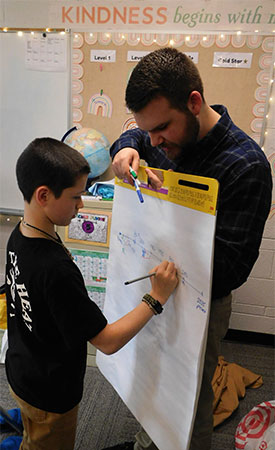
Another group recalibrated when the yeast-rising experiment partly failed and adopted a hands-off approach that prompted a girl to start brainstorming about how to produce better results. Others using pizza-apportioning decisions to teach about fractions adjusted and adapted when a boy’s calculations caused some head-scratching.
One connection that Gardner witnessed also impressed with the Chana hosts.
“In the older-student room, one girl was crying when I walked in. Apparently, she bit her lip,” Gardner says.
“The teacher told me later that she and the two paras stood close by because that student has difficulty sometimes getting back when she has an emotional difficulty, and the teacher said, ‘I tried really hard not to say anything’ – and she didn’t,” she adds.
“Pretty soon, the girl was calmed down, and our students had her back. The teacher said, ‘I want to talk to them and ask them what they did.’ The students told me that they had just affirmed her feeling – ‘Oh, that really hurts’ – and just talked to her calmly.”