

Michael Manderino is carrying on a proud NIU College of Education tradition.
The associate professor in the Department of Curriculum and Instruction has been elected vice president of the Association of Literacy Educators and Researchers (ALER), meaning he will ascend to the top office in 2026.
In doing so, Manderino follows in the footsteps of David Paige. And Norm Stahl. And Laurie Elish-Piper. And Jerry Johns.
And he knows what made this possible, quoting Sir Isacc Newton: “If I have seen further, it is by standing on the shoulders of giants.”
“Laurie suggested I join ALER when I first got here, and one of the first things I did was apply for the dissertation award, and I won that,” says Manderino, who came to NIU in 2011. “And because I won that award, and because Laurie and Jerry were super gracious and introduced me to a bunch of people, I got to meet a lot of members as a result of that first conference.”
His eagerness to expand his community quickly produced invitations to serve on committees, and then on the board of directors, and then to manage social media, and finally as an ex-officio member of the executive board, where Manderino “got to really understand the organization from that perspective.”
Elish-Piper, who is now NIU’s executive vice president and provost, calls herself “thrilled” for Manderino: “He is a collaborative leader, exemplary teacher and engaged researcher who brings a lens of student success, innovation and equity to his work,” Elish-Piper says. “I am confident that he will be an excellent and impactful leader for ALER.”
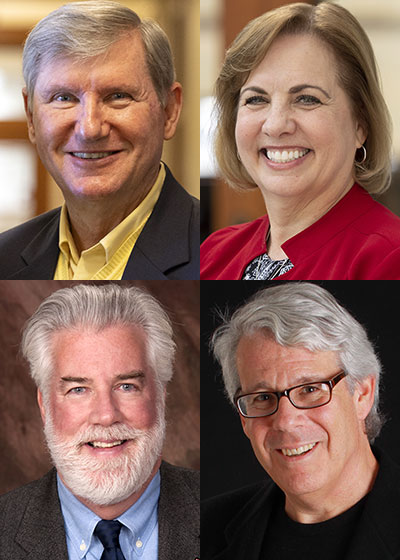
Formed in 1960, ALER seeks to stimulate the self-development and professional growth of professors, teachers, reading specialists and students at all levels. Members work at the forefront of policy, pedagogy and practice, positioning them to encourage continuous improvement of administrative, clinical, diagnostic and instructional work related to the learning process.
What Manderino has learned is that the NIU College of Education enjoys deep respect throughout the organization and across the discipline, thanks in large part to the reputational foundation that Johns, Stahl and Elish-Piper laid – one that helped attract Paige, who served as ALER’s president in 2016-17, to DeKalb in 2020.
“When you think of literacy programs, NIU is part of that conversation with a Syracuse, a Georgia, a Michigan – and then there’s a regional institution: Northern Illinois University. We are at the center of national conversations about where the field is, where the field is going and where the field should be going,” Manderino says.
“I think that speaks volumes to the people who have been here and who have stepped up as mentors. Laurie was my mentor. Laurie was mentored by Jerry; they’ve co-written. Jerry has reached out to me and has been an incredible mentor to me. Norm was my department chair and continues to mentor my research and connections in the field,” he adds. “I’m the beneficiary of this legacy, and so I hope to someday do the same for those who come after me.”
Goals for his time in leadership include “expanding the reach of the organization,” not only by pulling in more graduate students but also through improving access to the rich work of the ALER members.
 And, by “access,” Manderino means the availability of the content as well as its capacity for application.
“How do we make this accessible to teachers? How do we make this accessible to people who aren’t necessarily wanting to read a 30-page research article?” he says. “We have to climb out of the ivory tower more than we do and really see the bridging of practices.”
FOR MANDERINO, THE BRIDGE to the ALER presidency is the latest chapter in a story of unexpected plot twists.
He started teaching in 1996 at Joliet West High School, where he was part of the social studies faculty, “and, like most 23-year-olds, I didn’t know what I was doing.”
An answer came in an opportunity.
Jim Talarico, an English teacher and NIU College of Education alumnus who was nearing retirement, had just received a statewide honor for his work. Normally, part of that award would include a yearlong speaking tour through Illinois.
Talarico, Manderino says, proposed something different: He would lead a daily series of literacy-focused workshops for new teachers in Joliet.
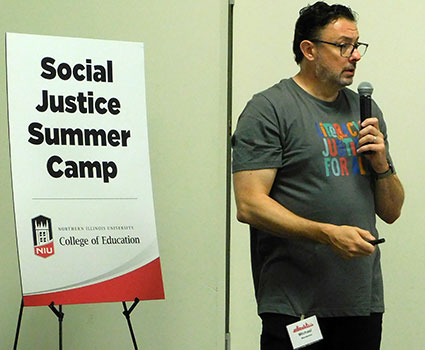
“It totally transformed me,” Manderino says. “I went from not knowing what I was doing to having good things to do. I worked with five other new teachers, and we developed a really good bond. I learned a ton.”
Among his five workshop mates, one is now a professor of literacy at Clemson University. Another earned a doctorate in English education. Another completed a Master of Fine Arts.
Manderino, the social studies teacher in the bunch, also began exploring graduate school options in his own discipline.
While at an open house at the University of Michigan, he went to the table for social studies but found no one there. But someone was sitting at the nearby table for literacy: Annemarie Sullivan Palincsar, “a giant name in the field.”
Palincsar, the Jean and Charles Walgreen Jr. Chair of Reading and Literacy and a teacher educator in Educational Studies in Ann Arbor, was happy to chat.
“She’s one of the nicest humans on earth,” Manderino says. “She said, ‘Well, you could do this, and you could do this.’ And I was like, ‘Yeah! Why am I not thinking about literacy? I’ve done all this work with Jim.’ ”
Newly married with a child on the way, Manderino ultimately decided to stay in state at the University of Illinois Chicago, where he went on to complete his master’s and doctoral degrees.
As a professor, he teaches courses that include LTRE 311: Content Area Literacy, LTRE 511: Reading in the Content Areas and TLCI 701: Theoretical Perspectives of Equity.
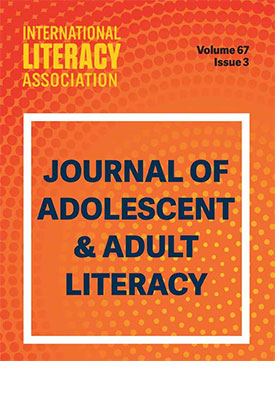 As a scholar, he studies the intersections of digital literacies for disciplinary learning, especially with adolescent learners, and, with NIU College of Education Director for Equity Eric Junco, is among the newly named co-editors of the International Literacy Association’s Journal of Adolescent and Adult Literacy.
“Most people have a narrower view of literacy – like, ‘Literacy’s about reading, right?’ – but through my coursework at UIC, and bridging to my own practice, I saw that my students don’t always understand when I put a documentary or a political cartoon in front of them,” he says.
“What’s most interesting to me is the expanse of literacy and how literacy is more than the printed text. Film. Photographs. Music. We’re all making meaning in the world, and it’s our literacy practices that do that.”
Considering the omnipresence of technology, he adds, literacy is a critically necessary skill.
“Messages are everywhere, and imbued in those messages, there’s bias. There’s power. We have to make sense of that. Grad school was the first time that I was like, ‘Oh, these things aren’t just in your head. They’re things we do together,’ ” Manderino says.
“That’s what’s most interesting to me. I’m drawn in by what counts as the text side of things, and then you start to uncover all of these social and cultural practices around viewing and making and composing media,” he adds. “I want the preservice and in-service teachers I work with to see how really powerful literacy practices are, and I always draw on Freire’s language that literacy is about reading not just the word but the world.”
Adopting that philosophy and approach “allows people to access those complex practices,” Manderino says. “I think it just makes us more-full human beings – and is demonstrated in the work we do here at NIU to prepare and support future and current educators.”
