
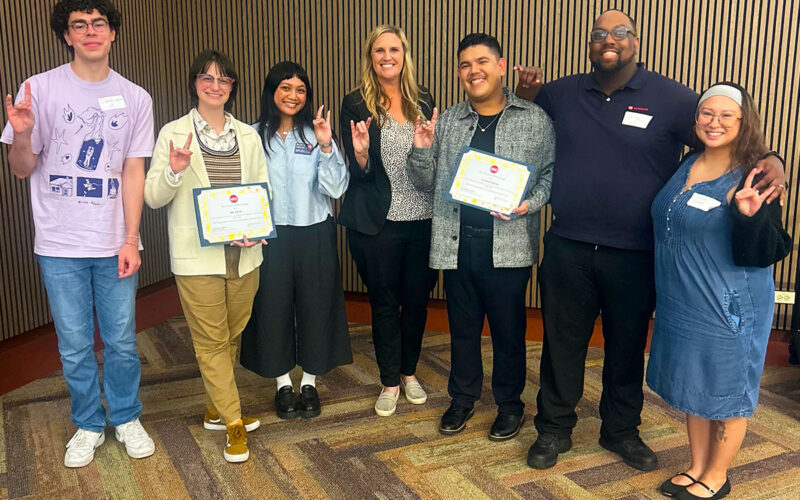
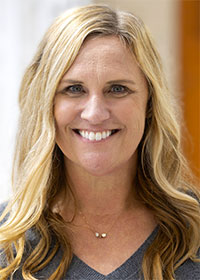
Danae Miesbauer is not a graduate of the University of Illinois Chicago, but her trip there Oct. 1 to attend the Fall Advising Summit seemed like a class reunion nonetheless.
Miesbauer, academic counselor in the Department of Counseling and Higher Education, was not only able to celebrate recognition given to UIC employees and NIU M.S.Ed. alumni Cristian Baeza and Jay Jarvis but also to see four other recent Huskie alumni working there.
“It’s great to see the connections between our HESA program and UIC’s academic advising and to see so many of my former students,” Miesbauer says. “It was definitely a ‘full circle’ moment to see one of my supervisees receive the award and hear to how he’s making such a big impact on students.”
Baeza served as Miesbauer’s graduate assistant from the fall of 2019 until completing his degree in May 2021; at UIC, he is the senior honors advisor and program specialist for the Honors Program and recipient of the university’s Outstanding Academic Advisor Award.
Jarvis, meanwhile, is an academic advisor in the College of Liberal Arts and Sciences working with students in more than 40 majors across the college, including a large population of pre-health students – and the 2023 alum is the winner of the UIC’s Outstanding New Advisor Award.
NIU Higher Education and Student Affairs master’s alumni James Alford (’17), Johnna Archua Gerona (’21), Ahyen Labanan (’23) and Dakota Williams (’25) were on hand to acknowledge their UIC teammates.
“Seeing multiple HESA graduates being recognized for their excellence at UIC highlights both the quality of academic preparation our students receive and the strength of our professional community,” Miesbauer says.
“Our graduates leave NIU with the knowledge, practical experience and dedication needed to advance student success,” she adds, “and it is inspiring to see these alumni continue to support one another while advancing the field of academic advising and creating positive outcomes for the students they serve.”
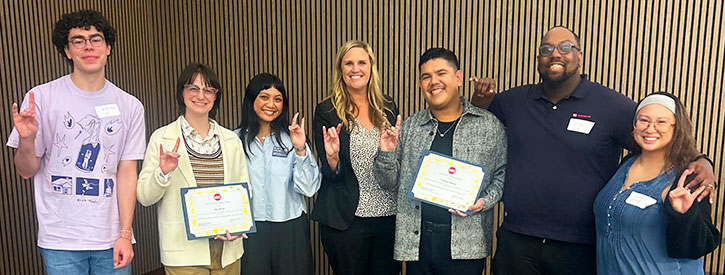
Cristian Baeza, James Alford and Johnna Archua Gerona.
FOR BAEZA, THE STORY began in Chicago, where he was born and raised, and took an unexpected turn that acknowledged his foundation.
“Given that I’m a first-generation college student, navigating higher education for me was a new thing and a new experience, not only for myself but also for my immediate family and even my extended family,” Baeza says.
“And so as I was working my way through – I initially wanted to learn communication or political science – I knew that I wanted to end up in some type of advocacy work,” he adds, “and once I bumped into being a college student myself, I was like, ‘There’s something here.’ ”
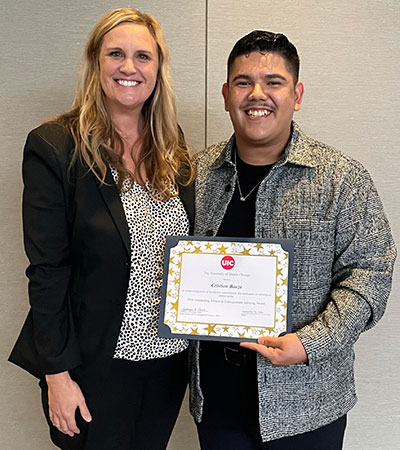
He began to think about his academic advisors at UIC, where in 2019 he earned a bachelor’s degree in Human Development and Learning, and even his high school guidance counselor.
Resolving to follow in those footsteps, he considered both levels of school before narrowing his destination to higher education.
“The more I went through my collegiate journey, I knew that I really appreciated my college experiences and what I got involved in, and I attribute a lot of my success in higher education to my academic advisors,” he says. “I started asking the question, ‘How can I have a job like yours one day? How can I become an academic advisor?’ ”
Coming to the NIU College of Education provided that answer.
“It’s a program that I always brag about to this day,” Baeza says. “For me, it was the opportunity to complete my graduate studies at a school that was at the top of my list of undergraduate choices. It was also close to home while still giving me a greater sense of independence, especially since I was a commuter student at UIC.”
Working closely with Miesbauer remains a highlight and ultimately sealed the deal among an array of graduate school and assistantship offers, leading him to commit to NIU HESA’s program.
“I was excited when I learned that I had attained my top Graduate Assistantship choice, and I also remember being filled with joy when I learned it was a mutual match,” he says.
And it remains a highlight.
“She became not only my counselor in grad school but also my supervisor. I’m always grateful for that experience, and I’ve told her this millions of times: She literally prepared me for what I’m doing today in terms of the position, including programming and teaching,” he says.
“I got to co-teach with her in the Social Change Leadership course, and she also provided me with the opportunity to advise the Counseling and Social Change Leadership minors,” he adds.
“Fast-forward to today. As UIC Honors College Advisor, I get to support and advise students across all majors and degree-granting colleges on campus. I also serve as an instructor for HON 101, a first-year orientation seminar, where I now support and teach alongside our wonderful student Teaching Assistants, as I did with Danae.”
Lastly, he adds, “I lead programming initiatives for First-Year Orientation and the President Awards Program-Honors (PAP-H) Scholars Program, and occasionally contribute to recruitment efforts. Who would have thought my graduate assistantship would literally set me up so well? I now apply much of what I learned from Danae.”
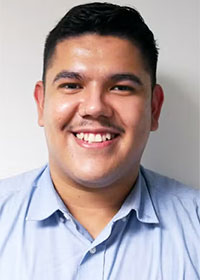
Baeza’s nominator for the award called him “an advisor’s advisor” who “combines natural ability with experience, preparation and a genuine commitment to helping students grow.”
Meanwhile, he is known for guiding students through difficult situations by helping them to “understand their choices, take ownership and move forward.”
He credits his own former advisors, Miesbauer included, for that philosophy.
“All the people who supported me were not necessarily giving me information of, ‘This is what you need to do’ and a checklist. It was always more of, ‘Let’s have a conversation about it,’ ” Baeza says.
“Then, at the end of that conversation, it was me knowing that I was the one making that next choice, taking that next step,” he adds. “All of them had that in common: being more of a sounding board.”
What it does is “humanize the experience” and foster “mutual learning,” he says.
“I always say, ‘Yes, I’m your advisor, and yes, maybe I already navigated higher education, and I have XYZ title,’ but at the end of the day, we’re all literally humans, right? We’re all learning from each other. It’s remaining humble. It’s being confident and comfortable in myself to know that I don’t know something,” Baeza says.
Moreover, he adds, “I love the privilege of advising students across all colleges and programs because I enjoy learning about and discussing engineering in one meeting, then nursing or business in the next.”
“I enter each advising meeting with a collaborative mindset, knowing students have questions, though I may have questions of my own or not have all the answers,” he says. “I may need to bring someone else into the conversation or help them with XYZ. They might also share something that challenges me to be a better advisor and helps the next student I meet.”
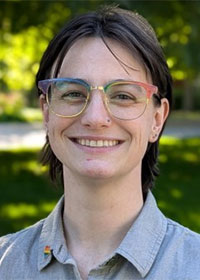
JAY JARVIS CAME TO NIU from the Salt Lake City area, where they grew up steeped in higher education.
“I’m not a first-gen student. My mom is a professor,” they say. “I always knew I was going to go to school. I always knew I was going to go to grad school – I just didn’t know for what yet – but there were always a lot of things that I just kind of knew implicitly.”
At Utah State University, where they earned a bachelor’s degree in Religious Studies in 2021, they realized that not everyone comes to college with that same foundation.
“While I was in my undergrad, I had a friend who was a first-gen student, and it was really eye-opening to see what she just didn’t know because she hadn’t had the chance to learn,” Jarvis says.
“That’s why I love working at UIC because it’s such a diverse campus – so many first-generation students, a lot of international students – and there is no reason to expect my students to know how this works,” they add. “But at the same time, they don’t have a class that teaches them here’s how college works. That’s where I fit. That’s my niche, and I get to learn from them in the process.”
Meanwhile, “it’s kind of a moral thing for me. College is very complicated and expensive.”
“If I have knowledge of how this works, and I have the ability to help students learn something that’s really going to help them out later on, it’s a moral obligation for me to help them learn that next thing,” Jarvis says.
“They need to have things done within a certain time frame. They have to go into the workforce, and maybe they’ve got a family or other obligations, especially at UIC. Most of my students are commuters,” they add. “It is important to me that I am a trusted resource who can help them navigate this complex system and make the most out of their undergraduate experience.”
Jarvis made their own future-focused discoveries while still in Utah.
“I like school. I like school a lot. I’ve always liked school. And while I originally went into my undergrad with a very specific teaching career in mind, I ended up not changing my mind, as many students do,” they say.
“And it was at that little crossroads point that many of my students find themselves in junior, senior year, and figuring out what I wanted to do, I thought that higher ed felt really good. I liked it. I wanted to stay on college campuses.”
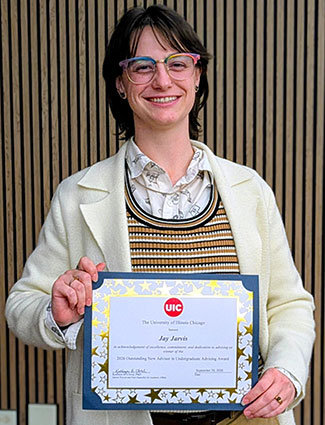
Enter NIU.
Knowing they wanted to find a graduate school outside of Utah, “I made this huge list and whittled it down and whittled it down and whittled it down – and NIU just kept making the cut. It’s really affordable, and my spouse is from the Midwest as well, so there was also a draw to this region.”
NIU’s built-in graduate assistantship was “one of the big pros.”
“That was huge. That was so helpful,” they say. “It was something that I knew I wanted because I wanted that professional experience, and it comes with the tuition waiver. Affordability was a really important piece for me. I didn’t want to go into a ton of debt.”
Serving at NIU’s Center for Student Assistance for two years provided “a really great breadth of experience” while pursuit of their master’s degree came with a small cohort, evening classes that afforded greater access to faculty and “space to really dive into a lot of different things.”
Part of that cohort was Ahyen Labanan, who is now a teammate in the UIC College of Liberal Arts and Sciences and winner of its 2025 Outstanding New Advisor Award.
“Ahyen had gotten her job at UIC advising right out of grad school, and so when I was looking for work, Ahyen mentioned that there was opening and that she really enjoyed it,” Jarvis says.
“I didn’t think that advising was going to be for me when I went into the program, but that’s kind of the classic tale of advising, I think. Most people kind of fall into it,” they add. “I tell my coworkers that it’s kind of like a Cinderella shoe. It just fits me really well. I like the pace of it. I like the structure of it. I like the developmental/holistic side, and I like that we also get to do a lot of prescriptive and administrative work, so it’s the perfect balance for me.”
Jarvis is known at UIC as “someone who approaches advising as a form of teaching, introducing information step by step and helping students gradually build both knowledge and confidence.”
“Honestly, it makes my job easier, right? If I teach my students how they can find their own degree audit, and how to translate it really early on, it’s fewer meetings for me down the line,” they say. “They can develop those skills that will really make them successful in and after college.”
Meanwhile, “I really love when my students are open to making the most out of their undergrad or are open to changing their mind or being surprised by things.”
“I have a lot of pre-health students planning on going to pharmacy, dentistry and medicine, and I do specialized advising with that population,” Jarvis says.
“I tell them, ‘You might have one hyper-specific thing in mind: one school, one specialization, one job that you’ve wanted to do since you were 7. That is awesome. We are going to work toward that. We’re going to apply to that school,’ ” they add.
“But I wouldn’t want a 7-year-old deciding my future, so what I think really excites me is when my students are saying, ‘Hey, I took this Public Health class for my gen ed. I really liked it. I heard about a minor. What is that? Can you tell me more?’ If they bring those questions to me, we can just so much more in depth.”
