
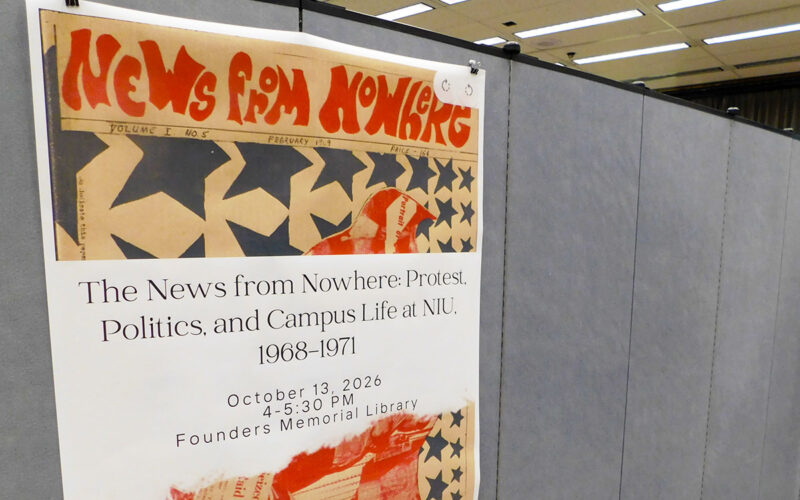
 Previous editions of the HESA 500: Foundations of Higher Education poster exhibition have explored all eras of NIU’s long history.
But the window of possible topics tightened significantly for this fall’s event, held Oct. 13 in Founders Memorial Library.
Such was the challenge from Professor Carrie Kortegast to her master’s students, who were told to find their subject matter within only four years’ worth of The News from Nowhere, an underground student newspaper published from 1968 to 1971.
The seed was planted in the fall of 2024 when Crystal Camacho, Ajahnaé Clay and Jenny Guzman – a trio of that semester’s HESA 500 students – discovered hard copies of the The News from Nowhere in the library’s archives and made it their project.
“Out of that, we have able to digitize through some crowdfunding and support through the libraries, and that became the inspiration for this year’s posters,” Kortegast said. “Students chose topics that happened at NIU during this period of the late ’60s and early ’70s. For some students, this was new information for them. For others, this provided an opportunity to understand how global context influences what happens at campuses and how campuses then respond.”

Kortegast and those who attended the poster talks heard about how national social and political movements of the Vietnam Era intersected with campus life at NIU, including anti-war protests, debates surrounding ROTC, the Gay Liberation Movement, Black Panther involvement on campus, the Horsley Commission and how administrators dealt with student activism.
Research support came from Founders Memorial Library staff Bradley Wiles, associate professor and head of Special Collections and Archives Department, and Alissa Droog, assistant professor and Education and Social Sciences librarian.
Ian Rabanal appreciated the new perspective.
An employee engagement specialist with NIU Career Services in addition to his M.S.Ed. pursuit, Rabanal and research partner Yahaya Tahiru studied the Horsely Commission created in 1970 by the Illinois General Assembly to investigate the causes of campus unrest.
Fortunately, The News from Nowhere supplied then-current content on the war in Vietnam and the May 4, 1970, shootings at Kent State University.
More input came guest speakers Erica Eckert, an assistant professor at Kent State who is researching the tragedy of 56 years ago as part of her faculty scholarship, and Peter Briggs, a 1972 alum of NIU and former editor of the News from Nowhere, who discussed the newspaper, his experiences on campus and additional information about that time period from his perspective as a student.
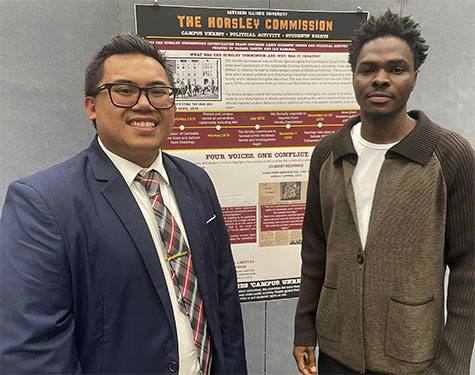
“We were surprised to learn how history repeats itself as we students take up activism and fight for what we believe in,” Rabanal said. “Our poster talks about how everyone views the same problem differently – for example, the Black Lives Matter movement.”
He expects to carry this outlook into his eventual professional roles “to form space for students that is equitable, that advocates for all students and that essentially shapes a place for all our students to be future leaders and changemakers.”
Deborah Eguakun and Sharrell McNeal looked into the changing roles of female students at NIU and their gender-specific issues on campus, including restrictions on the hours when women could leave their residence halls – limits that were not imposed on men.
Strong voices, backed by 5,131 responses from women to a campus survey, changed those unequal permissions.
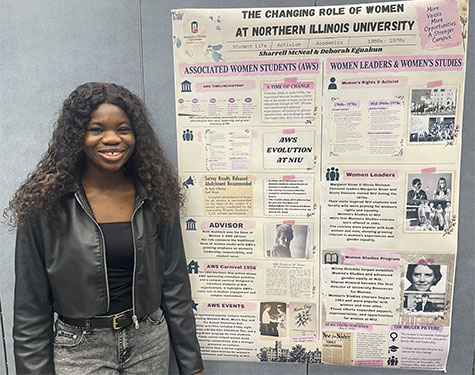
“Women were only supposed to do traditional things, but no. Women wanted to be seen. They wanted to be heard. So, what really interested me was how women came out and came to advocate for themselves,” Eguakun said.
“Even though we are students, we have to right to advocate for our rights and advocate for things that we want to be done in our way,” she added. “It shouldn’t only be, ‘The university says to do it this way, so we have to comply with this.’ As students and as women, we must challenge the traditional expectations.”
Lesli Herrera is pursuing a career in Student Affairs thanks to a positive experience at Waubonsee Community College, where she earned her associate degree in 2024.
An employee in Financial Aid offered personal care, support and guidance to the first-generation student who needed exactly that.
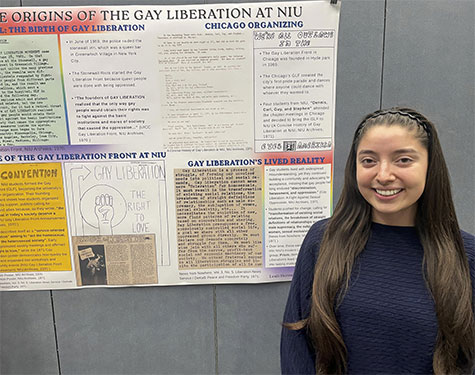
“It was difficult. I had a lot of obstacles of how to do this, how to do that,” Herrera said, “and she became a mentor for me. She changed my life. I want to be that difference for a student one day.”
Herrera and research partner Gabi Viveros studied the 1970 launch of the Gay Liberation Front at NIU – the university’s first LGBTQ+ organization.
“What fascinated me most about this project was learning how the Gay Liberation originally started in New York and how it ended up at NIU with four students who attended chapter meetings in Chicago and brought it to NIU,” said Herrera, who plans to carry with her that understanding of how social movements begin and evolve.
Good idea, Wiles told the students during their Oct. 13 reception, saying he was amazed by how they mined so much fodder from the short-lived News from Nowhere.
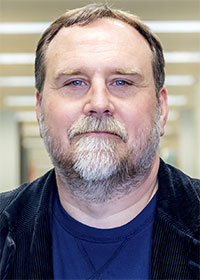
“You still managed to uncover all these different aspects, and you see how incomplete these records are. You know that there are certain things that are documented more thoroughly than others,” Wiles said.
“Hopefully, this helps you become a more conscientious person who supports higher education and who works with students, and with different aspects of the university, to tell that story,” he added. “Hopefully, you saw yourselves in those stories that you studied.”
Kortegast agreed.
“The administration does a really good job of archiving itself. Student organizations do less-good jobs,” she said. “In the roles you will have, what might be the ways you can help contribute to the archives and to the institutional knowledge of the student experience?”
Other presenters were Eric Avila, Cristian Bordabeheres, William Delmo, Kait Eversole, Akili Janel Jones, Taleen Mansour, Taquala Mills, Emmanuel Oduro, Khardell Jaequan Phelps, Mya Grace Muyu Stroup and Gabi Viveros.
