
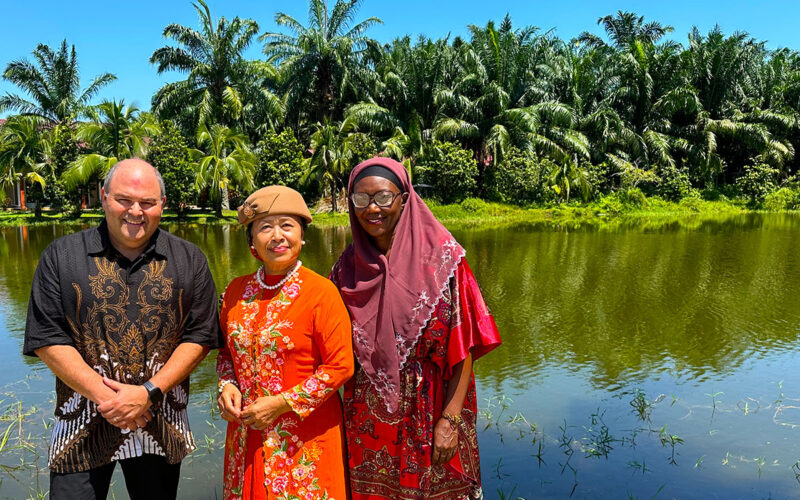
When Shuhaimi Salleh and Noripah Kamso hosted NIU College of Education Professor James Cohen in their Kuala Lumpur home, the couple loved their guest’s stories about Educate Global.
And when they wondered aloud if Educate Global could come to Malaysia, it was Cohen’s ears that perked up.
One year later, Salleh and Kasmo visited the school in Indonesia where Cohen and Teresa Wasonga had brought their Huskies – and they liked what they saw.
“For Noripah and me, it all started in Jogjakarta,” Salleh says. “We were let into several classroom sessions led by respective NIU students. With such observations, we had a good understanding of the program and were convinced that this program should also be replicated to Malaysia.”
The couple told Cohen and Wasonga they would look for a school in their country, a search that eventually led them to Imtiyaz Islamic School.
“Lo and behold, a friend suggested Imtiyaz Banting and suggested that we pay a visit. The lady patron and founder welcomed us and had arranged for a comprehensive briefing about her school,” Salleh says. “We were optimistic.”
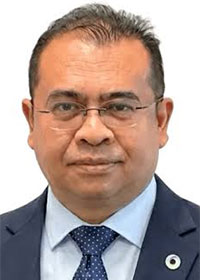
So were members of the school’s board of governors, Deputy Chair Amin Shafie says.
“I would say that, first and foremost, it was out of curiosity. We’re always curious to see how would-be teachers handle real-life classroom interactions, especially when those are with kids whose first language is not English, and also the cultural aspects and the environmental aspects happening at that time,” Shafie says.
“The second part was that we were introduced by Noripah Kamso as a common friend, and that we happen to have a private school that was able to accommodate,” he adds. “Those were the main factors, and were my personal drive, to go into this.”
NIU’s contingent received a “rousing welcome,” Salleh says, which cemented “warm and cordial ties” and set the tone for after the first few days of adjustment to a school in a remote, rural location without the level of facilities and educational materials provided in U.S. schools.
“In ensuing days, the onus was on the NIU students to warm up the Imtiyaz students and encourage their class involvement and participation. On the part of the Imtiyaz students, they were enthusiastic and evidently eager to participate,” he says.
“My suspicion on English language conversations is that many of the Imtiyaz students did considerably well. Thus, communication between teacher and students was not a major hindrance. Instructions were successfully carried,” he adds. “By almost the end of the three-week program, I observed a congenial teacher-student relationship in action.”
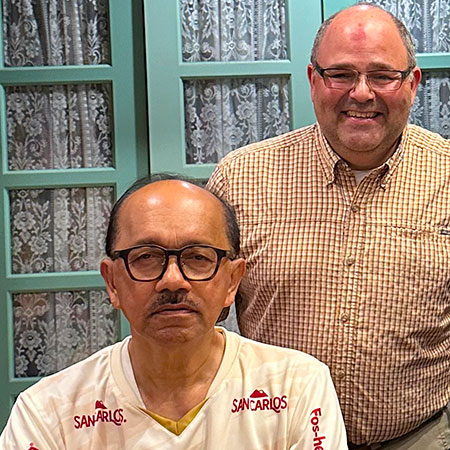
What that included, he says, were experiences with differences in pedagogy, culture, teacher-student relationships, discipline and mannerisms as well as regimented lifestyles and an adherence to regulations and rulings imposed by teachers, society and government authorities of education.
“In normal schools, quite a number would be troublemakers or belligerent, and this could distract teachers. This wasn’t the case at all at Imtiyaz,” he says. “By and large, these Imtiyaz students were much easier to handle and orderly, and there was no lack of class participation.”
And, he adds, the Malaysian teens showed growing levels of assurance in the presence of the NIU preservice teachers who were open to hearing and considering their ideas and opinions.
“That goes against our cultural norms,” Shafie says, “but the ability of them to show confidence, the ability of them to go up and express themselves through some of the activities organized by the NIU students? That was something that could be clearly seen, and that’s also one of the main things highlighted by the officers of the ministry who came over for some of these events.”
Shafie and other school leadership were impressed by how quickly the visitors from DeKalb acclimated to Imtiyaz, he says, as well as how they related to their young students despite the obstacles of culture and language.
Meanwhile, even though Imtiyaz is a private school, it still falls under the purview of the Ministry of Education in Malaysia. Consequently, he says, some restrictions are placed on subject matter.
But “the NIU students were able to adapt and proceed with what they had,” Shafie says. “That flexibility and agility to adapt is something that’s quite interesting on our side.”
 Leaders also appreciated the cultural sensitivity and awareness of the Huskies, including the need for modest dress and wearing headscarves.
His final impression?
Visiting and practicing in Malaysia will make the Educate Global travelers better teachers back home, he says, thanks to their immersion in reaching out with empathy to relate successfully to students and co-teachers and in keeping open and nonjudgmental minds to their surroundings.
For Imtiyaz, he says, the closing thoughts are just as positive.
“Number One, we’re very glad and very satisfied,” Shafie says.
“Number Two is that what we felt – our impression of the program – is resonant with that of the officers of the ministry who came in, and this is something that’s quite good,” he adds.
“A lot of the programs in the past by other organizations that came to some of our schools were not as well-grounded or as well thought out in terms of the learning outcomes and expectations for both parties. You always have that nervousness on an institutional level of whether this is something that we can be able to grow, and to be able to see how it affects positively for all parties, and I think that’s been clearly achieved.”
Salleh agrees.
“The derived benefits are enormous,” he says. “One significant impact is a boost to Imtiyaz’s reputation. Other schools would surely consider replicating a similar sort of program.”
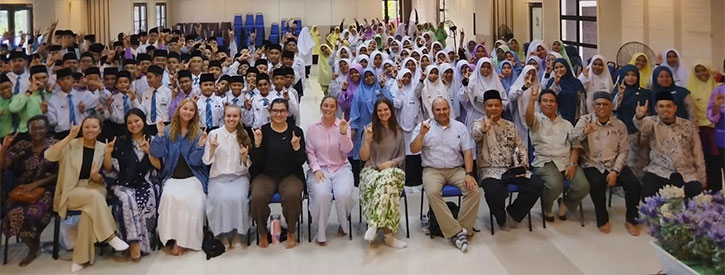
Locally, however, “I won’t expect the school to adopt constructive or remedial changes right away. It can materialize after a few more annual sessions, which may then convince school administrators and, more importantly, the teachers. Personally, I would think Malaysian schools would benefit most.”
As for NIU, he adds, “the benefits have accrued since Day One of the program.”
“Malaysia is a new international site. Diversity becomes one enriching feature as the program moves to other countries,” Salleh says. “Specific to each individual NIU student, he or she could possibly bring home new insights to living, work and family life and perhaps adapt to patterns of behavior that resonate with nature and its environment.”
