
 A pair of collaborative research projects between the NIU College of Education and the University of Tetova are accelerating toward final analysis and writing this spring.
One study focuses on trauma-informed and resilience-focused practices in North Macedonian schools while the other focuses on educator beliefs and practices related to student social-emotional competencies.
Work began a year ago to develop and translate surveys, which were distributed in late spring with analysis of those results taking place during the summer.
Researchers (including Kristin Lee and Irem Pilgir, doctoral students in the NIU Counselor Education and Supervision program) then visited North Macedonia in September to conduct focus groups and interviews, deliver workshops and set up community advisory boards.
Dana Isawi and Yenitza Guzman, faculty in the Department of Counseling and Higher Education, are examining trauma-informed practices while Eric Junco, the college’s director of Academic Cultivation and Engagement, is leading the team exploring socioemotional learning.
Paul Wright, NIU Board of Trustees Professor and Distinguished Engagement Professor in the Department of Kinesiology and Physical Education, consulted and mentored the trio as it conceptualized its work last spring. Wright is also helping the SEL team with analysis.
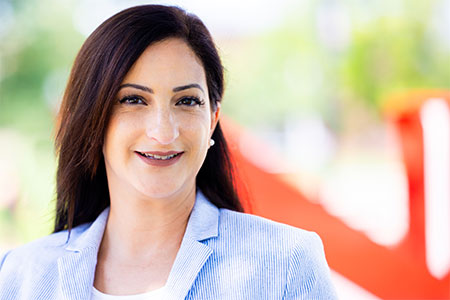
“Trauma-informed practices and a trauma-informed lens have been part of my career as a mental health clinician as well as a counselor-educator, so I’ve been looking for opportunities to expand the scholarship and the interest in conducting research and training globally,” Isawi says.
“I think that trauma is something that’s universally experienced, and I feel that this relationship with an international university allows me to expand that work through looking at this as universal experience,” she adds, “but I also understand that trauma is also culturally- and context-specific, so that would be a different context to apply.”
Guzman, a former school counselor, has long been passionate about mental health in the K-12 sector.
“When I was first hired at NIU and started teaching the trauma-informed courses, it just really spoke to me and sparked an interest in thinking about how effective I could have been as a school counselor if I was using these trauma-informed practices and how much more effective educators could be if they were thinking through this lens,” Guzman says.
“Because of my personal identity, I’ve always been interested in not only how this works nationally but also how this works internationally,” she adds. “I really wanted to get a better understanding of what mental health supports look like in schools and apply that knowledge to my current role as a counselor educator.”
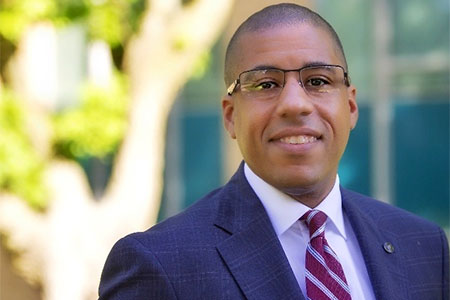
Junco also has appreciated the global perspective as well as the synergy of his work with that of Isawi and Guzman.
“Many of the questions they’re asking at the same ones at the center of my teaching and my scholarship. They’re asking who belongs, who feels safe to learn and what types of approaches we can use to help facilitate repair and cultivate deep learning in those contexts,” he says.
And, Junco adds, North Macedonia provides fertile ground for those conversations.
“What resonates with me is that a lot of their work is relational. Their culture is a relational culture – and so it’s not just about survey research,” he says.
“We were in there talking with educators and students about the social conditions that are impacting their day-to-day practices in their teaching and learning,” he adds. “We’re also trying to understand how faculty – teachers – are conceptualizing what social and emotional learning means, what their practices look like and how we can adapt our version of SEL to fit their cultural context.”
VISITING THE UNIVERSITY OF TETOVA delivered just that.
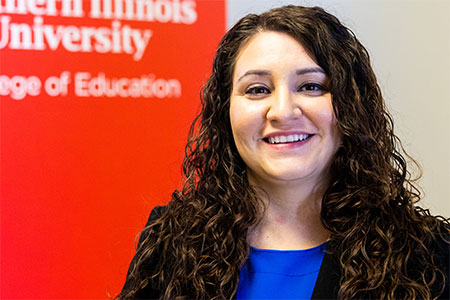
“None of us had been to North Macedonia prior to September,” Guzman says.
In advance of that trip, she says, NIU’s team communicated with its European counterparts via email and video conferencing “to get their feedback and ensure our thoughts and plans were appropriate within their context.”
“Our collaborators were very much a part of helping us navigate,” she says.
“We might know a lot about trauma-informed practices and social and emotional learning in the U.S., but they helped us quite a bit with understanding what the process was like on their end. We didn’t understand the school systems. We didn’t understand the structures that were in place. We asked a lot about language and the words we used and how they translated.”
Those pre-trip meetings also helped determine what schools and grade levels the researchers would visit to ensure a diverse range of socioeconomic status, Albanian and North Macedonian ethnicities and the lived experiences of people across those social identities.
Fast-forward to September – and, as Junco says, “so much learning happens when you’re in person.”

“We had heard that they live in a post-conflict context in their society, but you really can’t understand that until you experience it firsthand. We talked about how schools could be ethnically Albanian or ethnically North Macedonian or mixed, but you just don’t know what those tensions are like there until you live it,” he says.
“Now,” he adds, “we’re sifting through the data doing this analysis with them to triangulate and understand the types of solutions we can bring when we develop workshops and report back our research findings with them.”
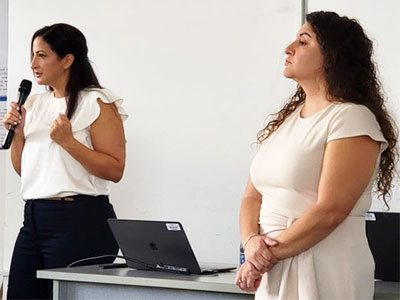
Part of the discovery process has been finding common ground.
“Even though our contexts are different, I’m struck by how familiar some of our struggles are,” Junco says.
“When we were there talking with the teachers who have these deep concerns about their students, they’re talking about things like social fragmentation – these divides across political differences that show up in classrooms,” he says.
“They’re talking about this idea that because students are now sometimes glued to their phones, or because of social media, sometimes that’s now creating gaps in how different generations socialize with each other. They’re talking about identity-based harm across religions and ethnicities,” he adds, “and these are problems that are very-human problems that are solvable.”
AS THE RESEARCH MOVES toward writing, peer-reviewed publication and professional conference presentations, Isawi says she, Guzman and Junco “hope that is the beginning of an enterprise and lifelong relationship and collaboration.”
“I feel a responsibility toward co-creating knowledge across borders,” Isawi says.
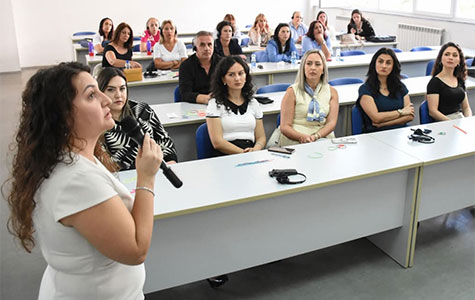
“Cultural humility is another interest of mine in my research,” she says, “and I think that engaging in international scholarship and research models with that cultural humility – that I want to learn from other cultures – I will only become a better research and educator.”
NIU’s access to scholarly journals and its established reputation and agendas of research will benefit the collaboration, she adds.
“I also have a strong pull toward social justice-related inquiry, especially in war-torn areas, and that’s what North Macedonia and the Balkans are,” Isawi says. “Helping and working to amplify these voices in our own journals in the U.S. is not just for us. It’s for our students. It’s for our communities. It’s for amplifying these voices beyond their borders.”
Guzman will remember the “honor” of taking graduate students Lee and Pilgir, who is Turkish, on the trip.
“We went for the research – we love this work – but we were also able to make really heartfelt, personal connections, human to human,” Guzman says.
Meanwhile, she adds, “it was just so interesting for me to see the school system, how the schools function. I was just like a sponge the whole week, soaking in as much knowledge as possible while we were there. It is an experience that I wish more people could have.”
Further reading
- Spring 2025: NIU-Tetova partnership invites chapters for ‘Peace as a Transcultural Language’
- Fall 2024: Faculty, students from Tetova visit NIU to explore topics in teacher preparation
- Fall 2017: Camera’s eye: Blackwell photo exhibition to tell tale of Tetova
- Center for Peace and Transcultural Communication
