

Where do education and democracy converge? How does education support and sustain democracy? What skills, habits and dispositions must students develop in school to participate in democracy?
Questions like these have fascinated Sarah Stitzlein since her undergraduate days double-majoring in Mathematics and Philosophy.
Math easily earned the approval of her agricultural and school-teaching family: “My dad said, ‘Great! You can come home and do the books for the farm.’ This was not abstract algebra kind of stuff. This was applied math – bookkeeping.”
Philosophy made sense to Stitzlein, however, and not at all to her “very practical” family through whom “runs this kind of proclivity to want to teach or help others.”
Grandpa worked his cattle, hog and grain farm and drove the school bus nearly 40 years for the rural district. Grandma was a teacher. Dad was a teacher. Two of her sisters are now teachers.
“So when I started asking big-picture questions, my family was like, ‘Oh, good grief. What are you talking about now?’ ” she says. “I was always that annoying child who constantly said, ‘Why, why?’ It just exhausted my mother, and she finally just said, ‘Because I said so,’ and then, ‘Just stop asking.’ ”
Her “traditional farming family” eventually comforted itself in the thought that Stitzlein’s study of philosophy was probably just a “young idealism” that would pass.
Yet it did not.
“I actually got more and more interested in philosophy and asking these big questions about what knowledge is, and how do we become good, and what does it mean to be good,” says Stitzlein, who now is professor of Education and affiliate professor of both Philosophy and Women’s, Gender and Sexuality Studies at the University of Cincinnati.
 “During my senior year, when I was writing my Honors thesis in philosophy,” she adds, “my professor turned to me and said, ‘These questions you’re asking are really questions about education. You really seem to want to know how we develop good people.’ And I said, ‘Yeah, you’re right.’ ”
The professor then took a more direct approach, effectively canceling his student’s plans to earn a “nerdy as it comes” master’s degree in the study of number theory.
“He said, ‘You know you’re not going to be happy there. I can tell that you and your family have this bent toward others and helping others and making an impact. Sitting in a room with a pile of math books is not going to fulfill you.’ ”
Right again, Stitzlein thought.
“I withdrew all of those graduate school applications and found about this field called Philosophy of Education, where I could bring theory to bear on real life in classrooms,” she says.
“And what a wonderful turn of events that was for me,” she adds. “I decided to get my master’s in Education because I thought it more important to learn about what was going on in real classrooms so that I was just talking abstractly but about what was really happening.”
The co-editor of Democracy & Education is the 2021-2022 recipient of the James and Helen Merritt Distinguished Service Award for Contributions to Philosophy of Education, an award given by the Department of Leadership, Educational Psychology and Foundations.
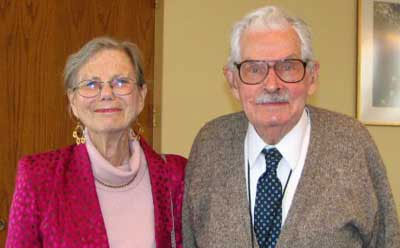
Named for the late James Merritt, philosopher of education and professor in the College of Education, and the late Helen Merritt, artist and professor of art history in the College of Visual and Performing Arts, the series spotlights scholars who have deeply influenced educational thought and practice.
Stitzlein will deliver the annual Merritt Address, titled “Teaching Hope and Reviving Democracy,” at 4 p.m. Thursday, Feb. 17, via Zoom.
- Copy this Zoom link to your calendar!
The presentation will explain hope, why it matters to democracy and how to teach it in schools, universities and civil society. Stitzlein also will respond to struggles resulting from the pandemic and other societal strains that challenge hope in schools and democracy.
Leslie A. Sassone, associate professor of Foundations of Education, and her NIU colleagues “are honored that Dr. Stitzlein has accepted the opportunity to be the 25th Merritt honoree.”
“Her work on the importance of democracy in schools speaks directly to Jim Merritt’s intent when he and Helen established the fund that supports this event,” Sassone says. “Dr. Merritt believed, as Dr. Stitzlein believes today, that teachers should learn how to become expert in critiquing and expressing theory – and he was hopeful that, with exposure to philosophy of education, this would happen.”

For Stitzlein, the concept of hope is a recent fascination.
“A few years back, something pretty traumatic happened in my personal life, and, for the first time ever, I went to a psychologist who met with me to talk through what had happened,” she says.
“The very first time I came to his office, I laid out what happened. Then I laid out, ‘Here’s how I’m moving forward.’ And he stopped me, and he said, ‘I’ve been doing this for 25 years, and you are the most hopeful person I have ever met,’ ” she adds. “He said, ‘Most people will go through something like this and they’re angry. They’re struggling. And you just laid out the future instead of getting stuck on the past.’ ”
Was he calling her naïve, she wondered? A little Pollyannaish? Was she failing to honestly and thoroughly contemplate just how significant this event was in her life?
No, Stitzlein decided.
“I started thinking more about it, and I thought, ‘No, this is really my outlook when anything happens in my life – not just bad stuff.’ I’m just somebody who’s looking forward,” she says.
“And so I started to think: Why aren’t others like this? And what might that outlook that I have offer for our struggling democracy right now, where so many people feel cynical? Where so many people feel that they can’t contribute to policy or really make a difference?”
Her reflections inspired her to write a book – “Learning How to Hope: Reviving Democracy through our Schools and Civil Society,” available free via “open access” – making the case “that schools and civil society should nurture hope as a set of habits that disposes citizens toward possibility and motivates citizens to act to improve their lives and, often, those of others.”
 COVID-19 arrived on the heels of its 2020 publication, however, prompting Stitzlein to refocus on what originally led her down this path.
“Your personal life is burdened down. You’re cordoned off at home. You can’t be near your loved ones. You can’t participate in sports and activities that matter to you. You’re struggling with your own health or the death of a loved one,” she says. “How do you have political hope when you don’t have personal hope?”
Stitzlein is confident that teachers can teach hope.
“There is some significant research going on in an area called ‘positive psychology’ that actually looks at how the brain does hope,” she says, “and it is something that we can nurture and build. The way we do that is by habitually enacting hope. We have to try it out, see that it works in a helpful way and then develop an inkling to keep hoping because it’s supporting us in helping us to grow and flourish and thrive.”
Consequently, she says, students will know from repeated action to turn to hope rather than “throwing their hands up in the air and giving up” when they face despair or uncertainty.
Next, she adds, is “affirming for students to look at how using hope was useful” through classroom discussion on how hope influenced their decisions and the outcomes.
“That’s a metacognitive awareness that helps students to see, ‘What I did worked, and I need to try that again in the future,’ ” she says. “It becomes something they eventually do unthinkingly. It becomes so routine for them. In that way, it becomes kind of a part of who they are – but yet they’ve learned it. It wasn’t there to start with.”
Prior to the pandemic, Stitzlein enjoyed a front-row seat to what is happening in K-6 classrooms at her neighborhood elementary school. She had taught there one day each week since 2012, finding fertile ground for philosophical research ideas.
Those days also fueled her own already hopeful optimism.
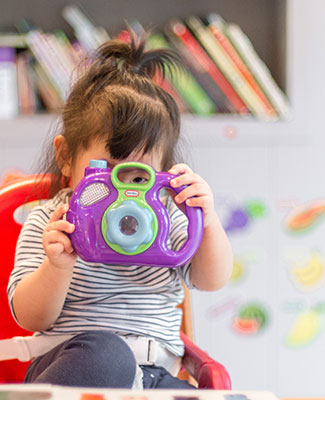 Young children “are more hopeful, in a way. They have that imagination of how things could be different, or what it would be like to live other places or do different things,” she says. “That’s been fun for me to see how they depict the world in their English language arts and in their visual arts.”
She also has discovered their level of critical thinking. She has overheard children discussing whether God exists. She has observed children sorting out whether one can continue to trust and remain friends with the other who had told a lie.
“You see children wrestling with these heavy topics, and they’re far more sophisticated than we ever give them credit for,” she says, “and that’s been really inspiring to me to see the capability they have for these kinds of conversations.”
In turn, Stitzlein hopes to inspire her Merritt Address audience to assume a sense of responsibility for their own hope.
“Our hope is an active verb. It’s a ‘doing,’ and as a result of doing, it shapes how we live together in democracy and what we ask of democracy; how we dissent when we disagree; and how we put forward better alternatives,” she says.
“What I want people to walk away with is understanding that hope isn’t something we put into other people, like a savior, or Donald Trump, or Barack Obama,” she adds. “Rather, it’s how we act and behave. It’s on our shoulders.”
