
When Lisa Borgo started taking babysitter jobs at age 11 or 12, she already was looking forward to Dundee Crown High School’s classes in cooking, sewing and, best of all, child care.
Bonus: District 300’s deLacey Family Education Center “was right next door – like walking distance,” providing opportunities for Crown students to interact with children at risk of developmental disabilities.
“I was assigned to a classroom that had identical twin boys blind since birth,” says Borgo, who earned her B.S.Ed. in Visual Impairments in 2014 and her M.S.Ed. in Special Education: Visual Disabilities (Orientation and Mobility) in 2017.
“They had retinopathy of prematurity. These twins were born very, very early,” she adds, “and what happens is that they get put in the incubator, and then the oxygen levels can cause issues with the retina and can cause blindness. Sometimes, with multiples like twins, triplets and quads, you’ll see one or more of them will have some sort of vision impairment.”
A fraternal twin herself (to nine-minutes-older Jessie), Borgo was quickly captivated by the independence of these boys.
“You would see them walking around with their canes sweeping in front of them. Think about how tall a 3-year-old is: These were tiny, little canes,” she says. “They were also starting to be introduced to braille, and I thought to myself, ‘This is really interesting.’ ”
Her full-circle moment came during one of her many babysitting gigs.
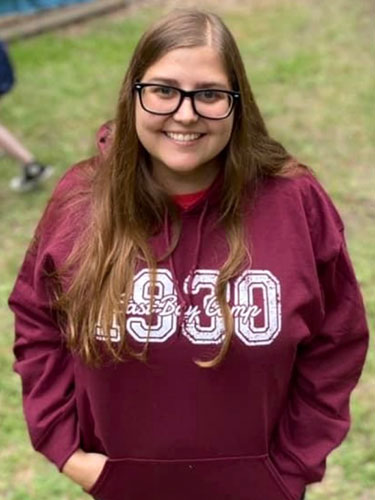
“One of the mothers of the families I babysat for was a teacher of the blind and visually impaired,” Borgo says. “I would glue myself to this woman, and I would go to work with her whenever my school had a day off and hers didn’t. I would just shadow her. I wanted to learn everything I could about working with the blind. She gave me the braille alphabet, and I started to teach myself.”
She soon could envision her future as a special education professional, which she correctly imagined would also include working with children with autism and other special needs on top of their visual disabilities.
Yet she couldn’t see everything awaiting her.
Following her graduation from NIU in 2014, Borgo filled in as a long-term substitute teacher of the visually impaired for the Rockford Public Schools while a teacher was on maternity leave. However, she first served as a paraprofessional for a third-grader named Jazel who was blind, autistic and nonverbal.
Returning to NIU for graduate studies briefly took Borgo away from that role, as she taught part time in Belvidere and Genoa-Kingston, “still getting my feet wet, still teaching, still getting experience and waiting for a Rockford position to open up.”
Master’s degree in hand, Borgo came back to District 205 in 2017 – and her supervisor had quite interesting news.
Just this: A full-time vision teacher position had opened, which meant that Borgo, who held educator licensure, would fill that position. And, even better, one of the students on her roster was none other than Jazel.
Eventually – seven years later, and just this May – Borgo guided Jazel across the stage at her high school commencement: “It was incredible to see how far she’s come since third-grade.”
 BORGO’S CAREER ALSO has come far, and into unexpected territory.
The now full-time vision teacher in Rockford serves 16 students at seven locations; some she sees daily while others are weekly or even monthly consults.
Of those 16, 15 have additional disabilities beyond blindness or low vision. These include autism, Down syndrome and deafness, the latter of which fits well with her life.
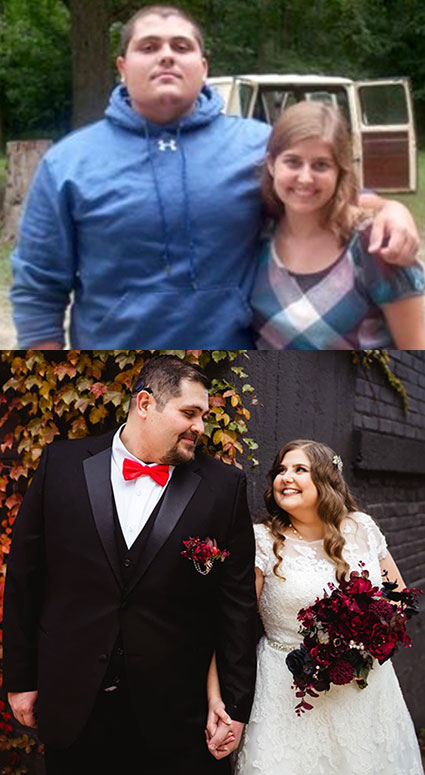
Her husband, Bronson Black, is deaf.
Their story technically begins about 15 years ago when Borgo was enrolled at Elgin Community College in pursuit of her associate degree. One of her classmates was deaf.
“She had a sign language interpreter, and that was really the first time I had seen one,” Borgo says. “I knew very basic sign, like the alphabet, and some simple words, and I would just kind of stare at the interpreter, like, ‘Oh my gosh, this is so amazing.’ One day at lunch, I went up to the student who’s deaf and told her that I was going to school to teach the blind, and that I currently help children who are autistic. Watching the interpreter helped me learn new signs to use with them.”
More importantly, Borgo’s classmate told her something intriguing.
“There was a camp called Camp Lions of Illinois for the blind and deaf, and she was going to work there for the summer. She was like, ‘You should come check it out,’ and I said, ‘OK, we’ll see,’ because I was nervous and didn’t know a lot of sign,” she says. “So, summer 2010 – it was July – I was like, ‘I’m gonna do this. I’m gonna get the courage, and I’m gonna go.’ ”
Courage, it turned out, was necessary.
“I show up, knowing my ABC’s and ‘Do you want a hot dog?’ – and the director is totally deaf and does not voice. I was just like, ‘Oh my God, what did I get myself into? This is the biggest mistake of my life.’ I couldn’t even ask what cabin I was sleeping in because I didn’t know the sign for cabin. I was so ready to just leave,” Borgo says.
“But then I thought to myself, ‘No. You have to give it a try,’ because it was the blind-specific week,” she adds. “I thought, ‘I know braille. I know how to help people who are blind. I know how to guide. I could be an asset for all the deaf staff who don’t have that much experience with the blind.’ So I volunteered, and I just fell in love with camp. It was the coolest experience.”
She returned every summer after that, committing to more and more weeks each year to serve beyond those campers with only blindness or low vision. That eventually included “Helen Keller Week” for campers ages 18 and older – some are in their 80s – and traveling to locations outside northern Illinois, including Bloomington-Normal, Carlinville and DuBois.
 All the while, she was learning more sign language.
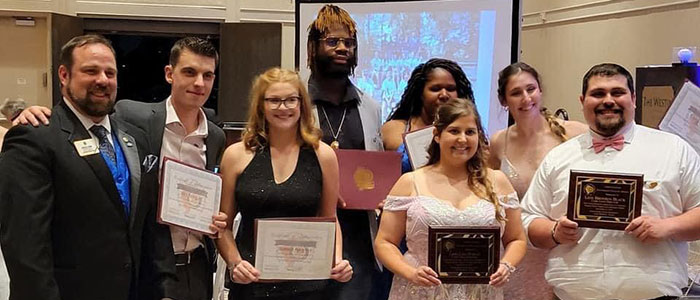
In 2018, her summers became paid ones as she was hired as a camp assistant. In 2019, she ascended into the role of co-director with Black, who also first served as a counselor in 2010.
“Camp has been a huge part of our lives,” Borgo says. “This is my 15th summer. I’ve seen some of the campers since they were 7 years old, and now they’re volunteering for us. One of our campers is now hired staff, and I’ve known her since she was 7 or 8. It makes you feel old – it hits you – but it’s inspiring to see because you just see all the gains they’ve made. I’ve seen them every single year, and they just grow, grow, grow.”
Growth at camp, and now at home, is true for Borgo as well.
“So few of us know how to properly work with students who are deaf-blind, and I feel like having the experience in the deaf culture – the deaf world – and learning sign, and living with someone every day where I have to sign, keeps me up on my skills.”
Black, who was not born deaf but lost his hearing after a medical procedure, and the Camp Lions of Illinois family also provide a good sounding board for Borgo.
“Although I’m not deaf, I can ask friends and Bronson for their perspective and their input to educate myself so I can better serve the community,” says Borgo, who also completed an online program in deaf-blindness. “Coming from the vision background, and putting these experiences together helps me to better advocate for my students who are deaf-blind.”
NIU’S VISUAL DISABILITIES program built a strong foundation, she says, crediting her degrees for some of her success in the Rockford Public Schools and at Camp Lions.
She remembers well Gaylen Kapperman’s “very difficult” classes in braille, covering not only the alphabet but contractions – “kind of like shorthand,” she says – as well as Spanish, French, German and music.
The curriculum also taught her about assistive technology, “cooking without looking,” 3D printers needed to fabricate “tactiles” for students and anatomy.
“We had to dissect a cow’s eye and learn all the various parts of the eye, which was very helpful because there are so many different eye conditions and so many different ways to be blind that I never really thought about,” Borgo says. “When someone says, ‘This eye condition has issues with the retina,’ I’ve physically seen a retina with my own eyes. I understand what they’re talking about.”
During her master’s studies in Orientation and Mobility, she practiced her white cane skills and traversed DeKalb and some Chicago suburbs while blindfolded with sleep shades. She also learned “the human guide technique, which I use every single day at work,” and completed coursework in vision rehabilitation therapy.
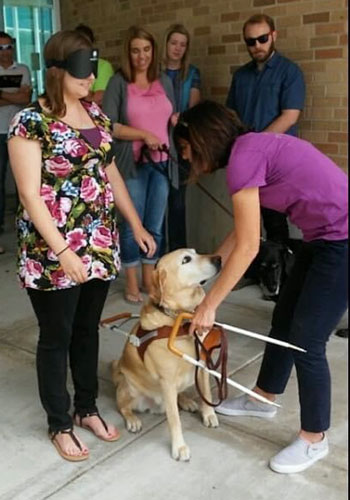
An internship at the Edward Hines, Jr. VA Hospital enlisted her into service with adults who’d lost their vision later in life, many of whom brought PTSD to boot.
Camp, meanwhile, has equipped Borgo with innovation – and it’s why her boss in Rockford Public Schools automatically assigns her new students who are deaf-blind.
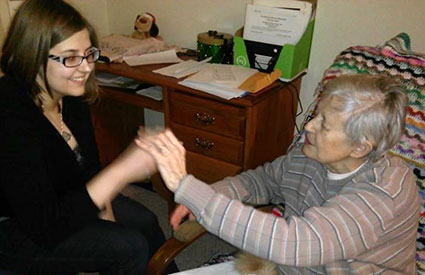
Her strategies include signing not for sight but for touch; for example, Borgo starts every session with one student by using tactile sign language and signing her name “L braille” into the student’s hand. She also uses her engagement ring as a personal identifier that the student feels so that the student knows who’s with her.
She also uses a more-consensual “hand-under-hand” technique that allows her to try things first, demonstrating that, whatever “it” is, it’s OK.
“I’m always so excited for new students who are deaf-blind because what they say about deaf-blindness is that it’s not blind-plus-deaf, it’s blind-multiply-deaf,” she says.
Borgo says she enjoys working with this population of students because she feels she has a good understanding of the best ways to help meet their needs: “It is a population that, unfortunately, many educators don’t have experience with.”
“When you think about someone who’s deaf, they utilize their vision to help make up for the differences of what they’re losing with their hearing,” she says. “And when you think about a blind person trying to cross the street, they stop and listen. They listen to the traffic patterns. If you’re now deaf or hard of hearing, that’s taking away what you’re relying on to compensate for the vision loss. It really isn’t just adding them together. It magnifies it so much more, and people don’t really understand that.”
For Borgo, everything adds up perfectly.
“I love what I do. I have so much passion for it, and I would not do anything else,” she says. “People’s lives are in your hands.”