

Rachel Newland found the NIU Department of Special and Early Education’s Visual Disabilities Program through a YouTube search.
And in coming to the College of Education, she’s found a home.
“Dr. Kapperman has been my primary guide; his interest in sex education and women’s empowerment have influenced me a great deal,” says Newland, who is earning certifications in Vision Rehabilitation Therapy (VRT) and as a Certified Assistive Technology Instructional Specialist (CATIS).
“I have a background in feminism, so being in a space where we can have open, candid conversations about women’s health and women’s issues related to health and sexuality has meant the world to me,” she adds. “It’s something I’m really passionate about, and I think Dr. (Gaylen) Kapperman, Dr. (Stacy) Kelly and I all share that same passion.”
Newland confirmed that conviction Feb. 24, when she shared the stage with Kelly and Kapperman as presenters during the annual conference of the Illinois Association for the Education and Rehabilitation of the Blind and Visually Impaired.
The trio delivered a session on “Guidelines for Providing a Meaningful Description of a Gynecological Exam for Individuals Who Are Visually Impaired,” describing how to assemble the contents of a kit of materials that enable meaningful instruction regarding the procedures involved in a gynecological exam for individuals who are visually impaired.
Materials necessary include hand-held models of female genitalia and different sizes of speculums, which Newland displayed, demonstrated and made available for audience members to touch.

She appreciated her opportunity in Naperville.
“It means so much to me to be around other people who are working in the field, and for it to be a dialogue. It’s not just standing up here teaching or presenting at everyone else; it’s a dialogue between us both. We’re both on an equal playing field, and we can learn from everyone – everyone who asks questions and everyone who participates and comes up to explore the items afterward,” she says.
“To me, that’s the most meaningful thing,” she adds. “We can talk your ear off all day long with this stuff, but if you’re not up and actively engaged with it, and if we’re not making those connections, it’s all for naught.”
Newland wasn’t alone at IAER, where NIU had a strong presence.
Sue Dalton, a longtime instructor in the Visual Impairments program, received IAER’s Outstanding Rehabilitation Award.
Dalton also presented “What Would MacEYEver Do? Extraordinary Uses for Ordinary Items for VIPs” with SEED alumna Jennifer Ottowitz of Mississippi State University’s National Research and Training Center on Blindness and Low Vision.

Graduate students Alex Gillaspie, Julie Pahr and Emmett Yost joined Kelly and Kapperman as presenters on topics also related to sex education for students with vision impairments: “STIs and How to Teach about Them in a Meaningful Manner: Safer Sex Instruction” and “Sex Education on the Cheap: Meaningful Health Methods and Materials.”
Razan Eltayeb, an M.S.Ed. student in Visual Disabilities, was honored for receiving one of two IAER scholarships.
Kelly is proud of NIU’s showing and especially of the students, who are “doing great work” in assisting their faculty to meet “a longstanding need for this new knowledge and expertise in our discipline.”
“There is so much value for everyone involved when Rachel and so many of her classmates conduct and present research with NIU vision program faculty,” Kelly says.
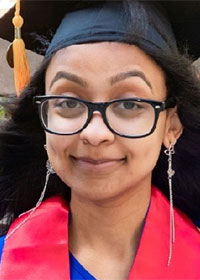
“It is great for Rachel and her classmates because they have the opportunity to been very visible in our profession at our professional conferences while they are graduate students. It is a great introduction to our field for our students, and our students are seen as leaders before they even graduate from the NIU vision program because of the groundbreaking research they present and publish with NIU vision program faculty,” she adds.
“And, to be frankly honest, there is no other visual disabilities training program on this planet doing this with their master’s degree program students. NIU is unique in this way that we have this commitment to providing our graduate students with the opportunity to publish with us in the peer reviewed journal of record in our profession and present with us at local, regional, state, national and international conferences.”
Newland, who is blind, agrees.
She earned a Ph.D. in Spanish from Arizona State University, where she taught during her doctoral and master’s studies “prior to making a huge career change in coming to NIU and coming back to the vision field to uplift and support my community.”
“I can’t echo enough what Dr. Kelly and Dr. Kapperman have to say about this being the best place to do vision studies – the best place to learn the skills and the techniques that we need to be able to go out in the field and work with blind adults and to be effective in working with them,” Newland says.
“I just feel so privileged because I feel like I’m learning from the best of the best because both Dr. Kelly and Dr. Kapperman are well published in the field and they’re doing cutting-edge research, which, coming from Arizona State University, I feel like I am in a similar place,” she adds.

“Now I’m here, and I’m doing a totally different thing, but I’m still able to be on the cutting-edge of what’s new in the field in order to help my community, better my community and give us opportunities and options.”
Currently, she says, that’s taking place as part of her internship at the Veterans Affairs hospital in Tucson, Ariz.
“What I plan to get out of that internship is to parlay that into full-time employment with the VA and working with the federal government in order to help blinded veterans just regain the ability to live their lives,” Newland says, “and to interact with low vision or with blindness to be able to lead full and meaningful lives after vision loss.”
Kelly has no doubt that Newland will accomplish just that.
“Rachel brings a high degree of entrepreneurship and leadership to our profession,” Kelly says. “She is preparing to support people who are visually impaired using her in-depth knowledge and expertise that she is developing and practicing in our program every day.”
