Educators in North Macedonia are, Lulzim Mehmedi said, the same as their counterparts around the world.
They want to move from research to practice. They want to move from practice to reflection. They want to move from reflection to improvement.
And not just isolated improvement. Continuous improvement.
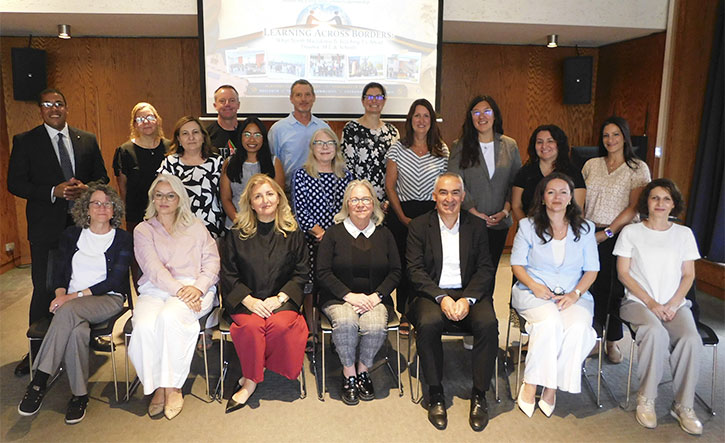
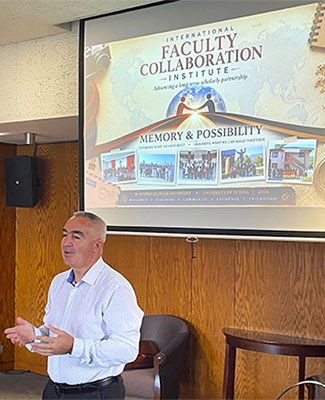
Mehmedi, dean of the Faculty of Pedagogy at the University of Tetova, made that declaration clear this fall at a panel discussion during the International Faculty Collaboration Institute at NIU that advanced the enduring scholarly partnership between the two schools.
Visiting Illinois this fall, and the reciprocal, biannual trips of NIU faculty to North Macedonia, help Tetova in its mission to prepare teachers who will deliver positive outcomes for their future students.
“For our Faculty of Pedagogy, it makes it possible to go beyond our local context. Through our partnership with NIU, we can engage in international and comparative research, develop joint publications, exchange expertise and learn from different educational systems and practices,” he said.
“For our students, international collaboration creates opportunities that cannot be provided through classroom learning alone,” he added. “They can communicate with students from another country, experience different educational perspectives, develop intercultural competencies and become more confident as future professionals.”
His university, meanwhile, strengthens its “international profile and create new opportunities for research, mobility, joint projects and connections with other universities and educational communities.”
“But I would add one very important point,” Mehmedi told those gathered in the Sky Room of the Holmes Student Center. “International collaboration is not only about what we receive. It is also about what we can contribute.”
Mary Earick, dean of the NIU College of Education, will attest to that.
“Senior leaders at our university long ago saw the value of Tetova’s story and of its deep commitment to peace and peacebuilding, which I think is a commodity we need dearly in the United States right now,” Earick said.
“What has happened since was a commitment by a diversity of faculty across all disciplines,” she added. “My colleagues in the College of Education understood the brilliance of the work Tetova was doing, where they came from, how they thrived and moved forward, and they wanted to be part of that story.”
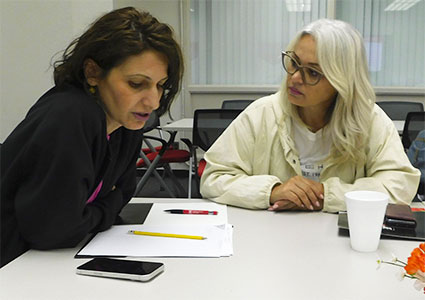
That desire has enabled the partnership’s survival, Earick said, as players on both sides pledged to get on planes, log into Zoom and to grow the scope of collaboration.
“We have this senior-level commitment. We have committed faculty. My role, coming in as a new dean, was to say, ‘How can we make this sustainable?’ ” she said.
“So, we looked at our resources and now we’re on a two-year model – one year, we go there, and the next year, they come here – and there’s a dedicated research study we’re doing in both countries. That’s what is going to take us to the next level and keep this moving forward.”
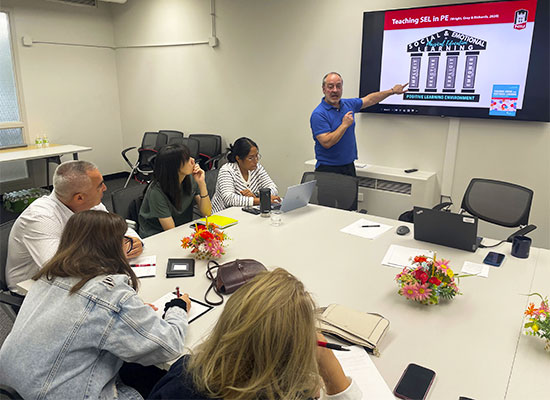
SEPTEMBER’S INSTITUTE focused on strategies regarding trauma-informed teaching, social-emotional learning (SEL), belonging and community-engaged scholarship.
The event came in response to last fall’s trip to Tetova made by Earick; Dana Isawi and Yenitza Guzman of the Department of Counseling and Higher Education; Director of Academic Cultivation and Engagement Eric Junco; and doctoral students Kristin Lee and Irem Pilgir.
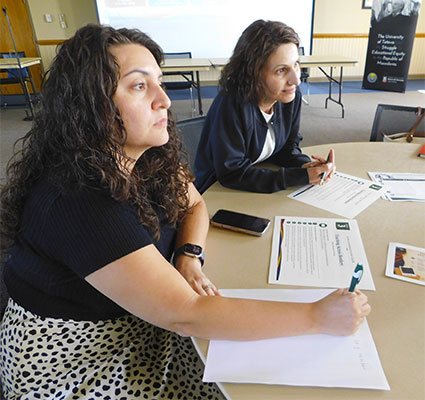
As Earick said, both sides will assemble new research teams for each visit overseas and then host their counterparts the next autumn.
Workshops in DeKalb last month included a day-long introduction on SEL foundations, delivered by Paul Wright, interim chair of the Department of Kinesiology and Physical Education and a globally recognized expert in teaching personal and social responsibility through sport.
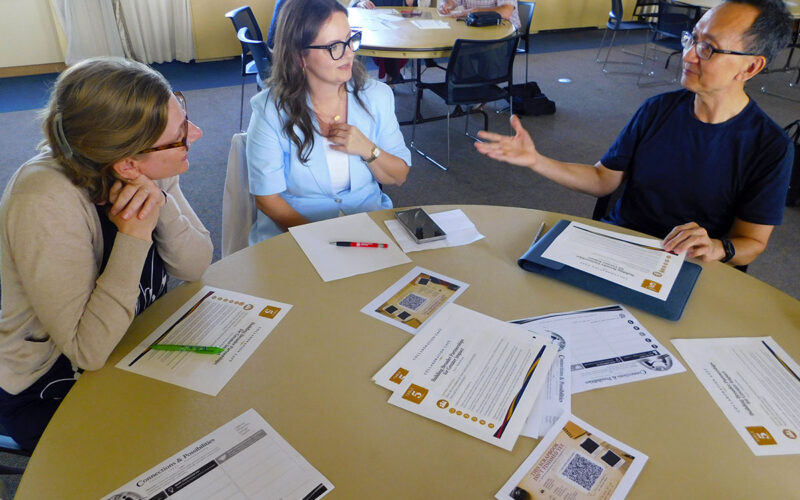
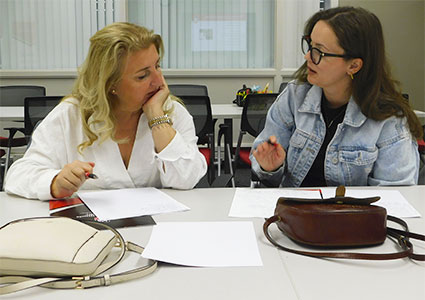
NIU’s visitors also made trips to DeKalb’s Brooks Elementary School and Mitchell Elementary School, dedicated time to writing journal articles, met with the NIU Office of Research and Innovation Partnerships to discuss funding opportunities and explored questions of professional relationships at a “Collaborative Café” event.
In collaboration with NIU’s Division of Outreach, Engagement and Regional Development (OERD), the Institute hosted Learning Across Borders and Building Global Partnerships at NIU, creating opportunities for colleagues across campus to connect with University of Tetova scholars, exchange perspectives and explore possibilities for future international partnerships.
Among the subjects discussed during the “Collaborative Café” were community-engaged international collaboration and scholarship; student exchange and global learning; teaching across borders; and working across cultures toward communication, trust and collaboration.
Teuta Ramadani Rasimi, vice dean of science for Tetova’s Faculty of Pedagogy, appreciated what the week delivered.
“What impressed me most during this visit were the SEL sessions in schools, particularly how closely the socio-emotional needs and challenges we observed resembled those in the North Macedonian context,” Rasimi said.
“It made me realize that, despite our different educational systems and cultures, socio-emotional well-being has many common dimensions,” she added. “This understanding was further strengthened by Dr. Wright’s model, which encouraged us to reflect first on ourselves as university educators and on how we can bring these principles into our own teaching and, ultimately, advance our partnership.”
Arbresha Zenki-Dalipi, head of the Classroom Teaching Study Program at the University of Tetova, also enjoyed the excursion to Mitchell and the inspiration she gained there toward “creating more opportunities to integrate SEL practices in ways that support both educators and students.”
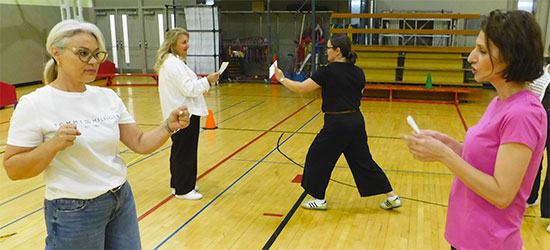
September’s institute, meanwhile, “motivated me to continue advancing this partnership and to creating more opportunities to integrate SEL practices in ways that support both educators and students.”
“This experience solidified my belief that SEL is not something we simply add to teaching. Rather, SEL reshapes the way we think about teaching itself – how we plan, build relationships and ultimately create learning environments that are responsive to students’ needs, interests and potential,” said Zenki-Dalipi, head of Tetova’s academic program in Classroom Teaching.
“Witnessing these principles translated into everyday practices that we can implement was especially inspiring because it demonstrated how academic learning and social-emotional development can work together to create the conditions for students to truly thrive,” she added.
“This kind of shared learning allows us to learn from one another, challenge our assumptions and consider what these ideas mean within our own educational contexts.”
The connection between SEL research and everyday classroom practice became especially visible during a visit to Cora Benner’s fourth-grade classroom at Brooks Elementary, Junco said.
Benner and her students begin each morning with SEL circles, Junco said, and the faculty from Tetova saw how she “facilitates building relationships with students individually and how she checks in on their mental health.”
“Her students walk up to a chart and privately indicate where they’re at on the mood meter,” he said.
“Students are essentially telling her the extent to which they are ready to learn: Some say things like, ‘I’m feeling great right now,’ while others ‘I’m feeling lousy. This just happened in my family. I need some time to myself.’ Or, ‘I need to go the counselor.’ That helps her prime the day for learning,” he added.
“We sometimes say that, ‘You can’t teach who you don’t know,’ and so Mrs. Benner is learning – and very early on – where her students are emotionally and how regulated they are. She then has a circle where they talk about where they’re at. It helps her build community with students, priming them for a day of learning. It was a profound experience to see how much trust she was able to establish within her class community.”
Faculty from Tetova, including Makfirete Ameti from the Faculty of Pedagogy and Sheruze Osmani-Ballazhi from the Faculty of Philosophy/Study Program of Pscyhology, were “excited to see what that could look like and thought about what that might look like back home.”
“Their teachers might be using circles,” Junco said, “but maybe not in a systematized and diagnostic way of figuring out what’s going on in their students’ home lives, how they feel about their relationships with each other and whether they’re ready to learn or not.”
At Mitchell, the group watched Jasmine Boyce and Evadne Bowlin implement scenario-based activities within the realm of social-emotional learning.
In participating in circles, students were given statements regarding real-life challenges involving scenarios related to collaboration and forgiveness. Students express how they would react to the situations described.
“Scenarios and questions were values-driven and moralistic,” Junco said. “The students would go to a part of the room that represented how they felt about each statement, and then the teacher would help the students explore what it means to regulate and respond in the midst of different challenges.”
NEXT ON THE AGENDA is the formation of an international community advisory board with the first meeting in October.
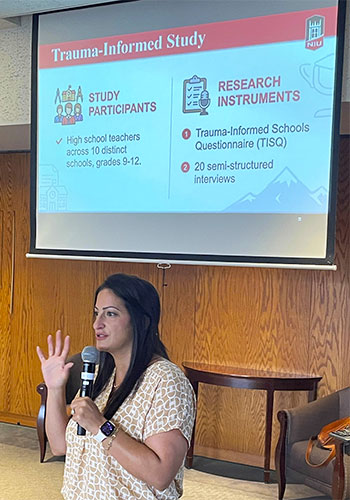
Members of the advisory board will include Tetova faculty pedagogy from September’s institute at NIU along K-12 teachers from various North Macedonia cities.
Serving in informal roles are representatives from the Regional Office of Education who work in social-emotional learning as well as from DeKalb Community Unit School District 428.
Plans for the fall, Junco said, include four or five workshops via Zoom that will establish research supported practices for SEL.
Then, professional development in North Macedonia takes place in 2026-2027 funded by a grant from NIU’s Division of Outreach, Engagement and Regional Development.
“Our colleagues from the Faculty of Pedagogy there are recruiting six to eight English-speaking teachers from across the country to come together to join Paul Wright, Dana Isawi, Yenitza Guzman and me to talk about social-emotional learning and to vet practices,” Junco said, “and we want to make sure we are doing this work in a culturally responsive way.”
Those various “best practices” on social-emotional learning come from organizations such as UNICEF, UNESCO and the Collaborative for Academic, Social and Emotional Learning.
Illinois has set its own guidelines for social-emotional learning.
“We’re the first state in the country to mandate social-emotional learning standards, and so we’re really interested in sharing resources,” Junco said.
“But we can’t do it all. We want our colleagues to figure this out with us – to join us on this journey of understanding the specific, local needs for social and emotional learning,” he added.
“How can these practices support peacebuilding? How can they help students regulate their emotions, create calmer classrooms, and strengthen opportunities for collaboration and learning? Ultimately, we want to build something together that reflects the strengths, needs and aspirations of the communities we serve.”