
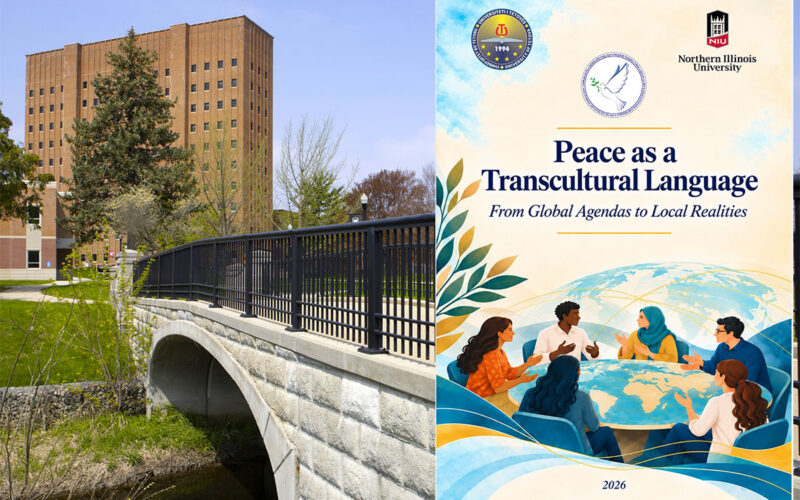
 Fall 2026 is another for the books in the evolving partnership of NIU and the University of Tetova.
Literally.
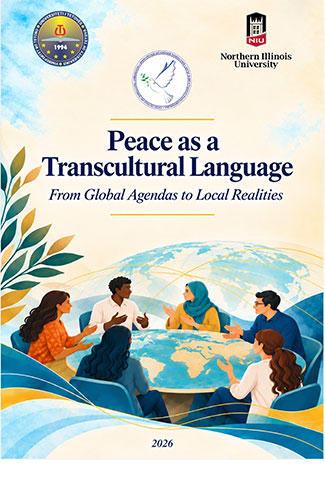
Publication of the sixth volume of “FREEDOM: Journal for Peacebuilding and Transcultural Communication,” titled “Peace as a Transcultural Language: From Global Agendas to Local Realities,” is expected soon.
With all nine revised chapters now submitted, the volume has entered its final copyediting and formatting stages. The editorial team expects to complete its manuscript review by mid-November, positioning the collection for publication later this year.
Building on the institutions’ established cooperation, the forthcoming collection offers a shared platform for scholars, practitioners and policymakers working across different political and cultural contexts.
The chapters examine how commitments to human rights, democracy and peacebuilding can inform local practice through education, governance, public communication and civic engagement.
Vullnet Ameti, founder of the Center for Peace and Transcultural Communication and recipient of an honorary doctorate from NIU, serves as editor-in-chief.
NIU President Lisa Freeman and Agon Memeti, vice-rector for Science and professor of Computer Sciences at the University of Tetova, serve as co-editors along with Eric Junco and Donika Kamberi.
Mary Earick, dean of the NIU College of Education, welcomes the forthcoming proceedings and the opportunities they create for deeper research cooperation.
“We’re looking at planning and submitting this coming summer for a special panel at the American Educational Research Association conference because we’ve really moved into a sustainable research partnership,” Earick says.
“The work that they’re doing at Tetova is so cutting-edge in looking how to have thriving communities because they don’t have the resources we have here in the United States, and yet they’re doing as much, or more, than we’re doing,” she adds. “The story behind who they are, and where they are today, is so compelling.”
Kamberi, former director of the Center for Peace and Transcultural Communication, describes the collaborative research proceedings as “an important interdisciplinary platform for examining peace, conflict, human rights and intercultural relations through diverse scholarly and regional perspectives.”
“Its contribution lies not only in advancing academic debate,” says Kamberi, “but also in challenging prevailing narratives, connecting scholarship with contemporary peacebuilding challenges and fostering more informed and critical approaches to understanding complex societies and conflicts.”
For Agon Memeti, the relationship between digital communication and peacebuilding is an important dimension of this work.
“Peacebuilding increasingly takes place in digital spaces, where information, public discourse and technology shape how communities understand one another,” says Memeti, a professor in the Department of Informatics.
“This collaborative research is important because it brings scholarship on communication and peace into conversation, encouraging the field to examine how these changing environments can support dialogue, trust and constructive civic participation.”
Chapters set to appear in Volume 6:
- “Why Peacebuilding Fails Locally: The Case of Bosnia and Herzegovina and the Dayton Peace Accords” by Donika Kamberi.
- “Corruption Threatening Peace: An Analysis of the Corruption Perceptions Index” by Faton Shabani.
- “Education, Digital Citizenship, and Peace as a Shared Civic Vocabulary” by Agon Memeti, Ibrahim Neziri and Kushtrim Ahmeti.
- “Language as a Peace-building Medium” by Dan Nyamangah and Lindita Skenderi.
- “Leveraging ‘Peace’ as a Democratic Practice through Curriculum, Pedagogy, and Engagement” by Razak Dwomoh.
- “BRAVE Conversations: Building Antiracist Pre-Service Teacher Workshops as a Model for Peace Praxis” by Daryl Dugas, Eric Junco and Donna Werderich.
- “Building a Shared Civic Vocabulary Using the Sourdough Research Model” by Meredith McLaughlin.
- “Sport, Youth Engagement, and Transcultural Peace: A Conceptual Framework from the Western Balkans” by Vullnet Ameti, Fitim Arifi and Shpresa Memishi.
- “New Water, New Seeds, Same Soil: Grassroots Peacebuilding and Cultural Unifiers in the Western Balkans” by Judy Puskar.
Junco, the NIU College of Education’s director for Academic Cultivation and Engagement, calls the forthcoming proceedings as a “revival” of the research collaboration.
“The book reflects the ethos of both our institutions,” Junco says.
“It invites us to consider how we are working together to advance not only peacebuilding but also democracy,” he adds. “How can we improve well-being through peacebuilding; anti-bias and antiracist education; democratic participation; intercultural dialogue; institutional trust; and civic engagement, particularly in contexts where political and ethnic divisions continue to exist?”
Readers will learn just that, he says.
“Both of our countries have some ongoing challenges related to political and ethnic or racial tension and part of the human condition is always going to be related to peacebuilding and finding ways to bridge divides,” he says. “Peacebuilding requires us to foster dialogue, build trust, and create opportunities for understanding and unity across our differences.”
“We hope readers find inspiration, practices and resources that encourage them to reflect on their own responsibility to advance peacebuilding, whether in their classrooms, institutions or local communities.”
