
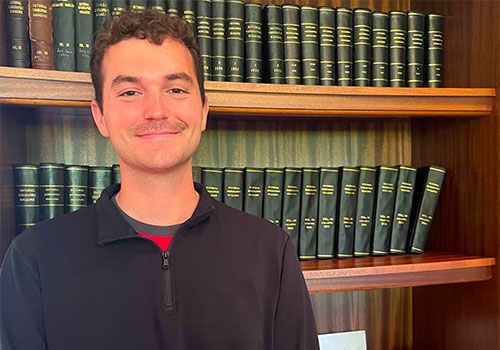
Please think, Graham Davis instructed his audience of future teachers, of a time when they struggled yet persevered.
Next, think of a time when they impacted someone in a way that was personal, not educational.
Finally, think about a time when they watched a student understand something that was unclear or unknown only moments earlier.
“These three things are exactly why we are what we are,” Davis said as keynote speaker for the NIU College of Education’s spring New Teacher Send-off in the Barsema Alumni and Visitors Center.
“We are educators for a reason. We chose this for a reason. We chose to be educators because we see the impact we have as human beings on younger human beings,” he added. “Being in your spot three years ago was a very large opportunity for me to take the right steps, and I feel as though that I have, and now it’s your turn to do so.”
College of Education Dean Mary Earick echoed those sentiments.
“Your encouragement, your flexibility and your belief in every individual’s ability to achieve is why we’re here today,” Earick said.
“Each of you has reached this moment through persistence, discipline and purpose, often balancing full-time coursework with taking care of family, extended family and all of the other responsibilities you have on a daily basis,” she added. “What you have accomplished matters. It matters in ways you haven’t even thought about at this moment in time. When you go into your new communities, find your collective. Find your people. Come together to move mountains.”
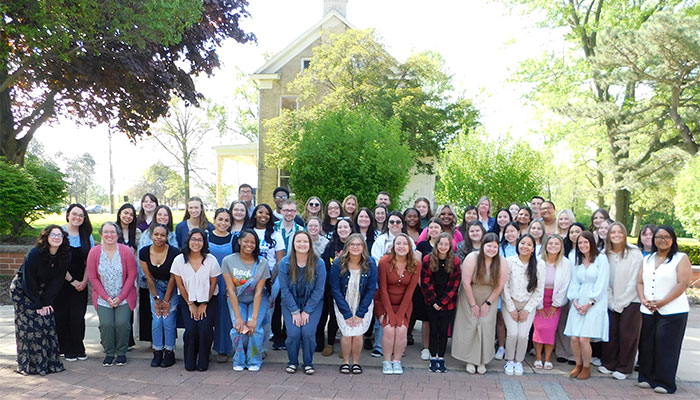
Graduates were recognized by name and with hugs from their clinical supervisors. They also received stress-ball red apples, NIU lapel pins and copies of the Teacher’s Creed, which they rose to recite as a group.
Davis, an instructional coach at Martin Elementary School in Huntley Community School District 158 who earned his B.S.Ed. in Elementary Education in 2023, told the almost-graduates that the work of a teacher is hard.
But the rewards are great, he said, and the need for their presence is even greater so that children “have someone in front of them who genuinely cares about them. That is really impactful.”
He shared a real-life example of a kindergartner going through a rough situation at home.
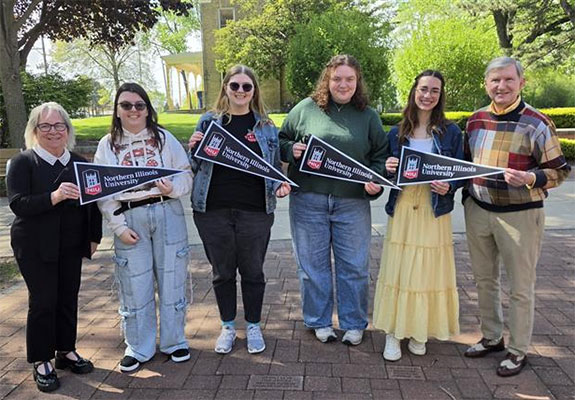
“I have gotten the luxury – and I am an incredibly lucky person – to make these last two weeks that child is with us the best we can make them,” said Davis, who will become an assistant principal in his district this fall.
“And I can tell you right now that that kid watched me come into the school the other day and ran to me as fast as possible, and when I walked out of school, I cried,” he added. “It doesn’t matter if you’re making an impact for a day. It doesn’t matter if you’re making an impact for a year. An impact is an impact.”
Such discomfort is part of what teachers agree to in their careers, he said.
“Maybe a kid came in one day who had a really tough time at home. You are in a state of uncomfortableness because of the fact that you don’t know what you can do for that kid at all times,” Davis said, “but the base level of showing up for them is the most important reason why we’re there.”
Other “agreements” include expecting and accepting non-closure; staying engaged; and speaking their truth – and what those will help to produce, he said, are successful careers on both sides of the classroom.
Just as necessary, he said, is found in a quote from “Because of Winn-Dixie,” the 2000 novel by Kate DiCamillo: “Why don’t you go on and tell me everything about yourself so as I can see you with my heart.”
“The character is blind – she can’t see her – and I think that is one of the most important things you can understand as an educator,” Davis said. “Understanding a kid with your heart is very different than understanding a kid with your eyes. These kids need your engagement. They need your teaching. They need your personal skills to understand who they are as human beings.”

